Confirmed COVID-19 Case Among Employees at Entertainment Venue in Yeoksam-dong, Gangnam... Concerns Over Cluster Infection
Park Won-soon "Seoul Entertainment Venues Ordered to Close Until the 19th," Effectively Halting Operations
Compensation Issues Remain... "Heavy Tax Burden Including Property Tax"
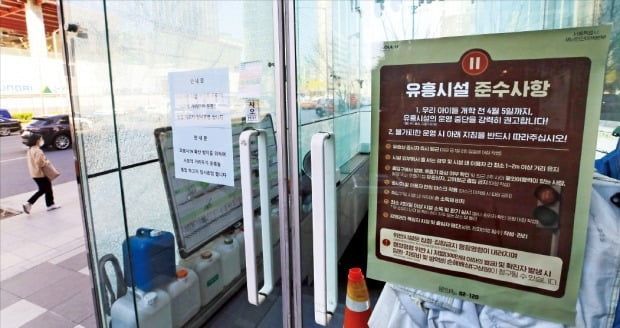 On the 8th, a notice of compliance guidelines for entertainment facilities was posted at a nightlife bar in Yeoksam-dong, Seoul, where a confirmed case of the novel coronavirus infection (COVID-19) had worked. / Photo by Yonhap News
[Asia Economy Intern Reporter Lim Juhyung] The Seoul Metropolitan Government has issued a gathering ban order for all entertainment establishments in Seoul city until the 19th to prevent the spread of the novel coronavirus infection (COVID-19).
Seoul plans to crack down on business owners, workers, and customers who violate this administrative order. As a result, some establishments are opposing the city's order due to concerns over losses caused by business suspension.
On the 8th, Seoul Mayor Park Won-soon announced at a regular COVID-19 briefing, "Regarding entertainment establishments, such as room salons, clubs, and colatecs, the government has issued a gathering ban order from today until the 19th, which is the period set for social distancing."
He added, "This means that entertainment establishments cannot operate automatically," and "This is effectively an order to suspend business under the authority of the mayor as stipulated in the Infectious Disease Control and Prevention Act."
Mayor Park explained that although temporary closure was recommended for 2,146 clubs, colatecs, and entertainment bars in Seoul, 422 establishments are still operating, saying, "Close contact occurs in these places, and it is impossible to follow quarantine rules, so the gathering ban order was issued."
According to the quarantine authorities on the day, 118 contacts were identified from employee A of the large entertainment establishment 'ㅋㅋ&Trend' in Yeoksam-dong, Gangnam-gu, Seoul. All of them have entered self-quarantine and undergone comprehensive testing, with 18 testing negative for COVID-19 so far.
Earlier, employee A was confirmed positive for COVID-19 on the 2nd. It was confirmed that A worked at the establishment for 9 hours from 8 p.m. on the 27th of last month to 9 a.m. the next day before symptoms appeared, being with about 500 people including staff and customers.
 A worker at a large entertainment establishment located in Yeoksam-dong, Gangnam-gu, Seoul, tested positive, leading the Seoul city government to issue a closure order for all entertainment establishments in the city. / Photo by Yonhap News
Seoul plans to start on-site inspections as early as the 9th and impose fines of up to 3 million KRW not only on business owners who violate the gathering ban order but also on industry workers and customers.
However, some establishments are opposing Seoul's policy. They claim that without support measures such as loss compensation or tax reductions, it is difficult to bear the losses incurred during business suspension.
A representative of the Korea Entertainment Food Service Central Association said in an interview with SBS on the day, "(Entertainment bars) pay 16 times higher property tax," and appealed, "Even if they do not operate, they have to pay this tax, so if the Seoul mayor orders establishments to close, shouldn't that be exempted?"
Seoul's principle for loss compensation regarding the gathering ban order on entertainment establishments has not yet been established. Currently, each district office in Seoul provides up to 1 million KRW in support funds to karaoke rooms, PC rooms, academies, private institutes, and sports facilities that voluntarily close during the government's social distancing period.
Meanwhile, Gyeonggi Province Governor Lee Jae-myung responded to a question about high-intensity measures such as entertainment establishment closures on CBS Radio's 'Kim Hyun-jung's News Show' on the 8th, saying, "It is time to make a decision by weighing which side has higher economic or social benefits regarding the operation of customer-attracting and customer-serving establishments."
However, he left room for the possibility of implementing high-intensity measures, saying, "If business is prohibited, there may be an issue of compensating the establishments."
© The Asia Business Daily(www.asiae.co.kr). All rights reserved.


















