Due to COVID-19 Impact, University Online Lectures
Students Voice Numerous Complaints Over Poor Quality
JeonDaenet: "Over Half of 6,261 University Students Dissatisfied with Lectures"
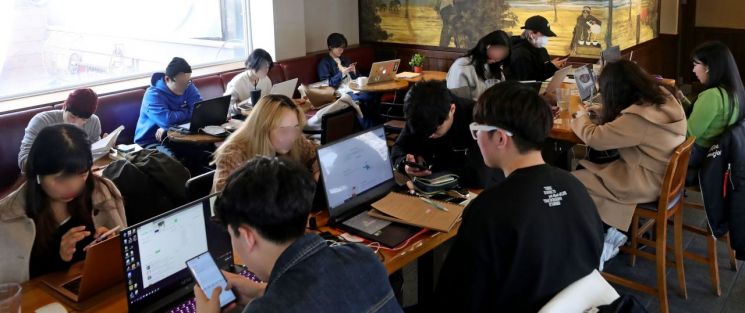 To prevent the spread of the novel coronavirus infection (COVID-19), on the afternoon of the 17th of last month, the second day since major universities in Seoul started online lectures, university students and citizens were spending time at a cafe near Hongik University in Mapo-gu, Seoul.
 [Image source=Yonhap News]
[Asia Economy Reporter Shinwon Yoon] As non-face-to-face lectures are in full swing on university campuses to prevent the spread of the novel coronavirus infection (COVID-19), students' complaints are growing as the midterm exam preparation period approaches. Most universities are leaving both the class and exam periods and methods to the 'discretion of professors,' which seems to be increasing students' confusion.
Shin (22), a university student, said, "I am taking nine courses this semester, but for two of them, neither lecture videos nor materials have been uploaded." He added, "The school announced that midterm exams would be held online from the end of this month, but some professors who have never held a class have not said how they plan to conduct the midterms."
He raised his voice, saying, "Students paid hundreds of thousands of won in tuition fees as usual while taking these low-quality lectures, and I feel anger thinking that some professors who did not even try to teach must have received their salaries."
Another university student, Kim (24), said, "The school said that the decision on whether to hold midterms and the method would be left to the professors' discretion, but some professors announced they would hold face-to-face exams on the 27th, while others have not even decided whether to hold midterms." He added, "It is three weeks before the exam, so I have to start studying now, but I haven't even been able to make a plan."
In fact, many university students like Shin and Kim were dissatisfied with online lectures. On the 6th, the National University Student Council Network (Jeondaenet) conducted a 'COVID-19 University Campus Class Rights Violation Survey' targeting 6,261 university students nationwide, and 64.5% of them responded that they were 'dissatisfied' with online lectures. Only 6.8% said they were 'satisfied.'
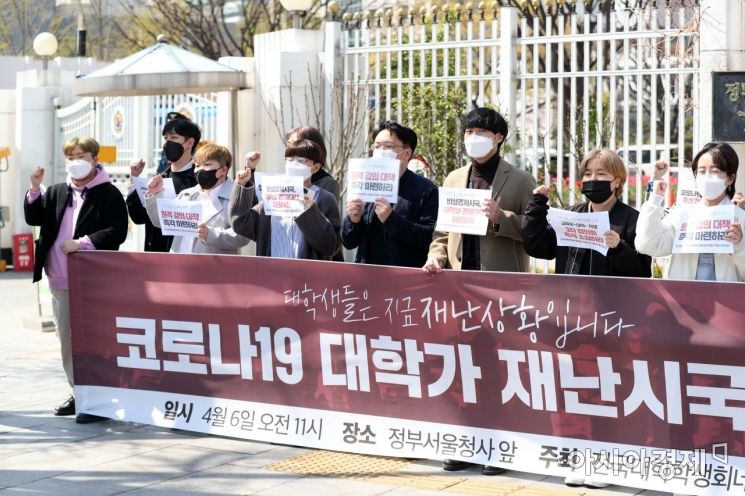 Students from the National University Student Council Network are making a disaster declaration for the COVID-19 university crisis on the 6th in front of the Government Seoul Office in Jongno-gu, Seoul. They urged for tuition refunds and measures for remote lectures. Photo by Moon Honam munonam@
As dissatisfaction with online lectures grows, demands for tuition refunds are also intensifying. Jeondaenet issued a 'COVID-19 University Campus Disaster Declaration,' stating, "The Ministry of Education says tuition refunds are under the jurisdiction of each university president, and universities say it is only possible if the Ministry of Education issues guidelines, thus putting students' demands on the back burner." They demanded tuition refunds for the first half of the year and the convening of a tripartite consultative body among the education authorities, universities, and students.
They said, "The 3 million university students nationwide are suffering not only from class rights and tuition but also from economic double and triple hardships." They added, "Many students work part-time jobs at night and on weekends to make a living, but some had to quit their part-time jobs due to sudden make-up class schedules."
However, the education authorities maintain that there is no legal basis for refunding tuition. According to the regulations on university tuition fees, if a university suspends classes for the entire semester or month, tuition for that semester or month can be waived, and in cases of natural disasters, tuition can be waived or reduced. There are no provisions regarding infectious diseases, and even the existing clauses are not mandatory.
Yoo Eun-hye, Deputy Prime Minister for Social Affairs and Minister of Education, also mentioned at a full meeting of the National Assembly's Education Committee last month, "University tuition is determined by university presidents, and there is no legal obligation to refund it."
For these reasons, some university students have filed constitutional complaints regarding tuition refunds. On the 3rd, Lee Da-hoon (24), a senior at Inha University, filed a constitutional complaint against the Ministry of Education, arguing that the failure to enact a regulation allowing tuition reduction due to legislative inaction violates the Constitution. Depending on the Constitutional Court's decision, a full legal discussion is expected to proceed regarding legal standards for partial tuition refunds when online lectures are the only option due to infectious diseases.
© The Asia Business Daily(www.asiae.co.kr). All rights reserved.


















