Cash Payments to Households with Reduced Income
Additional 10,000 Yen per Child Allowance Household Member
2 Million Yen and 1 Million Yen to Small and Individual Business Owners, Respectively
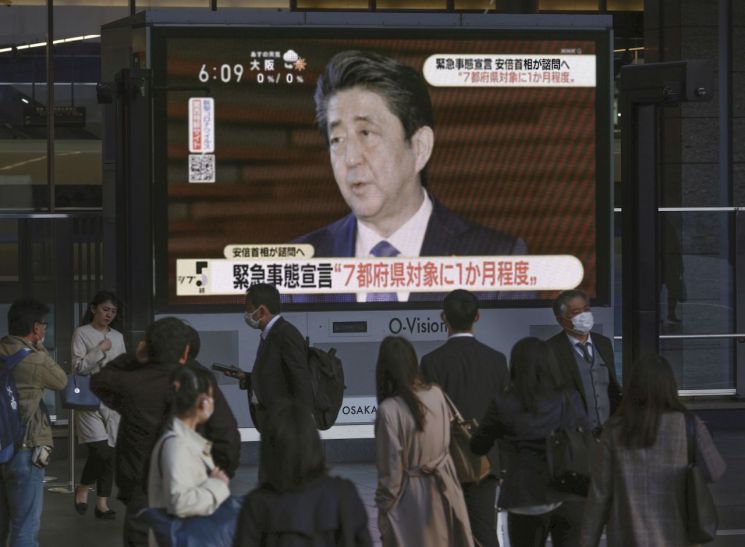
[Asia Economy Reporter Hyunju Lee] On the 7th, the Japanese government announced the largest-ever economic measures in response to the spread of the novel coronavirus infection (COVID-19). With the economy plummeting due to COVID-19 and a state of emergency declared, they unveiled stimulus measures to overcome the crisis. However, since COVID-19 is already spreading rapidly, especially in Tokyo, there are criticisms that the response is too late.
The scale of the emergency economic measures decided at the extraordinary cabinet meeting on the afternoon of the same day amounts to 108 trillion yen, which converts to approximately 1,216 trillion won. This is nearly double the 56.8 trillion yen economic measures announced in response to the 2009 'Lehman Shock' (global financial crisis). It accounts for 20% of Japan's Gross Domestic Product (GDP). The Japanese government plans to secure funding through the issuance of deficit bonds worth 14.5 trillion yen.
Cash payments are expected to target households where the head of household's monthly income has decreased compared to before the outbreak, excluding high-income earners whose income has dropped by more than half. Local media anticipate that about 10 million households out of Japan's total 58 million households will be eligible for cash payments. Additionally, households receiving child allowances will receive an extra 10,000 yen per child.
Small and medium-sized enterprises and sole proprietors whose income has decreased by more than half will receive 2 million yen (approximately 23.33 million won) and 1 million yen (approximately 11.17 million won), respectively. The total cash payment scale is about 6 trillion yen (approximately 67 trillion won).
The Japanese government also plans to establish a special system to defer tax and social insurance premium payments for one year for companies experiencing a sharp decline in income due to the spread of COVID-19. The scale of deferred tax and social insurance premium payments amounts to 26 trillion yen (approximately 290 trillion won).
Furthermore, private financial institutions will also be responsible for interest-free and unsecured loans currently provided by policy financial institutions to support the business continuity and employment retention of small and medium-sized enterprises and sole proprietors. The budget for stockpiling 2 million doses of 'Avigan,' Japan's influenza treatment drug that Prime Minister Abe is hopeful about as a COVID-19 treatment, is also included in the economic measures.
Prime Minister Abe declared a state of emergency for seven regions including Tokyo on the same day and urged people to reduce person-to-person contact by 70-80% until May 6, when the Golden Week holiday ends.
As of the 6th, the number of confirmed COVID-19 cases in Japan increased by 235 to a total of 4,804. Prime Minister Abe stated, "The cumulative number of infections in Tokyo has exceeded 1,000," and added, "We are seeing cases where the number of infections doubles every five days." He further warned, "If the spread continues at the current rate, the number could exceed 10,000 in two weeks and 80,000 in a month."
© The Asia Business Daily(www.asiae.co.kr). All rights reserved.

















