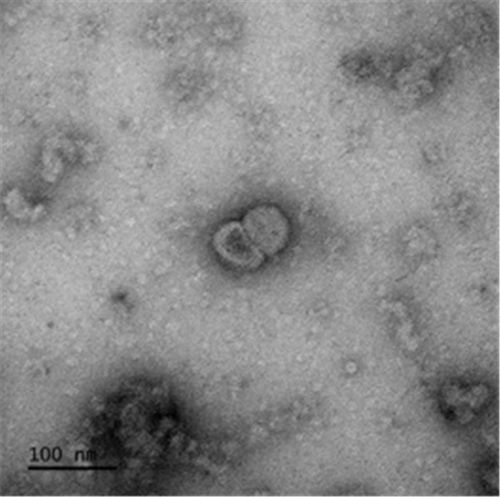
 Transmission electron microscopy image of virus-like particles composed of the COVID-19 virus antigen (Spike)
 [Asia Economy Reporter Choi Dae-yeol] The Korea Disease Control and Prevention Agency's National Institute of Health announced on the 7th that it has succeeded in producing a candidate material for a novel coronavirus disease (COVID-19) vaccine.
The institute created a virus-like particle (VLP)-based candidate material as one of the COVID-19 vaccine platforms. Virus-like particles are virus particles composed only of structural proteins without genetic material, making them safe as no viral replication occurs in the human body, and they only induce an immune response. This candidate material is in the form of influenza virus structural proteins carrying the COVID-19 virus spike antigen.
The institute previously obtained approval for a highly pathogenic avian influenza vaccine. It explained that it has long invested in developing various vaccine platforms to develop a universal influenza vaccine and respond to new and mutant viruses, which enabled a rapid response this time as well. Additionally, it is developing other candidate materials, such as synthetic subunit vaccines made by synthesizing only parts of the pathogen proteins (antigens) that can induce immune responses using genetic recombination technology, in cooperation with private institutions.
While analyzing the efficacy of various vaccine candidates in experimental animals, the institute also plans to select candidates with proven efficacy to support practical research such as preclinical and clinical trials. Kim Sung-soon, head of the Infectious Disease Research Center at the National Institute of Health, stated, "Vaccine development takes a long time, but we will strive for self-sufficiency in COVID-19 vaccines by closely cooperating with domestic research institutions and industry throughout the preclinical and clinical processes."
© The Asia Business Daily(www.asiae.co.kr). All rights reserved.

















