COVID-19 Spread Slows Exports and Causes Sharp Drop in Consumption
World Bank Report Downgrades Growth from 4.5% to -0.1%
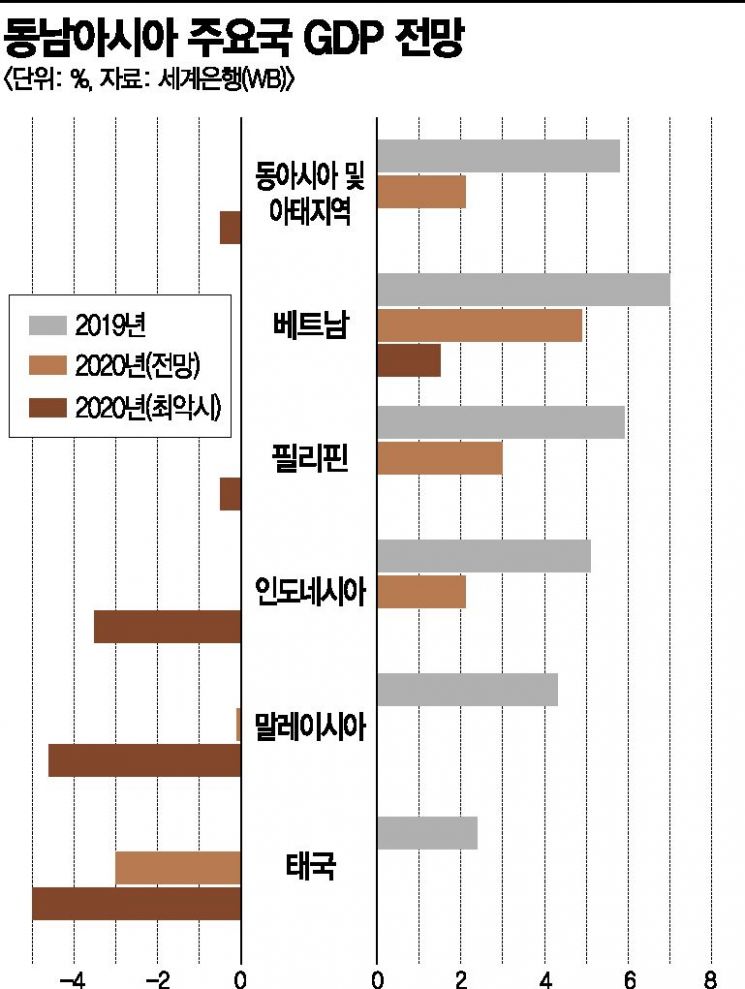
[Asia Economy Kuala Lumpur, Hong Seong-ah, Guest Reporter] The novel coronavirus infection (COVID-19) has severely impacted the global economy, turning a red light on Malaysia's economy as well. In particular, although the holy Islamic period of Ramadan begins on the 23rd, it is strongly expected that there will be no special economic boost this year.
According to local media such as The Star on the 7th, the World Bank recently downgraded Malaysia's economic growth rate from 4.5% to -0.1% in its latest report. It also warned that in the worst-case scenario, it could fall as low as -4.6%.
The World Bank evaluated that the spread of COVID-19 is accelerating the economic recession amid Malaysia’s weakening economic resilience since the second quarter of last year. Export slowdown and consumption decline were identified as the main factors behind Malaysia’s growth rate drop. Richard Record, a World Bank researcher, particularly forecasted that Malaysia’s export volume will decrease by up to 3.9% this year, and private consumption growth will sharply fall from 7.6% last year to 1.6% this year. However, he predicted a recovery starting from the fourth quarter of this year when the COVID-19 impact is expected to subside, with growth rebounding to 6.4% next year.
The Central Bank of Malaysia holds a similar stance to the World Bank. Bank Negara Malaysia cited the Movement Control Order (MCO) and supply chain disruptions as negative factors for the economy, while judging that the government’s stimulus measures and interest rate cuts will somewhat mitigate the shock. The Malaysian government announced a first stimulus package worth 20 billion ringgit (approximately 5.6736 trillion KRW) in February, followed by a second stimulus package worth 250 billion ringgit (approximately 70.92 trillion KRW) on the 27th of last month.
The World Bank advised that although the second stimulus package has bought some time, if the movement restrictions are extended, other economic policies will be necessary.
It is also difficult to expect strong consumption during the Ramadan period starting on the 23rd in Malaysia. Muslims account for more than 65% of Malaysia’s population, and economically, Ramadan is generally classified as a period of strong consumption. During Ramadan, Muslims fast during the day and eat after sunset. During this period, evening activities in various permanent markets and restaurants become active. However, this year, it is expected to be difficult to find any Ramadan-related economic boost because state governments have restricted commercial activities to prevent the spread of COVID-19 infections. The Star predicted that the weak Ramadan consumption will further accelerate the economic recession.
© The Asia Business Daily(www.asiae.co.kr). All rights reserved.