Detachable Bands Lead to Evasion Cases in Hong Kong
Effectiveness of Domestic Implementation Questioned
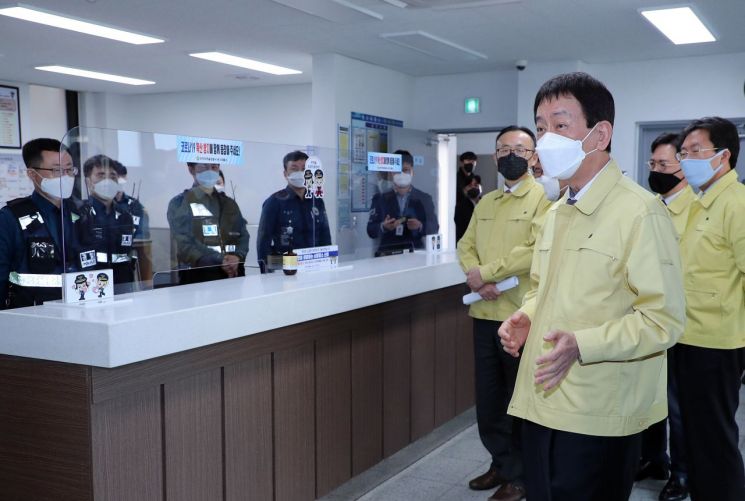 Jinyoung, Minister of the Ministry of the Interior and Safety, visited the Yong-o Police Substation of the Incheon Michuhol Police Station on the morning of the 6th to check the management status of self-quarantine violators related to COVID-19 and to encourage police officers.
 [Asia Economy Reporters Choi Dae-yeol, Kim Heung-soon] The government has begun considering a measure requiring self-quarantined individuals to wear wristbands, but there are concerns that the measure may not be effective. Although this 'last-resort' measure was proposed due to the surge in self-quarantine cases amid the spread of the novel coronavirus (COVID-19) and the increasing number of violations, it has many loopholes. Even if legal grounds and technical issues are addressed before implementation, it will take considerable time, and the device itself is detachable, raising doubts about its effectiveness in preventing unauthorized departures.
"Managing Quarantined Individuals with Bands" - Government's Deep Deliberation
Potential Legal and Human Rights Issues Highlighted... Effectiveness Also Questioned
According to the COVID-19 Central Disaster and Safety Countermeasures Headquarters on the 7th, the cumulative number of self-quarantined individuals related to COVID-19 was 46,566 as of 6 p.m. the previous day. Since the beginning of this month, about 5,000 people have been entering the country daily, most of whom have been designated for self-quarantine, increasing the number by 4,000 to 5,000 each day. Previously, as of 6 p.m. on the 5th, the number was 41,723.
The problem is that concerns about blind spots have grown as the number of people under management increases. Currently, self-quarantined individuals are monitored through a dedicated application and local government officials, but cases of people leaving home after leaving their smartphones behind or turning off their GPS have been repeatedly detected.
The authorities are considering strengthening management by using wristband-type devices to prevent such incidents. So far, there have been about 160 cases of violations of self-quarantine guidelines, averaging about six detections per day. Jeon Byung-yul, Dean of the Graduate School of Health Industry at CHA University, said, "Self-quarantine has been entrusted to individual citizens so far, but if violations continue, other regulatory measures should be considered." Son Young-rae, Head of Strategic Planning at the Central Disaster and Safety Countermeasures Headquarters, said on CBS Kim Hyun-jung's News Show that "We are reviewing ways to strengthen effectiveness, and regarding electronic bracelets, legal, human rights, and feasibility issues must be examined," adding, "Feasibility will be discussed and decided after further review."
The problem is that currently, such devices cannot be enforced. Consent from the individual is required, and it is expected that few will agree. Revising related regulations to mandate wearing is a matter of legal amendment, and discussions may be delayed due to human rights concerns. The fact that quarantine authorities have emphasized "open and democratic" measures so far, and that, like smartphones, the bands can be removed and left at home, making monitoring difficult, are also obstacles.
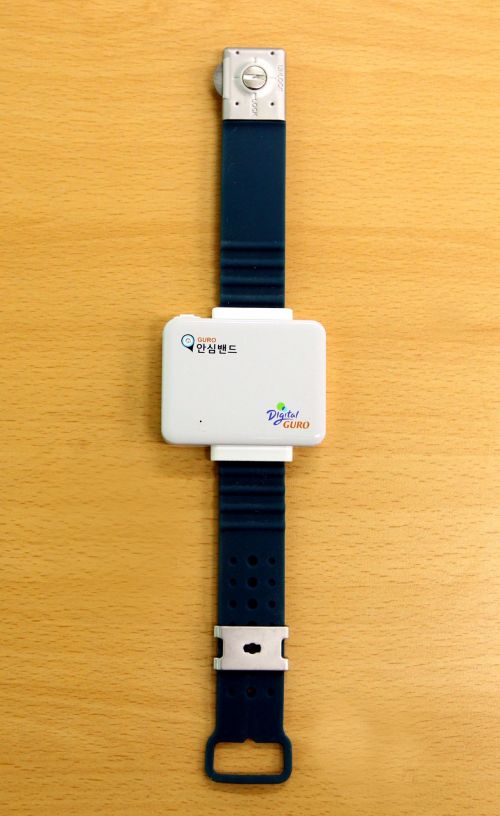 The safety band distributed by Guro-gu Office in Seoul in 2018. It was provided as a wristband to dementia patients in the district at that time. The band uses GPS to notify caregivers if the dementia patient deviates from a pre-set route. It is designed to be detachable. The government has stated that it is considering such electronic devices as one of the management measures for individuals under self-quarantine.
 COVID-19 New Cases Remain at 47 for Two Consecutive Days
Number of Tests Doubled, but Cases Remain the Same as Previous Day
According to the COVID-19 Central Disease Control Headquarters, as of midnight on the 7th, 47 new domestic cases were reported, bringing the cumulative total to 10,331. The number of diagnostic tests increased to 10,500, nearly double the previous day's 5,571, but the number of new confirmed cases remained below 50 for two consecutive days at 47. The government and health authorities have extended strengthened social distancing measures until the 19th, maintaining the daily target of fewer than 50 confirmed cases.
However, with an increase in visitors during the past weekend and reports of religious gatherings such as church meetings in some areas, the possibility of additional cases due to close contact cannot be ruled out. Kim Kang-lip, First General Coordinator of the Central Disaster and Safety Countermeasures Headquarters (Vice Minister of Health and Welfare), said at a briefing the previous day, "There has been a surge in visitors to commercial districts popular among young people such as Myeongdong, Gangnam Station, and Hongdae in Seoul, as well as flower-viewing spots near Yeouido, the Han River, and Namsan." Considering the average incubation period of COVID-19 is 3 to 5 days, there is a possibility of an increase in cases later this week.
On this day, 14 new cases were added in the Seoul metropolitan area, including Seoul and Gyeonggi Province. Four people tested positive in Seoul, and 10 new cases were confirmed in Gyeonggi, including a cluster outbreak at Uijeongbu St. Mary's Hospital. In Daegu, 13 cases were confirmed, including cases that tested positive again after recovery. Two cases were reported in Gangwon, and one case each in Busan, Chungnam, Gyeongbuk, and Gyeongnam. No cases were reported in nine other regions. Busan has maintained zero confirmed cases for 15 consecutive days since the 24th of last month.
Fourteen imported cases were confirmed through airport quarantine. So far, a total of 802 imported cases have been reported, with 92.1% being Korean nationals. Among the cumulative confirmed cases, 6,694 have been released from isolation after recovery, an increase of 96 from the previous day. The number of patients currently in isolation treatment, which is part of the goal of the second phase of social distancing, decreased by 55 from 3,500 to 3,445. The death toll increased by six from the previous day, reaching 192.
© The Asia Business Daily(www.asiae.co.kr). All rights reserved.
![Clutching a Stolen Dior Bag, Saying "I Hate Being Poor but Real"... The Grotesque Con of a "Human Knockoff" [Slate]](https://cwcontent.asiae.co.kr/asiaresize/183/2026021902243444107_1771435474.jpg)












