Efforts to Absorb Floating Voters... Controversies Like 3040 Derogation and n번방 Self-Inflicted
On Edge Over Impact on Centrist Voter Sentiment
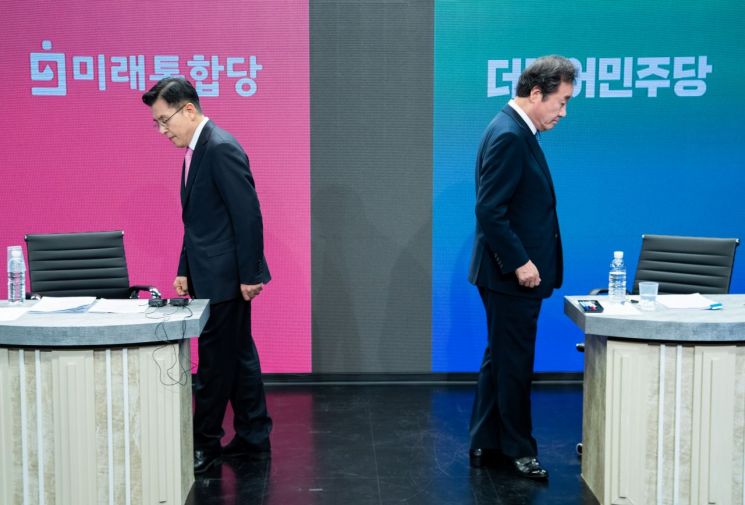
[Asia Economy Reporter Kim Hye-min] The United Future Party, which has staked everything on capturing the centrist vote, is embroiled in a series of verbal controversy just eight days before the April 15 general election. Considering that early voting begins on the 10th, there is hardly any time left to recover from these last-minute setbacks. Despite efforts to absorb the undecided voters through conservative unification, large-scale candidate reshuffling, and the recruitment of Kim Jong-in as the overall election committee chairman, there are concerns within the party that the election is becoming more difficult due to the candidates' harsh remarks.
On the 6th, Kim Dae-ho, the candidate for Seoul Gwanak-gap, sparked controversy during a meeting discussing the party's election strategy by saying that "people in their 30s and 40s lack logic." He stated, "It seems that people in their 30s and 40s do not fully understand how underprivileged conditions South Korea developed under," adding, "Their sense of issues lacks logic," which led to accusations of generational disparagement.
This was criticized as the United Future Party itself provoking controversy by alienating the 30s and 40s age group, which constitutes the majority of the undecided voters it needs to attract. Kim apologized within half a day, and the party issued a stern warning as disciplinary action to manage the situation, but the remarks became easy ammunition for competing candidates.
Hwang Kyo-ahn, the party leader running in Jongno, has also been embroiled in daily controversies. Amid public outrage over the 'Nth Room' case, he said, "There can be different judgments (such as personal information disclosure or punishment) for those who entered out of curiosity but stopped their activities upon realizing it was inappropriate," drawing heavy criticism. He quickly explained that he was clarifying sentencing standards from a legal perspective, but was criticized for failing to grasp the gravity of the issue.
He also sparked controversy over body shaming by saying, "Short people can't even hold the proportional representation ballot paper with their own hands," referring to the lengthened ballot paper caused by the proliferation of political parties. Although his intention was to criticize the backlash from the ruling and opposition parties' forced passage of the mixed-member proportional representation system, the metaphor was deemed inappropriate. When public opinion was urging restraint in group activities to prevent the spread of the novel coronavirus (COVID-19), he further fueled controversy by saying, "There is almost no COVID-19 infection within churches."
Of course, the ruling party is not free from verbal slip controversies either. Lee Hae-chan, leader of the Democratic Party of Korea, was criticized for disparaging a region by saying at a meeting in Busan the previous day, "I wondered why the city looks so shabby." On the same day, Lee Nak-yeon, running in Jongno, stirred controversy by referring to COVID-19 as "Wuhan coronavirus" during a rehearsal for the National Election Commission debate. The term "Wuhan coronavirus" has been persistently used by the United Future Party and strongly criticized by the Democratic Party.
The verbal gaffes that erupted near the end of the general election are directly connected to the sentiments of the centrist voters, who are the casting voters. This means they can sway the election outcome. In fact, in past general elections, verbal controversies have often shaken the election landscape.
In the 2004 17th general election, then-chairman of the Uri Party, Chung Dong-young, made disparaging remarks about the elderly that became a last-minute variable. About 20 days before the election, he said, "People in their 60s and 70s and above can stay home and rest without voting," sparking controversy. At that time, the ruling Uri Party was expected to win overwhelmingly due to the backlash against the impeachment. Although the Uri Party secured a majority of seats, the exit polls showed a much lower result than expected. Political circles analyzed that Chung's remarks had an impact.
In the 2012 19th general election, Kim Yong-min, the Democratic United Party candidate for Nowon-gap, became embroiled in controversy over his verbal gaffes. He was criticized after it was revealed that he said on an internet broadcast, "Let's remove elevators so that elderly people can't come to the polling stations," and subsequent past verbal slip-ups led to his defeat. It was analyzed that his remarks influenced the only loss of the Democratic United Party in northeastern Seoul, Nowon-gap.
In the 2018 local elections, Jeong Tae-ok, a member of the Liberty Korea Party, sparked regional disparagement controversy with the so-called "Ibu Mangcheon" remark, meaning "If you divorce, go to Bucheon; if you fail, go to Incheon."
The United Future Party is uneasy as verbal controversies pile up amid its own assessment that elections in the metropolitan area will not be easy. There have even been requests from party leadership to refrain from making remarks. Candidate Ji Sang-wook said, "If inappropriate remarks come from the party leadership, all efforts will be in vain," seemingly targeting leader Hwang by saying, "Please fight centered around Kim Jong-in and Na Kyung-won." Candidate Moon Byung-ho also urged, "We need to maximize Kim Jong-in's speaker capacity and minimize other leadership capacities to unify and deliver the message."
© The Asia Business Daily(www.asiae.co.kr). All rights reserved.
![Clutching a Stolen Dior Bag, Saying "I Hate Being Poor but Real"... The Grotesque Con of a "Human Knockoff" [Slate]](https://cwcontent.asiae.co.kr/asiaresize/183/2026021902243444107_1771435474.jpg)
















