[Asia Economy Reporter Oh Hyung-gil] Self-employed Kim Sang-sik (41) was involved in a traffic accident when the other party’s vehicle suddenly cut in while he was delivering goods. Fortunately, Kim was not seriously injured, but most of the goods were damaged, so he filed an insurance claim with the other party’s insurer. However, he received a call from the other party’s loss adjuster saying they could not pay the insurance money.
Kim was also pressured to reach a settlement at some level, with the adjuster claiming that Kim was partly responsible due to negligence. Kim said, “The adjuster was from a loss adjusting company exclusively contracted to the other party’s insurer,” and added, “I was upset because they said I wouldn’t receive a single penny even if I went to court, so I had no choice but to settle.”
The Life and Non-Life Insurance Associations are currently working to resolve issues related to self-loss adjusting, which has been identified as a source of insurance claim disputes. Loss adjusting is a crucial process that professionally investigates insurance incidents and determines the amount of insurance money the company should pay to the policyholder based on the results.
However, most loss adjusters are effectively subordinate to major insurers, leading to criticism that self-loss adjusting favors the parent company by prioritizing insurance claim reductions. Experts point out that due to the close relationship between insurers and loss adjusting firms in Korea, establishing a public loss adjusting institution is necessary to resolve this issue.
According to the insurance industry on the 7th, the Life and Non-Life Insurance Associations are currently working on disclosing the status of loss adjuster appointments from the consumer side to resolve complaints that frequently occur at the insurance payment stage. The work is expected to be completed within the first half of the year, and the number of loss adjuster appointment requests and the insurer’s consent or dissent cases will be disclosed.
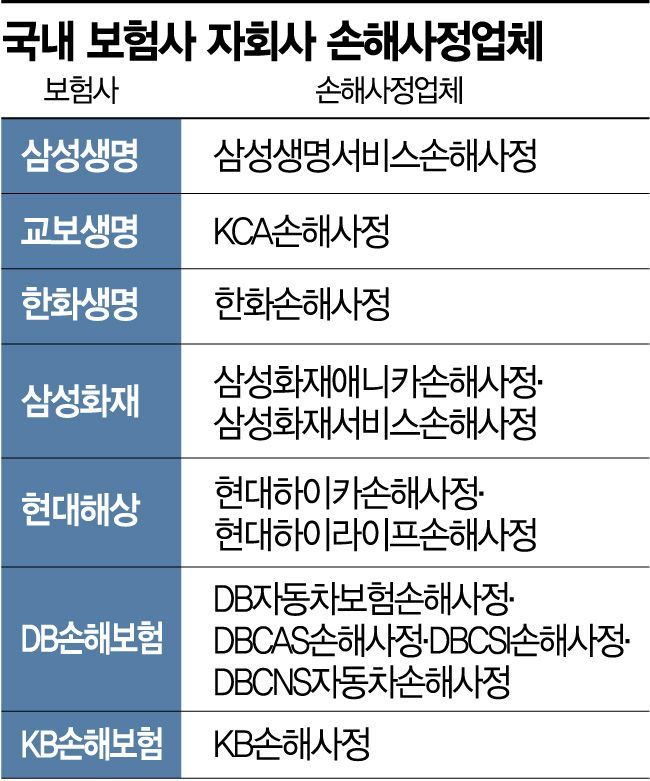
The Life Insurance Association’s decision to disclose the status of loss adjuster appointments reflects ongoing criticism that many loss adjusters are dependent on insurers in insurance claim disputes, resulting in a structure where customers find it difficult to receive proper compensation. The domestic loss adjusting industry mainly consists of subsidiaries of large insurers and firms exclusively contracted to insurers. Among insurer subsidiaries, 12 companies operate, including Samsung Life Service Loss Adjusting under Samsung Life Insurance.
Although not subsidiaries, there are also 14 firms with exclusive contracts with insurers. Many of these, such as Central Loss Adjusting (Samsung Fire & Marine Insurance), Genie Loss Adjusting (Hyundai Marine & Fire Insurance), and KG Loss Adjusting (KB Insurance), were established by former employees of the respective insurers and operate as quasi-subsidiaries.
Business goals and performance rates inevitably are influenced by the management policies of the parent insurer. Even if loss adjusters make objective and fair judgments, the manuals that serve as the standards for handling cases tend to favor the insurer.
The revenue generated by these loss adjusting firms mostly comes from their parent companies or affiliated group companies. In fact, as of 2018, the 12 insurer subsidiary loss adjusting firms earned 1.0654 trillion KRW in revenue through transactions with their parent companies or insurance-related affiliates.
Experts emphasize that to ensure fairness, a public specialized loss adjusting institution should be responsible for loss adjusting tasks. Professor Park Eun-kyung of Kyungsung University said, “Insurance disputes are significantly higher than disputes involving other financial products, and since insurance is not a simple financial product but one that most citizens subscribe to, its public nature cannot be excluded,” adding, “The insurance dispute mediation function within the Financial Supervisory Service should be transferred to a public specialized loss adjusting institution.”
Professor Park also added, “Loss adjusters should not calculate damages for the principal who appointed them, but should realize fair loss adjusting work to ensure balanced and just insurance payments between consumers and insurers.”
© The Asia Business Daily(www.asiae.co.kr). All rights reserved.

















