Bank of Korea February International Balance of Payments Announcement
Current Account Surplus for 10 Consecutive Months Due to Strong Exports
Service Balance Deficit Narrowed as Departures Plummeted
Foreign Investment in Domestic Stocks Declined
[Asia Economy Reporter Kim Eunbyeol] Despite the impact of the novel coronavirus infection (COVID-19), exports performed well, resulting in the current account balance recording a surplus for 10 consecutive months in February. Exports turned to an increase compared to the same month last year for the first time in 15 months, significantly expanding the surplus compared to the same period last year. With concerns over COVID-19, the number of people traveling abroad decreased by more than half, improving the service balance as well. However, foreign investors, whose investment sentiment worsened due to COVID-19, withdrew, causing foreign investment in domestic stocks to turn to a decrease compared to the previous month.
According to the 'February 2020 Balance of Payments (Provisional)' announced by the Bank of Korea on the 7th, the current account balance in February recorded a surplus of $6.41 billion, an increase of $2.56 billion in surplus compared to the same month last year. The expansion of the current account surplus was largely due to the increase in the goods balance. The goods balance in February was $6.58 billion, with the surplus increasing by $1.16 billion compared to the same month last year. Despite the spread of COVID-19, semiconductor exports showed a steady performance. Exports in February amounted to $41.82 billion, turning to an increase compared to the same month last year for the first time in 15 months. The semiconductor export volume index in February rose 51.3% year-on-year, and information and communication devices increased by 27.9%. Imports were $35.24 billion, turning to an increase compared to the same month last year for the first time in 10 months.
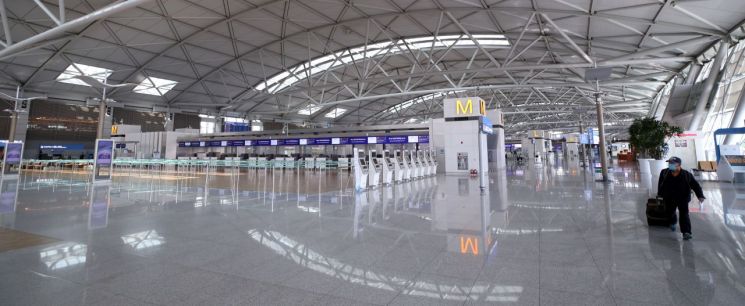
The service balance deficit was $1.45 billion, with the deficit narrowing by $90 million compared to the same month last year. Due to COVID-19, there was a phenomenon where people neither traveled abroad nor came to Korea, with a particularly large decrease in the number of departures having a significant impact. The travel balance deficit was $570 million, narrowing by $270 million compared to the same month last year.
Moon Sosang, Head of the Economic Statistics Department at the Bank of Korea, said, "The number of arrivals in February was 690,000, down 43.0% year-on-year, and the number of departures decreased from 2.62 million to 1.05 million, a 60.0% drop during the same period," adding, "the number of departures decreased more than arrivals, leading to an improvement in the balance." The travel expenditure by Korean nationals overseas in February was $1.82 billion, about $1.1 billion less than the previous month ($2.92 billion). This is the largest monthly decrease on record. In March, the number of departures is expected to decrease further, likely improving the service balance.

The primary income balance recorded a surplus of $1.25 billion, expanding by $790 million compared to the same period last year. This was due to increased dividend income from overseas, mainly from institutional investors.
Meanwhile, due to the unstable financial markets caused by COVID-19, the increase in foreign investment in Korea significantly slowed. Foreign investment in Korea increased by $370 million in February. While $3.37 billion flowed in mainly through overseas-issued bonds, $3.01 billion was withdrawn from domestic stocks. It has been estimated that foreign dividends paid by major domestic companies exceeded 5 trillion won, raising concerns that the current account balance may record a deficit again in April this year, following last year.
Park Dongjun, Head of the International Balance of Payments Team at the Bank of Korea, said, "Since last year's corporate operating performance was not as good as the year before last, the dividend scale is expected to decrease," but added, "It is difficult to make a definitive statement as there are no objective figures currently." In April last year, the dividend balance showed a deficit of $4.87 billion, resulting in a current account deficit of $390 million.
© The Asia Business Daily(www.asiae.co.kr). All rights reserved.


















