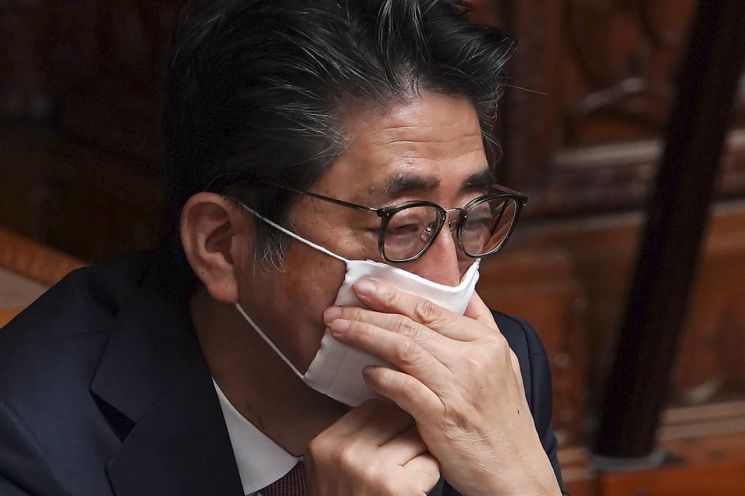
 Japanese Prime Minister Shinzo Abe adjusts the mask he was wearing while attending the House of Councillors plenary session on the 3rd.
 [Image source=AP Yonhap News]
[Asia Economy Reporter Lee Chun-hee] On the 6th, Japanese Prime Minister Shinzo Abe reportedly informed the ruling Liberal Democratic Party that he would begin preparations to issue a state of emergency declaration based on the "Special Measures Law for Countermeasures against Novel Coronavirus Infectious Disease (COVID-19)," according to Kyodo News.
It is known that the declaration could be made as early as the 7th, with the state of emergency taking effect from the 8th. The targeted areas include the Tokyo metropolitan area, Osaka region, and seven prefectures: Hyogo, Fukuoka, Chiba, Kanagawa, and Saitama. The period is until the 6th of next month.
Currently, the number of confirmed cases in Japan is increasing to a concerning level. As of 11:30 PM on the 5th, the cumulative number of confirmed cases was counted at 4,570, an increase of 362 from the previous day. This includes confirmed cases from the Diamond Princess cruise ship. The death toll rose by 9 from the previous day to a total of 104.
The region with the steepest increase in confirmed cases is the capital, Tokyo. Following an increase of 117 cases on the 4th, 143 new cases were reported on the 5th, bringing the total to 1,033 confirmed cases. Ultimately, it appears that the rapid nationwide spread of infections in Japan has led to the judgment that it is having a significant impact on the daily lives of citizens and the economy.
The Prime Minister, who is also the head of the Japanese government task force, is authorized under the law concerning infectious diseases such as COVID-19 to declare a state of emergency if the disease is spreading rapidly nationwide and is expected to seriously affect the lives and economy of Japanese people. Once declared, authorities can take measures that restrict individual property rights, such as using land necessary for medical facility installation, which is advantageous for securing hospital beds. Additionally, prefectural governors can request residents to refrain from going out and limit the use of public facilities based on legal grounds. However, even if a state of emergency is declared, going out cannot be forcibly prohibited, so a "city lockdown" is not possible.
If the Japanese government declares a state of emergency, the economic shock is also expected to be significant. Some forecasts suggest the impact could be 1.5 times that of the 2008 Lehman Brothers bankruptcy crisis. According to the Mainichi Shimbun, Professor Emeritus Katsuhiro Miyamoto of Kansai University estimated that if a state of emergency due to COVID-19 is declared across the Japanese archipelago, the economic loss over two years could reach approximately 63 trillion yen (about 717.381 trillion KRW). This estimate was calculated considering the current level of the domestic gross domestic product (GDP).
© The Asia Business Daily(www.asiae.co.kr). All rights reserved.

















