Crisis Rumors and Funding Shortages Amplify Market Instability and Worsen Affected Companies
Rapid Easing of Financial Sector Regulatory Burdens Such as LCR and Loan-to-Deposit Ratio
Awareness of Aviation Industry Situation... Comprehensive Measures Discussed with Relevant Ministries
Expectations for Solutions from Shareholders and Labor to Normalize Ssangyong Motor... Supportive Consultations Underway
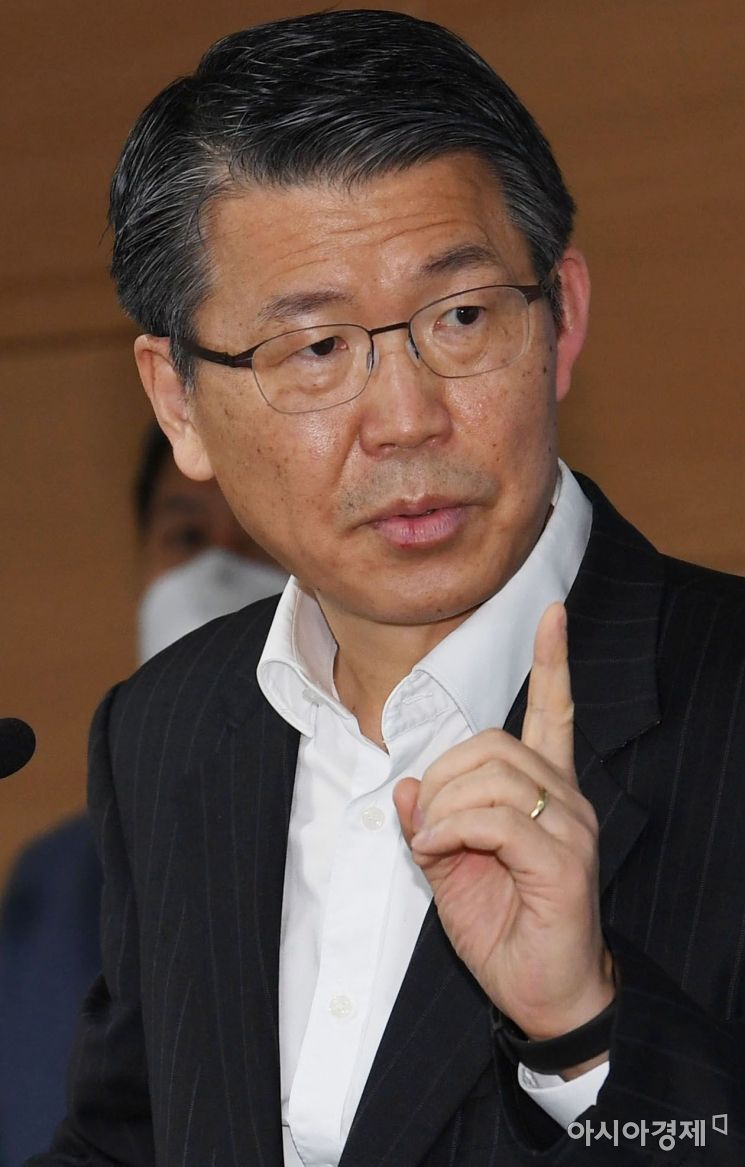 Financial Services Commission Chairman Eun Sung-soo is announcing measures to stabilize the financial market related to COVID-19 at the briefing room of the Government Seoul Office in Jongno-gu, Seoul on the 24th. Photo by Moon Ho-nam munonam@
[Asia Economy Reporter Kangwook Cho] Eun Sung-soo, Chairman of the Financial Services Commission, stated on the 6th regarding concerns recently raised around the financial market amid the novel coronavirus disease (COVID-19) situation, "The claims about a corporate funding crisis are not based on facts."
In an open letter released that day, Chairman Eun said, "In the past, whenever the economy faced difficulties, rumors of a funding crisis repeatedly surfaced, but in hindsight, they turned out to be exaggerated." The Financial Services Commission explained that the chairman sent an open letter containing the government's intentions and policy directions to major columnists, reporters, and private advisory members to dispel unnecessary misunderstandings in the market and answer questions related to policy directions amid recent concerns and policy proposals surrounding the financial market.
In the letter, Chairman Eun pointed out that while crisis rumors such as '○ month crisis theory,' 'fire on the stove,' and '○○ company funding difficulties' serve to raise awareness of issues, they can unnecessarily amplify market anxiety and worsen the financial conditions of the specific companies mentioned, thus requiring a cautious approach.
Regarding criticisms that the government's measures might have been delayed as market interest rates on instruments like CP (commercial paper) have risen despite the announcement of government countermeasures, the accompanying explanatory materials firmly stated, "That is not the case." Although CP rates have recently increased, this was partly due to the end-of-quarter effect in March and is not a phenomenon unique to Korea. It was added that this reflects market uncertainty and was somewhat anticipated.
The Financial Services Commission explained that the CP spread has not widened significantly compared to other countries such as the United States and that during the past global financial crisis, it even rose to 379 basis points. Particularly, since the Bond Market Stabilization Fund began full operation on the 2nd, corporate issuance volumes have been absorbed by the market, showing relatively stable conditions.
In response to criticisms that the government's situation assessment is complacent, the commission emphasized, "The government's firm policy is to prevent companies from going bankrupt due to temporary liquidity problems," and reiterated, "We will ensure timely provision of necessary funds through previously established financial support programs without limiting by company size or industry."
Regarding doubts about the effectiveness of the Bond Market Stabilization Fund, it was explained that since corporate issuance volumes have been absorbed by the market since the 2nd, it is preferable for corporate bonds and CP to be absorbed by the market itself. To encourage market-based financing, it is difficult to offer conditions better than the market in terms of interest rates and other aspects.
It was also stated that low-credit-rated corporate bonds are not included in the purchase targets of the Bond Market Stabilization Fund. The fund is intended to support bond issuance by relatively high-credit-rated prime companies to supplement market supply and demand during frictional market freezes. However, the commission clarified that not being a target for bond purchases does not mean abandoning or not supporting those companies; support will be provided through other policy financial institution programs such as P-CBO and rapid corporate bond underwriting.
Regarding concerns about the deterioration of financial institutions' soundness, the commission acknowledged, "Financial support has some negative impact on the soundness of financial institutions." However, it noted that the current soundness of financial institutions is good and manageable, and emphasized that regulatory burdens such as LCR and loan-to-deposit ratios will be promptly eased to minimize the burden.
In response to criticisms that the government is neglecting the aviation industry, which is on the brink of collapse due to the worst management difficulties, Chairman Eun said, "The aviation industry is facing difficulties worldwide due to COVID-19," and added, "The government recognizes the seriousness of the situation." He noted, "Due to the structural characteristic of the aviation industry’s high dependence on leases, the debt ratio is high, so comprehensive efforts including capital expansion and management improvement along with financial support will be necessary." He continued, "We are monitoring the situation with related ministries and policy financial institutions and are deeply discussing multifaceted and comprehensive alternatives," and added, "We will inform you of specific measures once conclusions are reached."
Regarding criticism of the Bank of Korea's passive stance, Chairman Eun said, "It is difficult to comment on matters under the Bank of Korea’s jurisdiction, but I believe they are providing active support." Regarding market skepticism about financial authorities emphasizing indemnity, he stressed, "We will comprehensively revise the indemnity system by amending supervisory regulations to guarantee indemnity more systematically."
Specifically, concerning the Mahindra Group’s announcement that it is difficult to inject new capital into Ssangyong Motor, he expressed, "I expect shareholders and labor to work together to find a solution for normalization."
Chairman Eun stated, "The Mahindra Group has announced plans to provide 40 billion KRW in new funding and support the search for new investors, and Ssangyong Motor has expressed a strong will to steadily pursue management reform efforts for normalization," adding, "I expect creditors and others to discuss whether there are parts that can support Ssangyong Motor’s management normalization, considering its management reform efforts and financial conditions."
© The Asia Business Daily(www.asiae.co.kr). All rights reserved.

















