Ssangyong Motor, Annual Fixed Costs at Least 90 Billion KRW
Mahindra's One-Time Support of 40 Billion KRW Insufficient
900 Billion KRW KDB Loan Matures in July
Liquidity Crisis If No Loan Extension or Additional Support
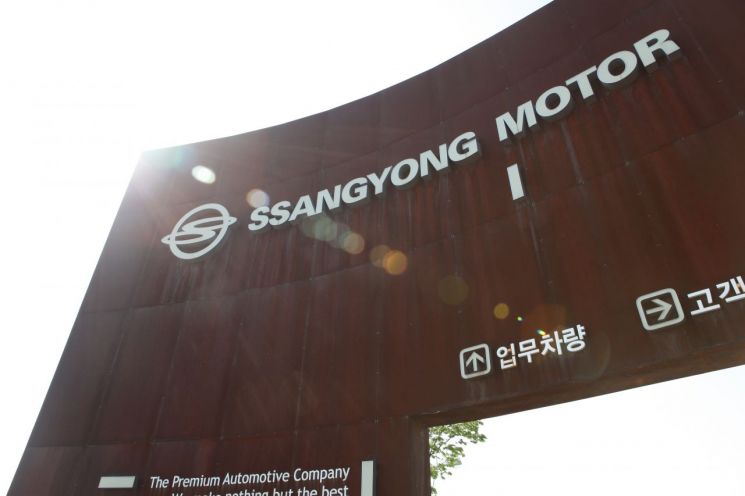
[Asia Economy reporters Su-yeon Woo and Kang-wook Cho] Ssangyong Motor has been put to the test of independent survival due to the withdrawal of new investment by its parent company Mahindra. With chronic deficits, a sales cliff caused by the novel coronavirus disease (COVID-19), and the failure of financial support from the parent company, concerns are emerging that Ssangyong Motor could face a short-term liquidity crisis within as soon as three months.
According to the business report on the 6th, Ssangyong Motor spent 549.5 billion KRW on selling and administrative expenses last year, including 55.6 billion KRW in employee salaries and 5.03 billion KRW in interest expenses. Even when adding only the minimum fixed costs such as salaries, interest expenses, and depreciation, an annual amount of 90 billion KRW, or 22.5 billion KRW per quarter, is required.
In addition, Ssangyong Motor has short-term borrowings of 256.3 billion KRW that must be repaid within one year. Among these, 190 billion KRW borrowed from the Korea Development Bank includes 90 billion KRW maturing in July. The 40 billion KRW one-time fund provided by Mahindra is far from sufficient to cover this. Without additional financial support or loan maturity extensions before July, a liquidity crisis appears to be an inevitable step.
Accordingly, Ssangyong Motor intends to secure cash by selling non-core assets such as the Busan logistics center to proceed smoothly with management normalization plans. However, considering the financial situation where current liabilities are twice the current assets, even this seems difficult. In last year's audit report, Samjong Accounting Corporation stated about Ssangyong Motor's financial condition, "Considering that current liabilities exceed current assets, there is significant doubt about the company's ability to continue as a going concern."
Resolving liquidity through its own business activities also has low feasibility. Ssangyong Motor's net loss last year was 341.3 billion KRW, 5.5 times higher than the previous year. This is because exports were sluggish and the competitiveness in the domestic market, its main market, sharply weakened from the second half of last year. Domestic sales of Ssangyong Motor in the second half of last year were 51,839 units, an 11% decrease compared to the previous year.
Except for 2016, Ssangyong Motor has suffered losses every year since 2007 until last year and was recently implementing a management reform plan by preparing a strong self-rescue plan. Until early this year, Mahindra, which had promised a new investment of 230 billion KRW in Ssangyong Motor, recently changed its stance, stating that investment is impossible due to the global automotive industry's impact from COVID-19.
Various interpretations have emerged in the industry regarding Mahindra's change of stance. One analysis is that it was an unavoidable choice considering the cash flow of the group amid global automakers facing a sales cliff due to COVID-19. Another interpretation is that Mahindra used COVID-19 and the domestic general election as excuses to pressure the government while the Korea Development Bank hesitates to support Ssangyong Motor. If rumors of Mahindra's withdrawal from Korea continue to surface, the government's burden could increase further.
The Korea Development Bank responded cautiously, saying, "It is not the stage to disclose our position now." Since support from the policy bank must be carried out through consultation with the government, it is known that they are currently focusing on seeking solutions for each scenario.
© The Asia Business Daily(www.asiae.co.kr). All rights reserved.

















