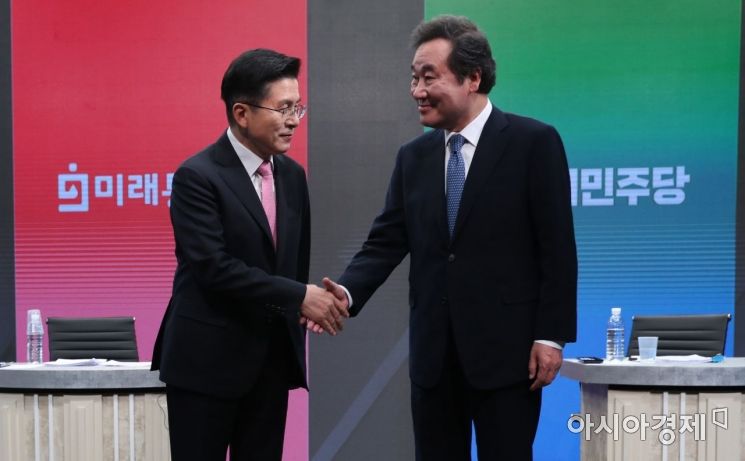
 In the April 15 general election, Lee Nak-yeon, co-chairman of the Democratic Party of Korea (right), who ran in Jongno-gu, Seoul, and Hwang Kyo-ahn, leader of the United Future Party, met and shook hands at a debate hosted by the Jongno-gu Election Broadcasting Debate Committee held on the 6th at the T-Broad Broadcasting Gangseo Production Center in Gangseo-gu, Seoul. Photo by the National Assembly Press Photographers Group
[Asia Economy Reporters Park Cheol-eung, Kang Nahum, Won Dara] As the April 15 general election approaches, the number of undecided voters is rapidly decreasing. Although the Democratic Party of Korea shows a relatively large lead over the United Future Party, some analysts suggest that this should be viewed considering the increase in so-called 'shy conservative' voters.
According to major public opinion polls released this month as of the 6th, Korea Gallup recorded 22% of undecided voters in a survey conducted from March 31 to April 2, a sharp drop of 11 percentage points from 33% at the end of February. Realmeter's survey results also show that the proportion of 'no party support or undecided voters' decreased from 18.5% in early March to 15.8% this month.
The Democratic Party's approval ratings range from 41% to 43% across different polling agencies, showing little variation. In contrast, the United Future Party's support varies significantly by agency: 23% in Korea Gallup, 28% in Realmeter, and 34% in Research View.
This is interpreted as being related to the polling methods. Korea Gallup uses a 100% telephone interview method, which may result in relatively lower support ratings for the conservative opposition party. An Il-won, CEO of Research View, said, "It is an industry consensus that telephone interviews tend to have a strong pro-government bias. Since the impeachment of former President Park Geun-hye, there has been much analysis that conservative supporters are reluctant to respond. This suggests that the actual vote share of the United Future Party could be higher than recent poll results."
In fact, a poll conducted by JoongAng Ilbo through Embrain Public on April 3-4 targeting 1,000 men and women aged 18 and over nationwide showed that 53.7% said they voted for President Moon Jae-in. This is seen as evidence that Democratic Party supporters are actively participating in opinion polls.
The Democratic Party is encouraged by the poll results and does not agree with the notion of 'shy conservatives.' Lee Geun-hyung, Chair of the Democratic Party's Strategic Planning Committee, appeared on CBS Radio's "Kim Hyun-jung's News Show" and stated, "It has been quite some time since groups like the Taegeukgi Unit have openly shown they are conservatives. Admitting to being 'shy' could be self-contradictory."
On the other hand, the United Future Party expects to win up to 132 seats in constituencies and up to 50 seats in the metropolitan area, emphasizing the low reliability of polls. Kim Jong-in, the party's general election committee chairman, said at a Seoul regional campaign meeting, "I never believe that early polls directly determine election results."
The most significant difference in this general election's polling compared to previous ones is the use of mobile phone safe numbers. Four years ago, ahead of the 20th general election, polls were mainly conducted via landlines, which resulted in higher conservative party support and a large discrepancy with actual voting outcomes. Polls targeting mobile phone users are considered to be closer to actual public sentiment.
Some analyses interpret the high support for the Democratic Party as a result of the weakness of third-party candidates. Park Sang-byeong, a visiting professor at Inha University Graduate School of Policy, said, "Voters tired of two-party politics tended to support third parties. However, in this election, centrist parties like the Minsheng Party and the People's Party failed to play their roles, putting third parties at risk of extinction. A significant portion of centrist supporters have shifted to the Democratic Party."
The government's response to the novel coronavirus infection (COVID-19) may also have influenced undecided voters. An official from a polling industry said, "Korea's quarantine measures have received favorable evaluations overseas, and the public's desire for stability in uncertain times seems to be at work."
© The Asia Business Daily(www.asiae.co.kr). All rights reserved.
![Clutching a Stolen Dior Bag, Saying "I Hate Being Poor but Real"... The Grotesque Con of a "Human Knockoff" [Slate]](https://cwcontent.asiae.co.kr/asiaresize/183/2026021902243444107_1771435474.jpg)











