Due to COVID-19 Impact, Half the Previous Sales
Samsung Electronics "Including Self-Supply, 80% Compared to Previous"
Reduced Official Subsidies and Frozen Consumer Sentiment
Additional Used Device Compensation Support to Offset Slump
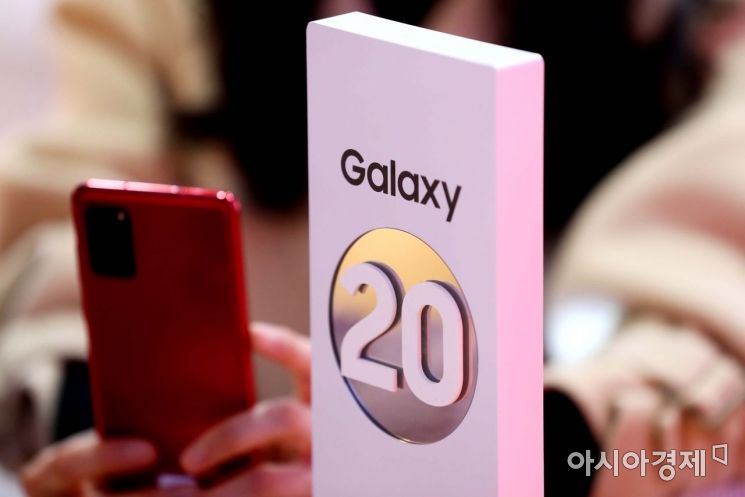 On the 11th (local time), Samsung Electronics held the Galaxy Unpacked 2020 event at the Palace of Fine Arts in San Francisco, USA, unveiling its strategic smartphones, the 'Galaxy S20 series' and the second foldable phone, the 'Galaxy Z Flip.' On the 12th, citizens are experiencing the related products at the KT Plaza Gwanghwamun branch in Seoul. Photo by Moon Honam munonam@
[Asia Economy Reporter Han Jinju] Although a month has passed since the launch of the Galaxy S20, its sales volume has reached only about half that of the Galaxy S10. The new coronavirus infection (COVID-19) has frozen consumer sentiment, and the Galaxy S20 could not escape the smartphone's early spring cold snap.
According to the industry on the 6th, the Galaxy S20 sales volume through mobile carriers fell below 300,000 units, reaching only about half the level of the Galaxy S10 released last year. This is the result of an increase in people postponing smartphone replacements due to the spread of COVID-19 since February, combined with significantly reduced official subsidies compared to previous years. Last year, the number of 5G subscribers increased by 300,000 to 880,000 per month, but this year, in January and February, it remained at around 300,000 to 400,000. Regarding this, a Samsung Electronics official explained, "Including unlocked sales, the Galaxy S20 sales volume is about 80% of the Galaxy S10."
To compensate for the sluggish sales, the telecommunications industry is providing additional trade-in compensation to Galaxy new smartphone buyers until next month. For example, if a subscriber using the Galaxy S9 purchases the Galaxy S20, they will receive a total of 260,000 KRW, which includes the existing trade-in compensation of 130,000 KRW plus an additional 130,000 KRW. Although this is a promotion by the carriers, Samsung Electronics contributed more to the additional trade-in compensation funds than the carriers. Since it is difficult to increase official subsidies, they raised the overall trade-in compensation by offering a higher purchase price for the devices previously used.
The sudden early spring cold snap in the smartphone market is not limited to Samsung Electronics. According to market research firm Strategy Analytics, smartphone shipments in February decreased by 38% to 61.8 million units compared to the same month last year (99.2 million units). Furthermore, the total smartphone shipments for this year are expected to decrease by 13% compared to last year. Technology analysis firm CCS Insight also forecasted that smartphone shipments this year will be 1.57 billion units, down by 240 million units from last year's 1.81 billion units, marking the lowest level since 2011 (1.58 billion units).
An industry official said, "Signs of sluggishness compared to previous years are appearing everywhere," adding, "The initial stock that should have already been sold out is still remaining, indicating that the situation is not good."
© The Asia Business Daily(www.asiae.co.kr). All rights reserved.

















