Analysis of Last Year's Financial Statements
Total of 10 Companies Recorded 87.6909 Trillion Won
Down 9.89% from Previous Year
Lotte -25%, SK -22%
Performance Decline Due to Increased Investment and Dividends
[Asia Economy Reporters Jeongsoo Lim, Soyeon Park, Hyowon Jang] The cash situation of major domestic conglomerates has worsened. Due to trade disputes between the US and China, and between Korea and Japan, earnings have declined while investment and dividend expenditures have increased, leading to a decrease in cash holdings among large corporations. The cash situation for large companies is expected to deteriorate further this year due to the COVID-19 pandemic.
On the 6th, Asia Economy analyzed the financial statements of the top 10 listed domestic groups (excluding financial affiliates) such as Samsung, Hyundai Motor, SK, and LG for last year. The combined cash equivalents (cash and cash equivalents, short-term financial instruments) based on separate financial statements amounted to KRW 87.6909 trillion. This represents a 9.89% decrease compared to KRW 97.3114 trillion in 2018.
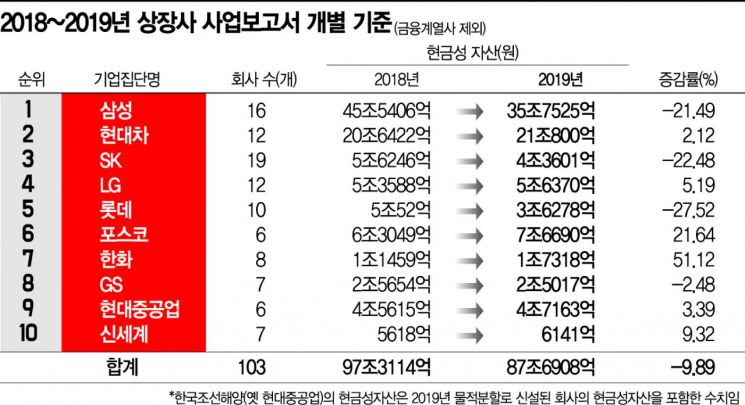
By group, Lotte Group (-27.52%), SK Group (-22.48%), and Samsung Group (-21.49%) showed the highest rates of decrease in cash equivalents. GS Group (-2.48%) also saw a slight reduction in cash holdings. On the other hand, Hanwha Group (51.12%) and POSCO Group (21.64%) increased their cash equivalents.
In terms of amount, Samsung Group experienced the largest decline. In particular, Samsung Electronics, the flagship company, reduced its cash holdings due to large-scale investments in facilities such as the Pyeongtaek plant despite declining earnings. Samsung Electronics’ profits were halved last year as the DRAM price decline that began in Q4 2018 led to inventory adjustments by major customers. As a result, Samsung Electronics’ cash equivalents decreased by about KRW 8 trillion. The holding company Samsung C&T also saw its cash equivalents drop by about KRW 1 trillion due to poor order performance and debt repayments.
SK Group’s cash equivalents at the end of last year were KRW 4.3601 trillion, down 22.48% from KRW 5.6246 trillion the previous year. This was mainly due to SK Innovation, the refining affiliate, whose cash equivalents plummeted from around KRW 1 trillion to about KRW 120 billion. Although SK Innovation’s operating profit fell by 37% last year, it continued investing in batteries and advanced materials, which reduced its cash holdings. The main affiliate SK Hynix’s cash equivalents also decreased by 13.03% year-on-year to KRW 1.9299 trillion due to semiconductor price declines and other factors.
Lotte Group’s cash equivalents also fell 27.52% to KRW 3.6278 trillion last year from KRW 5.0052 trillion the previous year. The sharp decline in Lotte Chemical’s cash equivalents from KRW 2.739 trillion to KRW 976.9 billion, a 64.33% drop, had a significant impact. A credit rating agency official explained, “For Lotte Group, the decline in cash equivalents was caused by deteriorating petrochemical market conditions leading to poor earnings and the cost burden from restructuring the group’s holding company. The worsening performance in retail also contributed to the decrease in cash holdings.”
In contrast, Hyundai Motor Group’s cash equivalents increased 2.12% to KRW 21.08 trillion from KRW 20.6422 trillion the previous year. Hyundai Motor’s return to profitability and improved earnings from Kia Motors and Hyundai Mobis contributed to the increase in cash equivalents. Hanwha Group’s cash equivalents rose 51.12% to KRW 1.7318 trillion at the end of last year from KRW 1.1459 trillion the previous year. Specifically, Hanwha Systems’ cash equivalents increased from KRW 214.6 billion to KRW 613.4 billion, and Hanwha Solutions’ cash equivalents rose from KRW 239 billion to KRW 475.7 billion.
Despite the significant decrease in cash equivalents, the retained earnings of large corporations increased, showing a considerable gap between companies’ cash situations and retained earnings. As of the end of last year, the retained earnings of the top 10 groups totaled KRW 654.129 trillion, up 1.21% from KRW 643.1021 trillion the previous year. Retained earnings consist of accumulated surplus and capital surplus since the company’s establishment, much of which has already been spent on investments and other expenditures, so they differ significantly from cash holdings. A financial investment industry official noted, “There is little correlation between companies’ cash situations and retained earnings. It is inappropriate to judge companies’ cash conditions based on retained earnings.”
This year, the overall economic downturn caused by the COVID-19 pandemic is expected to further worsen companies’ cash situations. Market experts anticipate that not only small and medium-sized enterprises but also large corporations will see significant earnings deterioration this year. Considering this, large companies are closely monitoring the cash liquidity of not only their group affiliates but also related companies. A representative from one of the top 10 groups said, “At the group level, we are closely monitoring the liquidity status of related companies in real time. Since issuing corporate bonds or commercial paper (CP) is not proceeding normally, related companies are securing bank credit loans to prepare for sudden risks.”
© The Asia Business Daily(www.asiae.co.kr). All rights reserved.

















