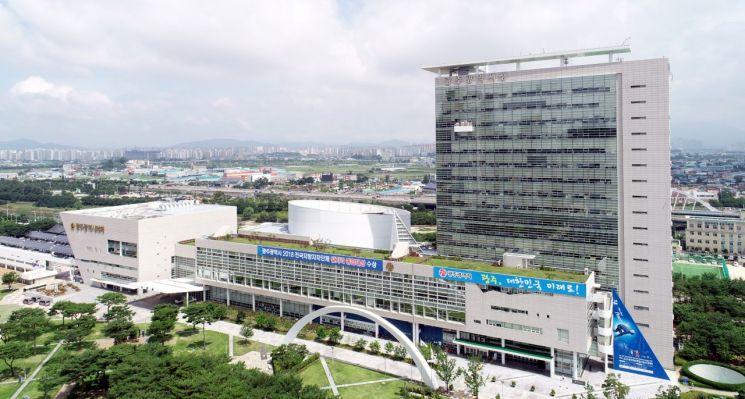
[Asia Economy Honam Reporting Headquarters Reporter Park Seon-gang] Gwangju Metropolitan City announced on the 5th that it will conduct a human rights impact assessment on newly constructed public buildings in 2020.
The public buildings to be assessed this time are the Hanam District Municipal Library and the Buk-gu Disabled Human Rights Town, both scheduled to begin construction this year. Gwangju City established the plan to conduct the human rights impact assessment last month.
The human rights impact assessment for public buildings was prepared to prevent human rights violations and guarantee human rights from the perspective of citizens and socially vulnerable groups in public buildings used by many citizens.
Before the building opens, the assessment evaluates users' facility access, rest, safety rights, barrier-free living environment, and the application of Gwangju City's universal design from a human rights perspective, aiming to reduce various social costs.
The public building human rights impact assessment conducted this year will form and operate a "Public Building Human Rights Impact Assessment T/F" based on the evaluation experience of the "Bitgoeul Safety Experience Center," which has been conducted since 2018.
Subsequently, a detailed checklist will be prepared, and evaluations will be conducted in four stages from the design competition task instructions to completion.
The Public Building Human Rights Impact Assessment T/F will be composed and operated by related experts, including Professor Nam Seung-jin of Donga Health College who participated in universal design preparation, Professor Son Seung-kwang of Dongshin University Department of Architectural Engineering, Kim Kwang-il, BF Certification Manager at Korea Disabled Development Institute, Hwang Hyun-chul, former head of the Transportation Vulnerable Mobility Support Center, Park Chan-dong, director of the Gwangju Disabled Advocacy Agency, Jeong In-gyeong, member of the City Human Rights Promotion Citizens Committee, Yoo Seung-hee, president of Gwangju Inkkochigi, and heads of relevant departments.
Gwangju City has been conducting human rights impact assessments on ordinances, regulations, policies, and public buildings since July 2017, the first among metropolitan local governments.
The human rights impact assessments on social welfare facility regulations and manuals, and the construction of the Bitgoeul Safety Experience Center have become exemplary nationwide, attracting visits from local governments and education offices across the country, and the National Human Rights Commission is also disseminating these as best practices nationwide.
Yoon Mok-hyun, Director of the Democratic Human Rights and Peace Bureau of the city, said, "Gwangju is conducting human rights policies such as the basic human rights plan, human rights ombudsman system, and human rights education in an exemplary manner nationwide and globally, befitting its status as a democratic human rights peace city. The human rights impact assessment is the most necessary human rights policy among human rights policies for the practical protection and promotion of citizens' human rights, and we will continue to expand the evaluation areas."
Meanwhile, the human rights impact assessment on ordinances and regulations has been cooperating with the Public Interest Human Rights Law Center at Chonnam National University since October 2017, evaluating 146 cases so far, recommending 23 cases, of which 19 have been accepted by departments.
© The Asia Business Daily(www.asiae.co.kr). All rights reserved.

















