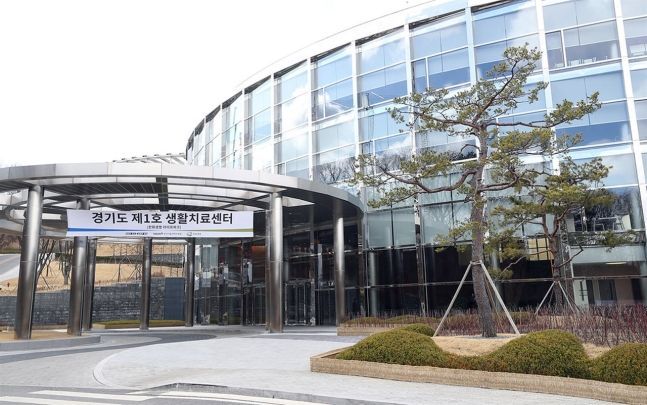
[Asia Economy (Suwon) = Reporter Lee Young-gyu] The average duration of stay for mild COVID-19 patients recovering at the Gyeonggi-do Residential Treatment Center was found to be 3.7 days.
Gyeonggi-do announced on the 5th that since the first operation of the province's No. 1 Residential Treatment Center on the 19th of last month, 100 COVID-19 patients have been admitted as of the 3rd of this month, with 39 patients having completed treatment and returned home.
Compared to the average hospitalization period of 14.6 days for 181 mild COVID-19 patients who were hospitalized and discharged over five weeks (February 9 to March 13) at seven public medical centers in Gyeonggi-do, the treatment period is significantly shorter.
The Gyeonggi-do Residential Treatment Center, operated using the Hanwha Life Park training center located in Namsa-myeon, Cheoin-gu, Yongin-si, has a total of 160 rooms. Currently, 90 rooms are in operation. Each patient is assigned one room, and family rooms can be used if necessary.
The operation method is not the existing 'hospital substitute type' but a 'home substitute type.'
It takes care of recovering patients who have completed medical treatment at hospitals, have a low possibility of emergency situations, and are in a stable condition.
The center focuses on minimizing excessive medical and management resource input while helping the psychological and emotional recovery of mild recovering patients.
Patients are cared for by a dual system consisting of a monitoring headquarters established at Bundang Seoul National University Hospital and a dispatched team at the center.
The center's operating personnel consist of 61 members across four teams, including 5 medical support team members (doctors, nurses, public officials), 3 rescue and emergency teams (firefighters), 26 administrative management team members (administrative officials, police, military personnel), 8 waste disposal team members (public officials and contractors), and the center director (head of the provincial asset management department), totaling 43 staff on site.
Twice a day, at 9 a.m. and 5 p.m., patients have video calls with nurses from the Bundang Seoul National University Hospital headquarters to check their health status and receive consultations. Doctor examinations are conducted remotely every other day.
Additionally, residents measure their temperature, pulse, blood pressure, and oxygen saturation twice daily and input the data into the Bundang Seoul National University Hospital health management app.
In response to the increase in overseas arrivals and ongoing cluster infections, Gyeonggi-do has begun preparations for the worst-case scenario, including tripling the number of intensive care beds, securing additional residential treatment centers, restructuring the medical system, minimizing economic damage, and implementing measures to stabilize residents' lives.
© The Asia Business Daily(www.asiae.co.kr). All rights reserved.

















