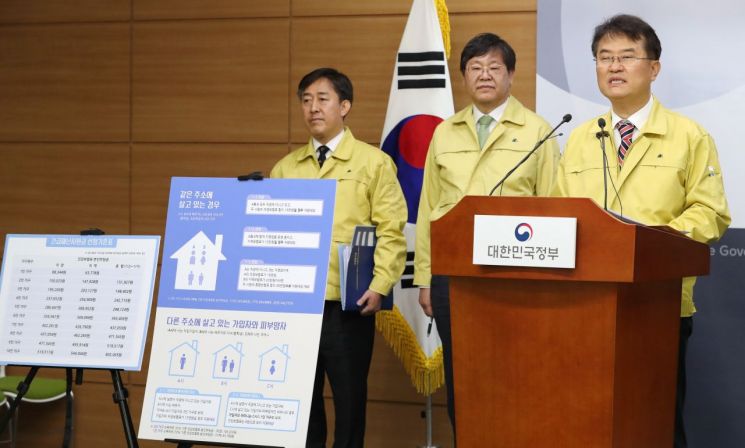
 Yoon Jong-in, Vice Minister of the Ministry of the Interior and Safety, is announcing the results of the joint task force (TF) of related ministries regarding the payment of emergency disaster relief funds due to the COVID-19 situation at the Government Sejong Complex in Sejong City on the morning of the 3rd.
 [Photo by Yonhap News]
[Asia Economy Reporter Jusangdon Joo] As the government decided to determine the bottom 70% income bracket eligible for the emergency disaster relief fund based on health insurance premium payments, interest is focusing on how to check the health insurance premiums.
For employees, health insurance premiums can be checked on the monthly salary statement, and for regional subscribers, on the health insurance premium payment notice. It is also possible to check by accessing the National Health Insurance Service (NHIS) website or calling the call center.
The NHIS launched a system on the 3rd to allow households to check their health insurance premiums. You can click on "Check Health Insurance Premium" on the website or the smartphone app "M-Health Insurance." A public certificate is required at this time.
For workplace subscribers, if the monthly health insurance premium burden for a household of four is 237,652 KRW or less, they are eligible for the disaster relief fund. The amounts for other household sizes are ▲ three-person household: 195,200 KRW ▲ two-person household: 150,025 KRW ▲ one-person household: 88,344 KRW. For regional subscribers, the amounts differ: ▲ four-person household: 254,909 KRW ▲ three-person household: 203,127 KRW ▲ two-person household: 147,928 KRW ▲ one-person household: 63,778 KRW.
The emergency disaster relief fund is paid on a household basis, and the household members are determined based on the resident registration as of the 29th of last month. According to the Resident Registration Act, people registered together on the household resident registration are considered the same household. However, spouses and children registered as dependents of the health insurance subscriber are considered the same household even if their addresses differ.
If the total health insurance premium burden as of last month falls within the bottom 70% income bracket, the emergency disaster relief fund can be received in the form of local gift certificates or electronic money, with amounts of 400,000 KRW for one person, 600,000 KRW for two persons, 800,000 KRW for three persons, and up to 1,000,000 KRW for four or more persons per household.
The government plans to establish exclusion criteria through additional review of related official data, considering that when using health insurance premium payments to determine the bottom 70% income bracket, owners of high-priced houses, tenants of jeonse or monthly rent, and owners of luxury cars who are not reflected in income may become eligible. Also, for small business owners and self-employed individuals, recent income is difficult to reflect. Therefore, the government will prepare various supplementary measures so that local governments can make the final decision on support eligibility by reflecting the income situation at the time of application according to regional conditions for small business owners and self-employed households whose income has sharply decreased recently but is not reflected in health insurance premiums.
© The Asia Business Daily(www.asiae.co.kr). All rights reserved.

















