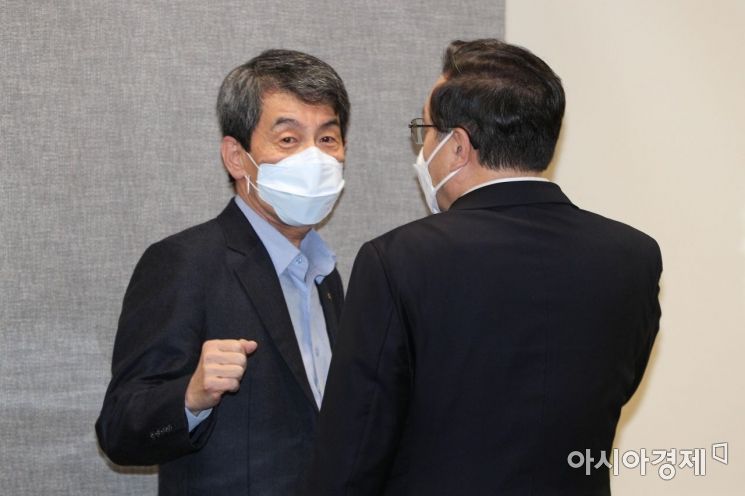
 Lee Dong-geol (left), Chairman of KDB Industrial Bank, and Sohn Tae-seung, CEO of Woori Bank, are attending a meeting between the Financial Services Commission Chairman and bank CEOs held at the Bankers' Hall in Jung-gu, Seoul on the 20th, sharing their opinions. Photo by Kang Jin-hyung aymsdream@
[Asia Economy Reporter Kangwook Cho] As the number of companies struggling to secure liquidity due to the novel coronavirus disease (COVID-19) crisis increases, the Korea Development Bank (KDB), responsible for policy funding support, is facing deepening concerns. This is because Ssangyong Motor has now joined Doosan Heavy Industries and low-cost carriers (LCCs) in facing a survival crisis.
Although Ssangyong Motor has not yet issued an official statement, the burden on KDB is expected to increase as it is highly likely that the company will soon request support.
According to industry sources on the 4th, Mahindra & Mahindra, the automotive division affiliate of the Mahindra Group, Ssangyong Motor's parent company, held a special board meeting on the 3rd and concluded that it cannot inject new capital into Ssangyong Motor.
Mahindra had previously emphasized its willingness to support Ssangyong Motor. At the end of last year, it reportedly revealed plans for a direct investment of 230 billion KRW during a meeting with the Ssangyong Motor labor union.
Earlier this year, in January, Pawan Goenka, Chairman of Ssangyong Motor's board and Mahindra's president, visited KDB and met with Chairman Lee Dong-geol to express his intention to normalize Ssangyong Motor's management and requested support.
At that meeting, Goenka reportedly stated that although Ssangyong Motor's operating performance had deteriorated due to the recent global automotive market slump, as the major shareholder, Mahindra was making responsible efforts to revive Ssangyong Motor.
He also explained that, in addition to the direct investment plan, Mahindra was pursuing strategic alliances with leading global automotive companies to enhance Ssangyong Motor's sustainable competitiveness, according to KDB.
At the time, KDB stated, "We expect Ssangyong Motor to be normalized promptly through a sufficient and reasonable feasible management plan with the participation and cooperation of all stakeholders."
However, with Mahindra's recent refusal to make new investments in Ssangyong Motor, the company's future has become uncertain.
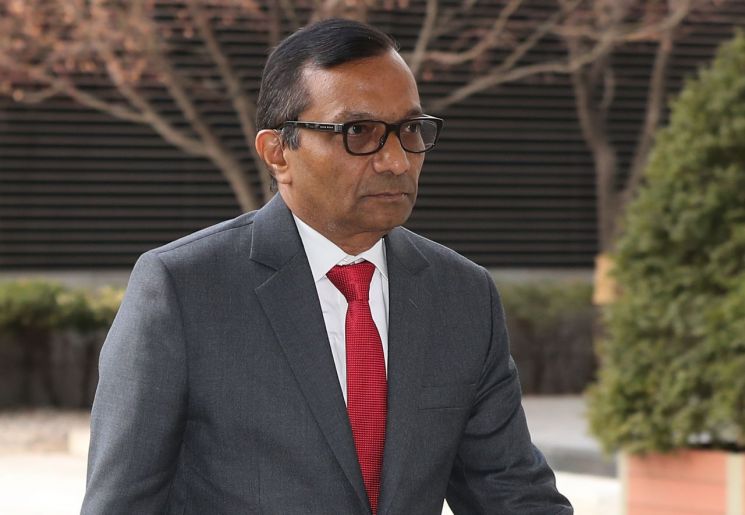
Some suggest that Mahindra's decision to refuse support for Ssangyong Motor is intended to draw support from the Korean government ahead of the general elections. During Goenka's visit to Korea in January, he spoke as if the investment would be decided soon but then postponed it until the end of March, seemingly monitoring the situation in Korea before responding.
In fact, when Mahindra announced it was considering a direct investment of 230 billion KRW, it was reportedly contingent on KDB providing support for Ssangyong Motor's revival. Mahindra is understood to have referred to KDB's case of supporting Korea GM's revival with 800 billion KRW.
However, KDB maintains that the situation with GM is fundamentally different. In GM's case, KDB was the second-largest shareholder, but with Ssangyong Motor, KDB is merely a creditor bank holding some bonds and does not own shares. Currently, Ssangyong Motor has borrowed about 190 billion KRW from KDB. Of this, 100 billion KRW was loaned last year for facility investment with a maturity in 2024. The remaining 90 billion KRW must be repaid by Ssangyong Motor by July.
KDB believes it is not yet the stage to announce its position regarding Ssangyong Motor. However, concerns are deepening. If Ssangyong Motor's normalization plan falters, considering the impact on related partner companies, it would be difficult to ignore any support requests.
Especially, following the direct hit to LCC airlines due to the COVID-19 outbreak and KDB's decision to provide 1 trillion KRW in emergency operating funds to Doosan Heavy Industries, KDB, which has taken on the role of resuscitating companies in crisis, inevitably faces the burden of additional financial support.
According to KDB, since the government's announcement of 'LCC airline financial support' on the 3rd of last month, financial support to LCC airlines has totaled 126 billion KRW as of the 31st. Additionally, this month, up to 28 billion KRW will be provided to Air Busan through Asiana Airlines, and further support is planned for T'way Air. Regarding Jeju Air's acquisition funds for Eastar Jet, a joint support plan of 150 to 200 billion KRW with other banks is scheduled this month after the Fair Trade Commission completes its corporate merger review.
Moreover, the acquisition of Asiana Airlines by HDC Hyundai Development Company remains. HDC Hyundai Development is reported to have recently requested support from KDB and others concerning Asiana Airlines' borrowings. Last year, KDB acquired 500 billion KRW in perpetual bonds issued by Asiana Airlines with the Export-Import Bank of Korea and provided credit lines of 800 billion KRW and standby letters of credit (LC) worth 300 billion KRW, totaling 1.6 trillion KRW in support.
As KDB takes on the role of an emergency room for companies, it finds itself in a difficult position. Emergency support for companies is carried out independently by KDB without government funding, but there are complaints that the government decides on support and then shifts the subsequent responsibility and criticism onto KDB. If support is provided indiscriminately without confidence in 'recovering' the funds, KDB would have to bear the full responsibility. The pressure to prevent the collapse of the entire market and concerns about deteriorating soundness come simultaneously, placing KDB in a dilemma.
Therefore, KDB emphasized that for large corporations, thorough pain-sharing, responsibility fulfillment by major shareholders, and self-help efforts must precede support. Chairman Lee Dong-geol also stated, "If Doosan Heavy Industries' management normalization fails, we will hold the major shareholders fully accountable."
The government announced at the 2nd Emergency Economic Meeting on the 24th of last month that it is determined to prevent companies from going bankrupt due to temporary liquidity shortages caused by COVID-19. However, when large corporations, including financial companies, seek to use government support programs, they must first make maximum use of available internal reserves and assets and primarily attempt to raise funds from their banks and the market.
The Financial Services Commission stated, "We plan to actively provide financial support to large corporations as well," adding, "If efforts on their own and government support programs are insufficient, policy financial institutions will decide on support based on a comprehensive consideration of the individual large corporation's self-help efforts, liquidity, and financial status."
© The Asia Business Daily(www.asiae.co.kr). All rights reserved.


















