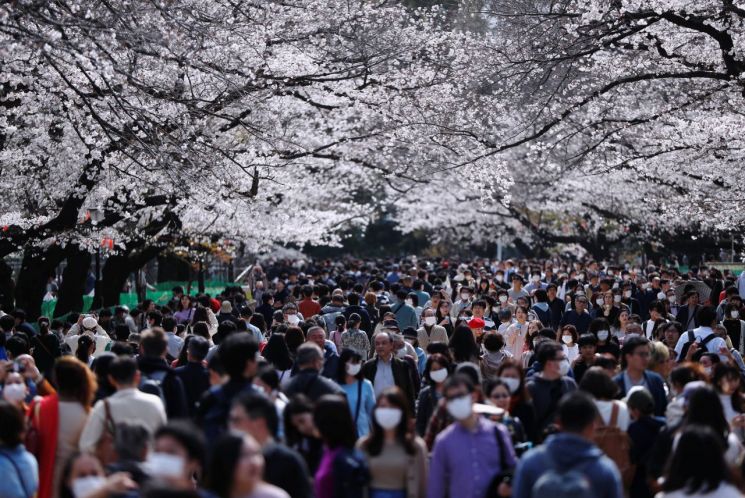
 On the 22nd of last month, despite concerns over the spread of the novel coronavirus infection (COVID-19), many citizens visited Ueno Park in Tokyo, Japan, to enjoy the full bloom of cherry blossoms. [Image source=Reuters Yonhap News]
[Asia Economy Reporter Chunhee Lee] As the number of new coronavirus infections (COVID-19) in Japan is gradually accelerating, concerns have arisen that Tokyo could become the 'second New York.'
Kentaro Iwata, a professor of infectious diseases at Kobe University Hospital and an infectious disease control expert in Japan, warned in an interview with CNN on the 4th (local time) that Tokyo could follow in the footsteps of New York, the largest virus hotspot in the United States. He stated, "The current spread in Tokyo is quite similar to the early patterns seen in Spain, France, Italy, and New York."
Professor Iwata said, "If this trend continues, the outlook is bleak," and argued, "Japan needs the courage to change course once it realizes it is heading in the wrong direction." He further emphasized that Japan is not taking sufficient measures to prevent the virus spread and pointed out the need to expand diagnostic testing. On the other hand, Japanese health authorities maintain the position that testing people with a low probability of infection is a waste of resources.
Previously, the daily number of new confirmed cases in Tokyo doubled from about 40 last week to 80-90 this week, and on the 4th, the daily new confirmed cases reached 118, surpassing 100 for the first time. The total number of COVID-19 cases in Japan also increased by more than 300 from the previous day to 3,813. The death toll stands at 88.
However, the scope of diagnostic testing in Japan remains limited. Among Tokyo's population of 13.5 million, fewer than 4,000 people have been tested so far. Even when expanded nationwide, the number of tests conducted is only about 39,466.
CNN reported that the number of diagnostic tests conducted in Japan is only a very small fraction of the total population, and introduced that South Korea, with a smaller population than Japan, has conducted 440,000 tests. It also reported that last week’s cherry blossom festival in Japan still attracted large crowds, many of whom were not wearing masks.
© The Asia Business Daily(www.asiae.co.kr). All rights reserved.

















