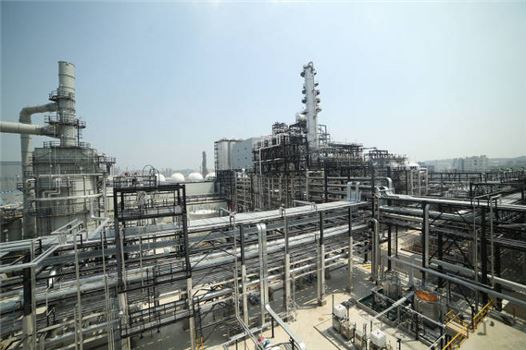
 ▲A view of the Nexlene plant within SK Innovation's Ulsan Complex, the largest oil refining company in Korea
[Asia Economy Reporter Hwang Yoon-joo] Amid the 'oil price war' between oil-producing countries such as Saudi Arabia and Russia, there is growing anticipation for a production cut agreement, but the refining industry is facing deepening concerns. Even if international oil prices rise in a situation where demand for petroleum products has decreased due to the COVID-19 pandemic, there is no guarantee that refining margins will improve.
According to the refining industry on the 5th, as of the 27th of last month, the raw material input time lag effect (1M lagging margin) recorded -31,000 KRW (/bbl). This is the lowest level in history, even lower than in 2014 when the refining industry was in poor condition.
In 2014, the combined sales of the four domestic refiners were 156.2 trillion KRW, with an operating loss of 700 billion KRW. The operating profit margin was -0.5%. At that time, the daily lowest record of the raw material input time lag effect was about -15,000 KRW (/bbl), which was better than now, yet the industry posted an annual loss.
Son Ji-woo, a researcher at SK Securities, analyzed, "Basically, the situation is compounded by oversupply, low oil prices, and the adverse effects of COVID-19," adding, "The biggest problem is that the recent sharp drop in oil prices still reflects the high prices from one month ago."
The refining industry agrees that resolving the issue of decreased demand for petroleum products is more important than ending the oil price war among oil-producing countries. To increase the refining margin spread, which determines refiners' profits, consumption must rise. The breakeven point for refining margins is known to be around 4 to 5 dollars per barrel. The refining margin recorded -1.9 dollars in the third week of March and -1.1 dollars in the fourth week, marking two consecutive weeks of negative margins. This means that the more refiners operate their plants to produce products, the more losses they incur.
In response, the government has decided to defer crude oil import tariffs for refiners by two months. However, the refining industry agrees that tax deferrals alone are insufficient to endure the current situation. There is an urgent need for effective measures, such as temporarily reducing crude oil import tariffs and petroleum import surcharges.
A refining industry official said, "The biggest problem is that demand for petroleum products could sharply decline in the US following Asia and Europe," adding, "Due to the nature of the industry, refiners cannot significantly adjust operating rates even if demand decreases, and there is great anxiety because it is difficult to predict how long the current situation will last."
© The Asia Business Daily(www.asiae.co.kr). All rights reserved.
![Clutching a Stolen Dior Bag, Saying "I Hate Being Poor but Real"... The Grotesque Con of a "Human Knockoff" [Slate]](https://cwcontent.asiae.co.kr/asiaresize/183/2026021902243444107_1771435474.jpg)















