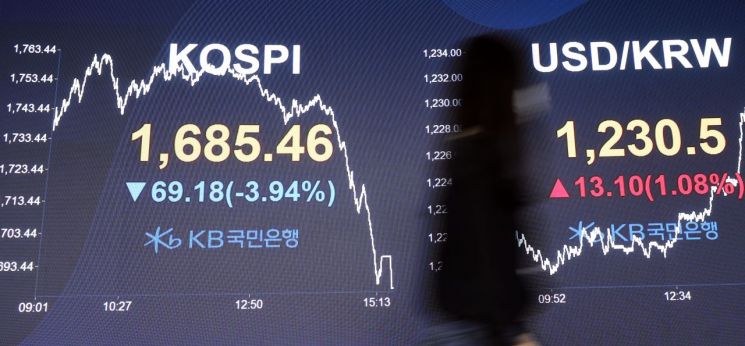
[Asia Economy Reporter Koh Hyung-kwang] As concerns over an economic recession spread due to the impact of the novel coronavirus infection (COVID-19), the stock market has been experiencing a rollercoaster ride with sharp fluctuations. In March, there were only four days when the KOSPI index's rate of change was in the 0% range. Since the contraction of the real economy is still in its early stages, it is expected that market instability will be inevitable for the time being.
According to the Korea Exchange on the 4th, out of the 21 trading days in the last month on the KOSPI market, there were 17 trading days when the index recorded a fluctuation rate of more than 1%. Only four trading days showed a rate of change in the 0% range, while the remaining 17 trading days experienced repeated sharp rises and falls of over 1%. Among these, there were as many as 10 trading days with severe rollercoaster swings of over 3%. Even this month, two out of three trading days showed fluctuations in the 2-3% range.
Last year, out of a total of 246 trading days, the KOSPI index recorded a fluctuation rate of more than 1% on 51 trading days (20.7%). On average, this means that once every five trading days, the index moved more than 1%. The months with the highest number of days with over 1% fluctuations were January and November, each with six days. In July and August last year, when Japan's trade retaliation intensified and the 1900-point level was broken, there were only five trading days each with fluctuations over 1%. Additionally, April, May, October, and December each had four such days, June and September had three, and March had only two trading days with fluctuations over 1%.
However, this year, the frequency of sharp fluctuations has increased. The number of days with more than 1% rise or fall was nine in January, eight in February, and as many as 17 last month. Since the World Health Organization (WHO) declared COVID-19 a pandemic on the 11th of last month, volatility has increased further. This is interpreted as the pandemic declaration implying that a short-term end to COVID-19 is unlikely, which maximized anxiety. From the 11th to the 25th of last month, the KOSPI index showed a fluctuation rate of over 2% for 11 consecutive trading days, and from the 18th to the 25th, there were six trading days with sharp rises and falls of over 4%. In particular, on the 19th and 24th of last month, the two days showed fluctuations in the 8% range, surpassing a rollercoaster to a 'panic market' phase.
On the 24th of last month, during the trading session, the KOSPI and KOSDAQ indices rebounded by more than 5%, triggering a buy-sidecar that temporarily halted program trading in both markets. This came just one day after a sell-sidecar was triggered in both markets immediately after the opening on the 23rd. Combining buy and sell sidecars, the sidecar has been triggered six times already this year in the KOSPI market. Lee Kyung-min, a researcher at Daishin Securities, said, "Although countries around the world, including the United States, have lowered benchmark interest rates and introduced economic stimulus measures one after another, they have failed to quell the fear sentiment," adding, "Market fear has reached an extreme, reacting to even small uncertainties with repeated sharp rises and falls."
Market experts predict that the volatile trend will continue for the time being as uncertainty about COVID-19 still dominates the market. Kim Hyung-ryul, head of the Research Center at Kyobo Securities, said, "The biggest concern is uncertainty, and it is difficult to accurately gauge the economic impact of COVID-19, with varying forecast figures," adding, "As long as uncertainty remains, the market will continue to show unstable behavior." Kim Yong-gu, a researcher at Hana Financial Investment, explained, "The key is how quickly the real economy shock for market stabilization is resolved," and added, "If the global financial market and real economy continue to be adversely affected by the impact of COVID-19, sharp fluctuations in the stock market will be inevitable."
There is also a view that it will be difficult for the stock market to rebound in a trend as the real economy shock caused by COVID-19 begins to take full effect. Kim Young-hwan, a researcher at KB Securities, said, "Since 1945, during seven recessions and stock market corrections, without exception, stock prices rebounded only after confirming negative growth in gross domestic product (GDP)," adding, "If this case follows past patterns, the end of the stock market correction is more likely to be in the second quarter rather than the first quarter."
There are also opinions that volatility may expand further. Seo Sang-young, a researcher at Kiwoom Securities, said, "Initially, the issue was limited to factory shutdowns and supply disruptions, but it expanded to concerns about economic recession, and now scenarios are spreading to debt and financial crisis debates," and predicted, "The Korean stock market's volatility may increase as concerns about economic contraction due to a sharp rise in COVID-19 cases in the United States become more prominent."
© The Asia Business Daily(www.asiae.co.kr). All rights reserved.
![Clutching a Stolen Dior Bag, Saying "I Hate Being Poor but Real"... The Grotesque Con of a "Human Knockoff" [Slate]](https://cwcontent.asiae.co.kr/asiaresize/183/2026021902243444107_1771435474.jpg)











