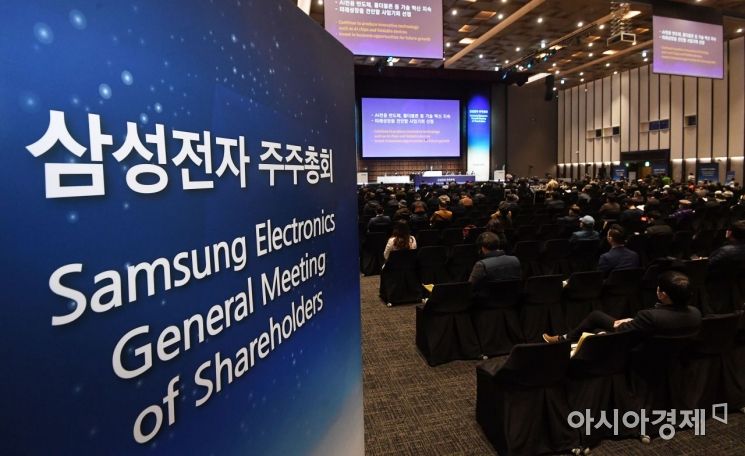
 The 51st regular shareholders' meeting of Samsung Electronics is being held on the 18th at the Suwon Convention Center in Suwon, Gyeonggi-do. At this shareholders' meeting, Samsung introduced electronic voting for the first time since its founding in 1969 to prevent the spread of the novel coronavirus infection. / Suwon - Photo by Jinhyung Kang aymsdream@
[Asia Economy Reporter Koh Hyung-kwang] Since the outbreak of the novel coronavirus disease (COVID-19), foreign investors withdrawing funds from the domestic stock market have sold off Samsung Electronics shares worth 6.7 trillion KRW over the past month. On the other hand, individual investors, often called "ants," have absorbed most of the Samsung Electronics shares sold by foreigners, launching what is known as the "Donghak Ant Movement." Individual investors, based on the belief that "buying Samsung Electronics at a low price will definitely yield profits," are poised to continue net buying. The "money war" between foreigners and individuals is heating up day by day.
According to the Korea Exchange on the 5th, since February 24, foreigners have shown massive daily sell-offs on all but one trading day (March 4) out of 30 trading days until March 3. The net sell amount reached a staggering 17.5084 trillion KRW. During this period, the stock most heavily sold by foreigners was Samsung Electronics, totaling 6.7447 trillion KRW, close to 40% of the total sell amount (17.5084 trillion KRW). On average, they sold 225 billion KRW per day, with four trading days seeing sales exceeding 500 billion KRW in a single day.
Most of the Samsung Electronics shares sold by foreigners were bought by individual investors. During the same period, individuals scooped up Samsung Electronics shares worth 6.5913 trillion KRW. The term "Donghak Ant Movement" is derived from the 1884 Donghak Peasant Revolution, a social reform movement by farmers aiming to oppose feudalism and foreign invasion, reflecting the intense back-and-forth between individual and foreign investors over Samsung Electronics. Kim Hyung-ryeol, head of the Kyobo Securities Research Center, said, "Even amid a plunging stock market, individuals continue buying Samsung Electronics shares with the belief that the stock price of this flagship domestic company will inevitably rise, thereby supporting Samsung Electronics' stock price."
As foreigners have steadily sold Samsung Electronics shares over the past month, their ownership stake has dropped from 57.14% to 55.00%, a decrease of 2.14 percentage points. It remains uncertain how long the foreigners' selling spree will continue. However, compared to past cases, there is speculation that the foreign selling pressure on Samsung Electronics may persist for some time.
During the financial crisis, the KOSPI index plunged more than 50% from its peak of 1901.13 on May 19, 2008, to a low of 892.16 on October 27 of the same year, while foreign funds flowed out like a receding tide. At that time, foreigners also sold off large amounts of Samsung Electronics shares, with their ownership dropping from 46.00% to 42.49%, a decrease of 3.51 percentage points. Compared simply to the recent decrease of 2.14 percentage points, there is still room for further selling.
A representative of an asset management firm said, "Foreigners have mechanically net sold large-cap stocks including Samsung Electronics," adding, "Rather than anticipating a downturn in the semiconductor industry, they are withdrawing funds from emerging markets including Korea due to the COVID-19 situation, so they have no choice but to pull money out of stocks with relatively large capital inflows." Labor-gil, a researcher at NH Investment & Securities, explained, "Foreigners account for 40% of the domestic KOSPI market by market capitalization, and the top three KOSPI stocks by market cap?Samsung Electronics, SK Hynix, and Samsung Electronics Preferred Shares?make up over 30% of the KOSPI, so reducing their fund allocation is impossible without selling semiconductor stocks."
Individual investors' buying appetite remains strong. Individual investor A said, "Conversations among friends and colleagues always include talk about Samsung Electronics' stock price," adding, "Just like when real estate or cryptocurrencies were in the spotlight, everyone is investing in Samsung Electronics, but on the other hand, there is some concern that it might be overheating."
The highest foreign ownership stake in Samsung Electronics was recorded on April 9, 2004, at 60.13%. The only period when foreigners held more than 60% of Samsung Electronics shares was for six trading days from April 7 to 14 of that year. Conversely, the lowest ownership stake was during the global financial crisis in 2008, dropping to 42.18% on November 19 of that year.
© The Asia Business Daily(www.asiae.co.kr). All rights reserved.

















