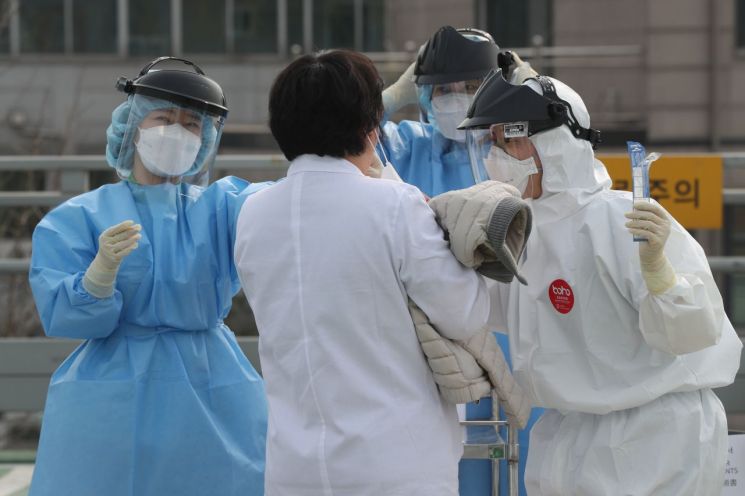
[Asia Economy Reporter Jeong Hyunjin] Amid the recent surge in COVID-19 cases in Japan, the Asahi Shimbun reported on the 3rd from Seoul that the reason South Korea has not experienced a 'medical collapse' like Italy is believed to be due to thorough testing, tracing, and treatment.
Regarding South Korea's testing, while there are criticisms in Japan about the accuracy, Korean medical officials emphasized, "If testing is not done first, the next steps of isolation or treatment cannot proceed and it becomes too late." Asahi introduced that South Korea has the capacity to conduct about 20,000 tests per day and recently installed 16 'walk-through' testing booths at Incheon International Airport to guard against the possibility of infection spread from incoming travelers.
Additionally, Asahi highlighted that South Korea is a 'cashless' society with minimal cash usage, allowing authorities to track which public transportation such as buses or subways people used, providing a basis to trace the movement paths of those who had contact with confirmed cases. The newspaper explained that a new system integrating card usage records and mobile phone location information system (GPS) data is operated, enabling health authorities to identify the movement paths of infected individuals within 10 minutes.
Asahi also reported that an application (app) has been developed, based on anonymous information released by authorities, allowing users to track confirmed patients' movement routes on a map, and many people are using it. While these measures are seen as helpful for quarantine efforts and privacy infringement concerns are not widespread, there have been criticisms regarding cases where real names of confirmed patients have been exposed on the internet.
From the treatment perspective, the newspaper evaluated that although there were incidents in the early stages of the cluster infection in Daegu where mild patients were hospitalized and severe patients died at home, the situation was resolved by establishing a system to distinguish between severe and non-severe patients. Asahi cited OECD data (2017) stating that South Korea has 12.3 hospital beds per 1,000 people, which is higher than the OECD average of 4.7, indicating a solid medical infrastructure from the outset.
South Korea does not have a mask culture like Japan, but through the COVID-19 outbreak, almost everyone on the subway wears masks, and even though there has been no government-imposed lockdown like in the US or Europe, people voluntarily refrain from going out. The newspaper interpreted this as "people's participation in quarantine efforts also seems to be effective."
© The Asia Business Daily(www.asiae.co.kr). All rights reserved.
![User Who Sold Erroneously Deposited Bitcoins to Repay Debt and Fund Entertainment... What Did the Supreme Court Decide in 2021? [Legal Issue Check]](https://cwcontent.asiae.co.kr/asiaresize/183/2026020910431234020_1770601391.png)















