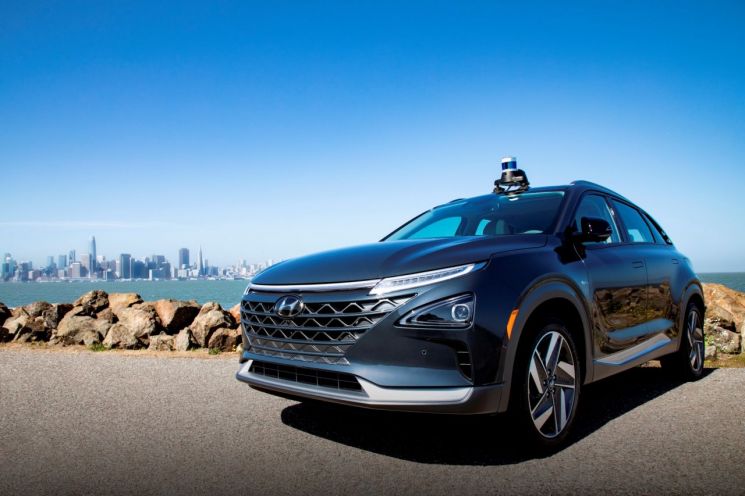
 Hyundai Motor's hydrogen electric vehicle Nexo equipped with Aurora's advanced autonomous driving system (Photo by Hyundai Motor)
[Asia Economy Reporter Suyeon Woo] Thanks to the Chinese government's proactive policies promoting eco-friendly vehicles, the Chinese hydrogen fuel cell vehicle market is expected to grow to a scale of 1 million units by 2030. As local automakers accelerate technology development, there are calls for Hyundai Motor Company to increase technological partnerships and secure a leading position in the Chinese market.
The Korea Automobile Manufacturers Association (KAMA) forecasted in its March 3 report titled "Current Status and Implications of Hydrogen Fuel Cell Vehicle Development in China" that the supply of hydrogen fuel cell vehicles in China will exceed 1 million units by 2030, making China likely to rapidly emerge as the world's largest market.
China is prioritizing the development of hydrogen fuel cell vehicles mainly for commercial vehicles that require long driving ranges. About ten Chinese automakers, including Shanghai Automotive Industry Corporation (SAIC), First Automobile Works (FAW), and Guangzhou Automobile Group (GAC), are actively developing passenger hydrogen fuel cell vehicles aiming for a 2025 launch. They are accelerating the training of specialized personnel and the development of core technologies through collaboration with regional technical universities such as Wuhan University of Technology and Tsinghua University.
In this process, Japan's Toyota is actively participating in hydrogen fuel cell vehicle technology development through technological partnerships with Chinese companies to secure a leading position in the rapidly growing Chinese hydrogen fuel cell vehicle market. Toyota has already decided to produce hydrogen fuel cell vehicles in China and signed technology partnerships with its joint ventures FAW and GAC. Through this, Toyota plans to introduce various hydrogen fuel cell vehicles equipped with its fuel cells to the Chinese market. Additionally, Toyota has formed hydrogen fuel cell partnerships with local commercial vehicle manufacturers and parts suppliers and jointly established a Future Technology Research Institute with Tsinghua University to nurture local talent.
The Korea Automobile Manufacturers Association emphasized that Korean automakers, which possess the world's best hydrogen fuel cell vehicle technology, should actively enter the early market by leveraging the current situation where China is increasing outsourcing to foreign companies to secure technological capabilities. Chung Manki, president of KAMA, stated, "Although Korean companies have the world's best technology, there is a risk of losing leadership to Japanese companies that are increasing their influence," adding, "If we secure the early Chinese market with our technology, we can establish a foothold to lead the global market through the Chinese market."
© The Asia Business Daily(www.asiae.co.kr). All rights reserved.
![User Who Sold Erroneously Deposited Bitcoins to Repay Debt and Fund Entertainment... What Did the Supreme Court Decide in 2021? [Legal Issue Check]](https://cwcontent.asiae.co.kr/asiaresize/183/2026020910431234020_1770601391.png)















