'Need for Unification' Responses Hit Lowest in a Year
Disagreement with 'Unification Daebak Theory' Also Increases
North Korea's Repeated Armed Provocations and Dialogue Refusals Since Last Year
One in four South Koreans believes that unification between South and North Korea is impossible. The number of people who think 'unification is necessary' has also slightly decreased over the past year.
According to the '2020 1st Quarter National Unification Opinion Survey' released on the 3rd by the National Unification Advisory Council (Minjupyeonghwa Tongil Jaumunhoe, Minjupyeongtong), 24.5% of the public responded that unification is impossible. This figure was 20.9% in the first quarter of last year, marking a 3.6 percentage point (p) increase over one year.
The response that unification is impossible has steadily increased over the past year. It was 20.6% in the second quarter of last year, 21.8% in the third quarter, and 24.4% in the fourth quarter, setting a new high each quarter.
The opinion that 'unification is necessary' is also gradually losing strength. It was 76.2% in the first quarter of last year but dropped to 69.2% in the first quarter of this year, the lowest in one year.
The proportion of people who agree with the view that 'if unification happens, our country will live better than now' is also decreasing.
This figure was 65.2% in the first quarter of last year but fell to 59.1% in the first quarter of this year, dropping into the 50% range.
The proportion of people who disagree with the 'unification jackpot' idea slightly increased from 33.3% in the first quarter of last year to 39.2% in the first quarter of this year.
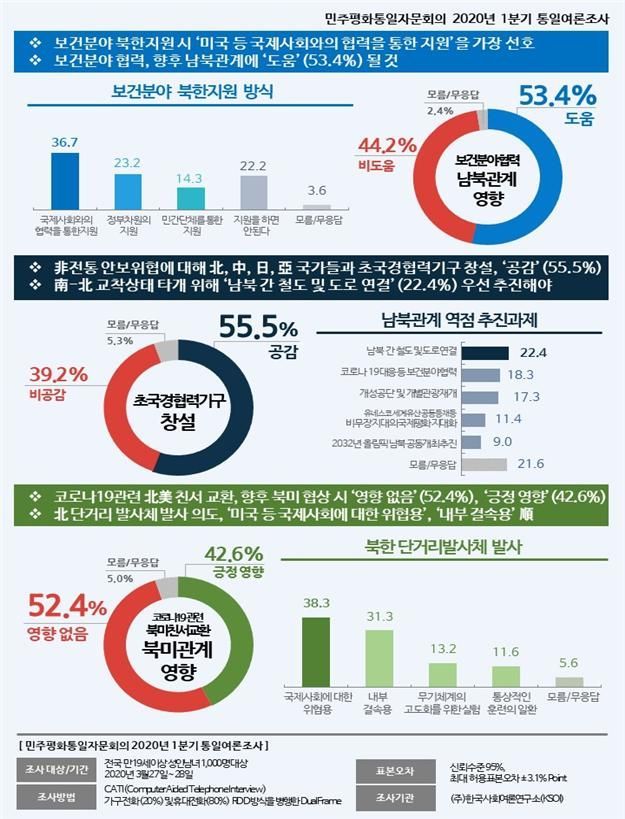
The percentage of respondents who see North Korea as a 'subject of cooperation and support' decreased from 52.4% to 44.2%, while those who see it as a 'subject of caution and hostility' increased from 28.9% to 36.1%.
Expectations for North Korea's reform and opening-up possibilities are also declining.
The proportion of respondents who believe North Korea's opening-up possibility is high dropped from 58.9% to 44.0%, while those who think it is low rose sharply from 37.6% to 52.6%.
The rising trend of negative views on unification is interpreted as a result of North Korea's continuous military provocations and the deadlock in inter-Korean and North Korea-US dialogues following the 'no deal' at the Hanoi North Korea-US summit in February last year. Since May last year, North Korea has conducted 17 missile launch tests. This year, it has carried out four projectile launches.
The 2020 1st Quarter National Unification Opinion Survey was conducted by the National Unification Advisory Council through the professional polling agency 'Korea Social Opinion Institute' from March 27 (Friday) to 28 (Saturday). It surveyed 1,000 adults nationwide via telephone interviews. The confidence level is 95% with a sampling error of ±3.1%p.
© The Asia Business Daily(www.asiae.co.kr). All rights reserved.
![Clutching a Stolen Dior Bag, Saying "I Hate Being Poor but Real"... The Grotesque Con of a "Human Knockoff" [Slate]](https://cwcontent.asiae.co.kr/asiaresize/183/2026021902243444107_1771435474.jpg)
















