Government Announces Emergency Disaster Relief Fund Criteria on the 3rd
How to Secure 9.1 Trillion Won
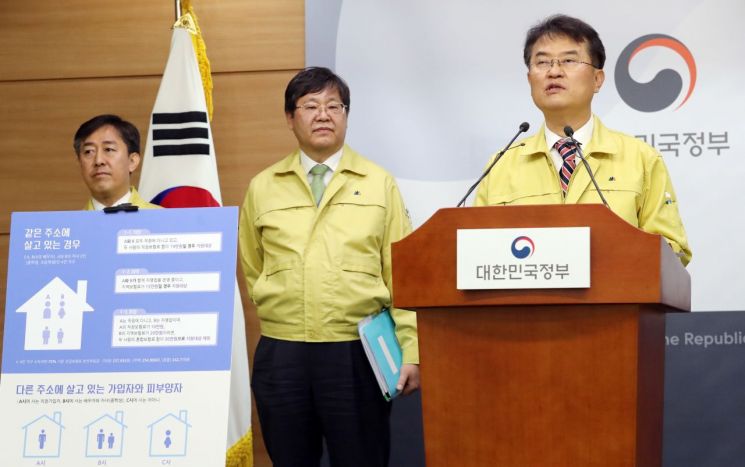
[Asia Economy Reporters Kim Hyunjung (Sejong), Joo Sangdon (Sejong), Jang Sehee] As the criteria for emergency disaster relief fund payments amid the spread of the novel coronavirus infection (COVID-19) have been finalized, attention is focused on how to secure the 9.1 trillion won funding to be injected into the market. The government plans to cover the related support amount as much as possible by cutting budgets for social overhead capital (SOC) projects, defense expenses, rural support, and official development assistance (ODA), but in reality, issuing deficit bonds seems inevitable.
According to multiple government ministries on the 3rd, the Ministry of Economy and Finance began expenditure restructuring work on the 2020 main budget (512 trillion won) together with each ministry from the end of last month. They considered reductions in costs due to the decline in international oil prices and interest rate cuts as common reduction items, and separately discussed reductions for unused projects from past years, projects that became impossible to proceed due to the COVID-19 situation, and non-essential projects by ministry. A senior government official explained, "We plan to reduce budgets by treating projects currently facing execution difficulties due to COVID-19 as unused," adding, "We are conducting a comprehensive review of projects from the previous year and past years as well."
The government previously announced that it would secure 7.1 trillion won by adjusting budgets for defense, medical benefits, environment, ODA, rural areas, and SOC. However, at present, it is difficult to expect reductions of more than a trillion won per ministry due to the unpredictable end of COVID-19 and the intertwined interests of each project.
One of the candidates for reduction is the ODA budget in the public diplomacy sector, which has inevitably been delayed or downsized due to COVID-19. This budget has expanded at the highest growth rate (11.4%) in the past five years, with about 3.5 trillion won allocated this year. In particular, overseas training related to this is expected to be suspended for the time being. Water supply and sewage projects, such as the smart water supply system classified as SOC projects, are also under review for restructuring. Among them, the government announced that it would newly execute about 19 projects this year targeting vulnerable areas to water accidents or special cities, metropolitan cities, and hub cities with excellent operational conditions, amounting to approximately 400 billion won.
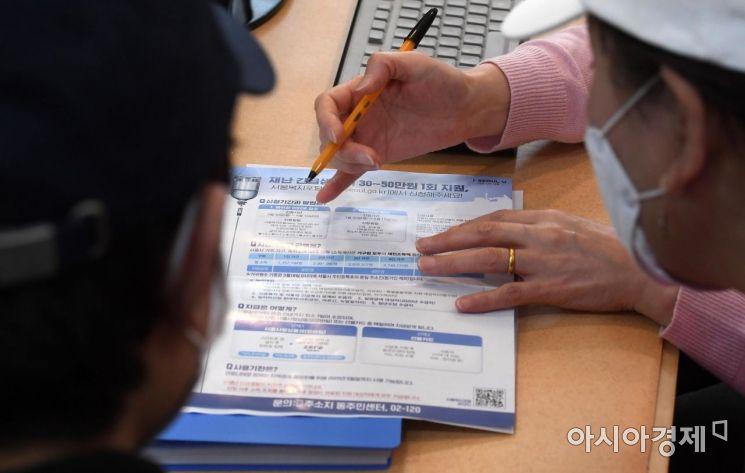 On the 31st, citizens visiting a community service center in Seoul are receiving consultations for applying for Seoul City's emergency disaster living expenses. Applications for Seoul City's emergency disaster living expenses are accepted through the Seoul Welfare Portal until May 15, and from April 16, in-person applications at community service centers are also available. Photo by Hyunmin Kim kimhyun81@
Regarding the defense budget, most of it is directly linked to military power, making it difficult to cut large chunks of the budget. The most positively reviewed reduction areas currently are the decrease in fuel costs due to the drop in international oil prices and a significant portion of the reserve forces training costs, which were virtually canceled in the first half of this year. As of last year, about 700 billion won was spent on fuel costs and about 170 billion won on reserve forces training within the defense budget. Additionally, research and development (R&D) costs in the industrial sector and the Ministry of Culture, Sports and Tourism’s budget related to the Tokyo Summer Olympics are also under consideration for cuts.
However, both inside and outside the government foresee that issuing deficit bonds is inevitable even after the government’s so-called "painful restructuring." During the 1998 International Monetary Fund (IMF) foreign exchange crisis, the Ministry of Economy and Finance implemented supplementary budgets with expenditure cuts without issuing deficit bonds, but ▲at that time, Korea was facing a national default crisis, and ▲currently, the basic background is very different as it is a global emergency situation due to COVID-19.
Moreover, the 2 trillion won local budget that must be secured from local governments cannot be guaranteed. Past cases of supplementary budget expenditure cuts (restructuring) include ▲85 trillion won in the first supplementary budget of 1998, ▲7 trillion won in the second supplementary budget of 1998, and ▲3 trillion won in the 2013 supplementary budget, but during the second supplementary budget of 1998 and the 2013 supplementary budget, deficit bonds of 7.9 trillion won and 13.8 trillion won were issued, respectively.
© The Asia Business Daily(www.asiae.co.kr). All rights reserved.
![From Hostess to Organ Seller to High Society... The Grotesque Scam of a "Human Counterfeit" Shaking the Korean Psyche [Slate]](https://cwcontent.asiae.co.kr/asiaresize/183/2026021902243444107_1771435474.jpg)

















