Government-wide Task Force Establishes Selection Principles for Support Recipients... Up to 1 Million KRW per Month
Same Household Based on Resident Registration... Separate Discussion on Exclusion Criteria for High-Value Asset Holders
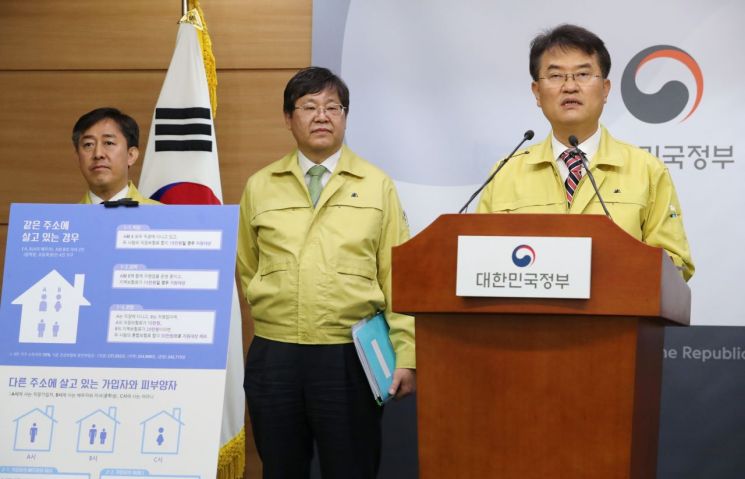
[Asia Economy Reporter Jo In-kyung] The government has decided to use health insurance premiums as the criterion for selecting recipients of the emergency disaster relief fund. Although those with high-value assets who pay low health insurance premiums will not receive the fund, the exclusion criteria will be established later.
A plan to assist those whose rapidly decreased income due to the COVID-19 pandemic has not yet been reflected in their current health insurance premiums will also be prepared and announced soon.
On the morning of the 3rd, the government held a 'Government-wide Task Force on Emergency Disaster Relief Fund' meeting chaired by Vice Minister Yoon Jong-in of the Ministry of the Interior and Safety, where the principles for selecting recipients of the emergency disaster relief fund were decided and announced.
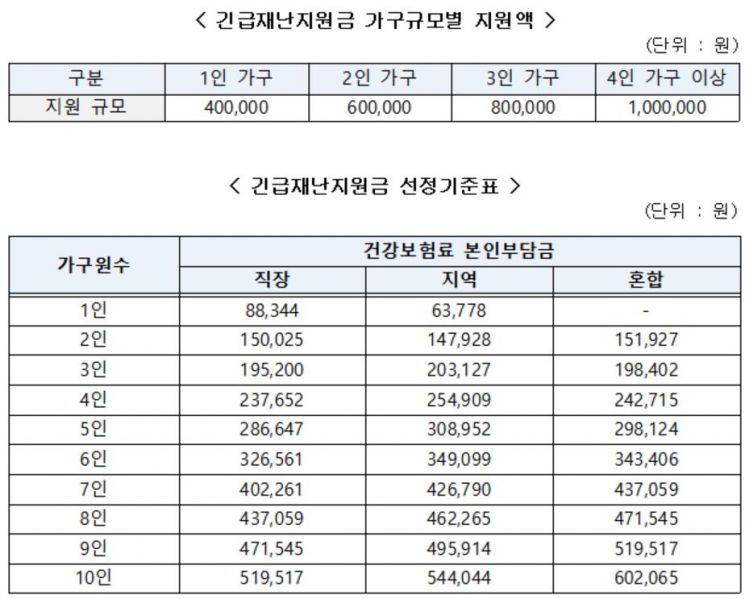
According to the decision, the total health insurance premiums imposed on household members as of March this year will be summed, and households falling within the bottom 70% will receive the relief fund. For a four-person household with workplace insurance, if the total health insurance premium is 237,000 KRW or less, they are eligible for the disaster relief fund. For a single-person household, the threshold is about 88,000 KRW; for two persons, 150,000 KRW; and for three persons, 195,000 KRW. If the household meets this criterion, a single-person household receives 400,000 KRW, a two-person household 600,000 KRW, a three-person household 800,000 KRW, and a four-person household 1,000,000 KRW.
The support fund is provided based on the 'household' rather than the individual, and detailed upper limits are set differently depending on whether there are two or more workplace (or regional) insured persons in one household or a mix of workplace and regional insured persons. For example, if both the insured person and their spouse work at workplaces and their combined workplace insurance premium is 190,000 KRW, they qualify for support.
Individuals can check their health insurance premiums via their payslips if they are workplace insured, or through health insurance payment notices if they are regionally insured. Information is also available on the Health Insurance Corporation website or call center.
The government explained the reason for using health insurance premiums as the criterion is that "it allows for relatively simple selection of recipients using the latest data, and citizens can easily estimate whether they qualify."
As of the 29th of last month, people registered together on the resident registration under the Resident Registration Act are considered the same household. However, spouses and children who are dependents of the health insurance subscriber are considered the same household even if their addresses differ.
The government decided to exclude high-asset individuals from recipients even if they fall within the bottom 70% income bracket based on health insurance premiums, with the criteria to be established through further review.
Additionally, for small business owners or self-employed individuals whose income sharply decreased due to the COVID-19 situation but whose March health insurance premiums do not reflect this, the government will coordinate with local governments to prepare various supplementary measures.
Vice Minister Yoon said, "We will prepare various supplementary measures so that local governments can make the final decision on support eligibility by reflecting income conditions at the time of application according to regional circumstances." Since the disaster relief fund is urgent support that must be quickly delivered to the people, the government plans to promptly prepare a supplementary budget bill and submit it to the National Assembly.
© The Asia Business Daily(www.asiae.co.kr). All rights reserved.


















