Increasing Domestic Flights and Launching Cargo Operations with Passenger Planes
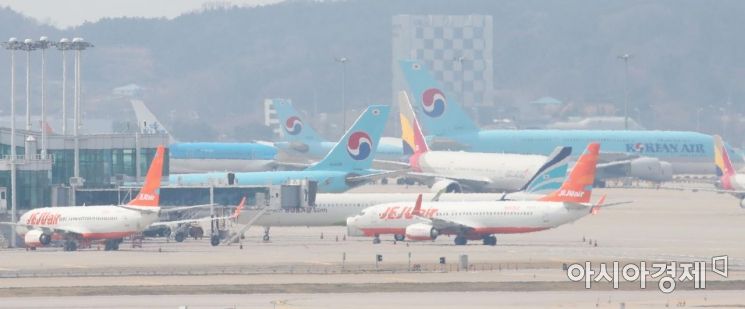 On the 2nd, aircraft are parked at the apron of Incheon International Airport. Photo by Mun Ho-nam munonam@
[Asia Economy Reporter Yu Je-hoon] Low-cost carriers (LCCs) pushed to the brink of collapse due to the novel coronavirus infection (COVID-19) are actively seeking lifelines for survival. They are increasing domestic flights in anticipation of a possible boost in domestic travel demand and exploring revenue sources such as cargo operations using passenger aircraft.
According to the industry on the 3rd, Jeju Air will increase a total of 92 flights on the Gimpo-Busan route from today until the 25th. The additional supply seats from this increase will reach about 17,400 seats. Recently, Jeju Air is also reportedly considering launching domestic routes from Yeosu Airport.
Jeju Air is not the only one considering expanding domestic routes. T’way Air, after increasing flights on the Daegu-Jeju route on the 29th of last month, plans to operate irregular flights on the Cheongju-Jeju route four times daily starting from the 25th. Air Busan has also decided to maintain the increased flights on the Gimpo/Busan-Jeju routes implemented last month for the time being.
The reason LCCs are increasing domestic flights is due to the improvement in supply and demand following large-scale flight reductions after the COVID-19 outbreak. For example, in the fourth week of February, the total number of domestic flights at Jeju Airport was 998 (including departures and arrivals), but in the fourth week of March, it dropped by about 25% to 746 flights. As a result, the load factors of each airline are reportedly maintaining a decent level of 80-90%.
This is also interpreted as a preemptive response based on expectations that existing overseas travel demand will shift to domestic travel demand. An airport official explained, "With the delay in the start of school terms at various educational institutions, student groups are noticeable on weekdays and family groups on weekends," adding, "It seems they have taken early measures keeping in mind the full-scale spring travelers."
In addition, some LCCs have started cargo operations using passenger aircraft. Jin Air, the only LCC possessing a medium-to-large aircraft, the B777-200ER, plans to operate belly cargo sales until the 13th. Belly cargo operations refer to the business of transporting air cargo using the lower cargo hold of passenger aircraft. The cargo capacity of this aircraft is about 15 tons. With the large-scale suspension of passenger flights, which account for 30-40% of air cargo supply, freight rates have recently been rising. Moreover, due to the frozen logistics network caused by COVID-19, there has been an increase in cases using air cargo for timely transportation of medical supplies and other goods despite the high rates, according to industry sources.
However, despite these 'desperate measures,' it is generally assessed that it is not easy to offset losses caused by the suspension of international flights. An industry official said, "Although this is a desperate measure taken while most aircraft are grounded, it will only be like putting a band-aid on a wound."
© The Asia Business Daily(www.asiae.co.kr). All rights reserved.

















