Mention of Article 80 of the Bank of Korea Act
"Considering lending to non-bank financial institutions if the situation worsens"
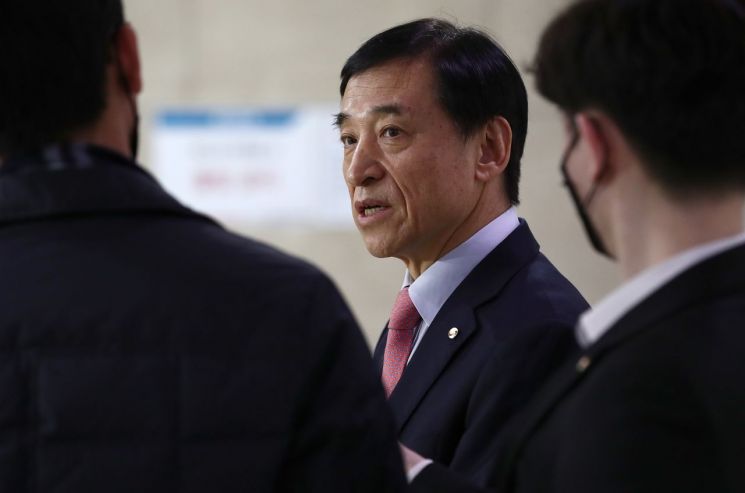
[Asia Economy Reporters Eunbyeol Kim, Sehee Jang] Lee Ju-yeol, Governor of the Bank of Korea, expressed his determination to directly lend to non-bank financial institutions such as securities firms to prevent a credit crunch if the financial market deteriorates further.
On the afternoon of the 2nd, Governor Lee convened an executive meeting and stated, "The Bank of Korea basically supports market stability through banks or open market operations," but added, "If the situation worsens, we may also consider lending to non-bank financial institutions under Article 80 of the Bank of Korea Act to stabilize the corporate bond market."
Article 80 of the Bank of Korea Act states that "if significant difficulties arise or are likely to arise in raising funds from financial institutions, the Bank may extend credit to profit-making enterprises engaged in financial business that are not financial institutions." This means that if market conditions worsen, the Bank of Korea can lend to "non-bank financial institutions," such as securities firms.
However, Governor Lee added a caveat, saying, "It will not exceed the scope of authority defined by law for the Bank of Korea, nor will there be preferential support for specific companies." This means that lending will be limited to non-bank financial institutions, and the Bank will not directly lend to specific companies. In a similar context, the Bank of Korea explained that it will not directly purchase corporate bonds or commercial papers (CP) of specific companies without government guarantees.
Governor Lee’s reference to Article 80 of the Bank of Korea Act is interpreted as a response to the recent instability in the financial market, which has increased the burden on securities firms. Recently, securities firms have been rushing to sell CPs in the market to raise margin call collateral for equity-linked securities (ELS), causing an increase in CP supply and a sharp drop in prices (a surge in interest rates). The project financing (PF) securitized commercial papers and short-term bonds (ABCP·ABSTB), which securities firms once competitively entered, have backfired. There are concerns that ABCP issued to support PF project securitization could trigger a secondary funding crisis, especially among small and medium-sized securities firms.
As concerns about the growing insolvency of securities firms have been reported, the financial market, particularly the bond market, has continued to be shaken. Therefore, it appears that the Bank of Korea has stepped in to send a message that "in emergencies, the Bank can provide loans."
On the same day, it was reported that securities firms participated more actively than banks in the Bank of Korea’s repurchase agreement (RP) purchase auction, which was conducted to expand liquidity supply to the market. The RP purchase auction attracted bids totaling 5.25 trillion won.
Meanwhile, Governor Lee also reviewed the financial market situation, including corporate bonds and CP, during the meeting.
According to the Bank of Korea, the maturity amount of corporate bonds issued by general companies from April to December this year is 20.6 trillion won (14.4 trillion won for AA-rated and above, 6.2 trillion won for A-rated and below), and the maturity amount of CP is 15.4 trillion won (10.7 trillion won for A1-rated, 4.7 trillion won for A2-rated and below), totaling 36 trillion won. The corporate bonds maturing in the second quarter amount to 8.9 trillion won, and CP to 11.4 trillion won.
The Bank of Korea stated that the maturity amount of high-grade corporate bonds (AA-rated and above) and CP (A1-rated) this year is 25.1 trillion won, and considering the market’s own demand for high-grade securities and the size of the bond stabilization fund (20 trillion won), refinancing is expected to proceed without significant difficulties. The maturity amount of lower-grade corporate bonds and CP is about 11 trillion won. The Bank of Korea said, "We expect that the P-CBO and the Korea Development Bank and Industrial Bank of Korea purchase programs (8.4 trillion won and 3.9 trillion won, respectively) will substantially support refinancing issuance."
Governor Lee said, "The bond stabilization fund started operating on the 1st, and liquidity supply through the Bank of Korea’s full allotment RP purchase began on the 2nd," adding, "Considering the maturity scale of corporate bonds, we believe that refinancing will be possible for the time being through the market’s own demand and bond stabilization fund purchases."
However, he emphasized, "Depending on the global development of COVID-19 and changes in the international financial market, the possibility of a credit crunch in the domestic financial market, including the corporate bond market, cannot be ruled out," and stressed, "The Bank of Korea must prepare safety measures to respond to emergency situations."
© The Asia Business Daily(www.asiae.co.kr). All rights reserved.

















