'Corona Blue', Depression and Lethargy Due to Large-Scale Infection Outbreak
7 out of 10 Citizens "Stressed by Infection Concerns"
Experts Emphasize "Psychological Quarantine"... Recommend Light Physical Activity and Regular Lifestyle
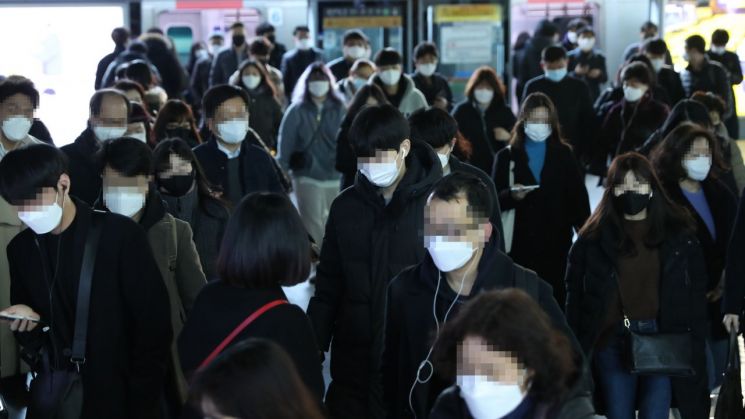 On the morning of the 11th of last month, citizens wearing masks are commuting to work through Sindorim Station in Guro-gu, Seoul. Photo by Yonhap News
[Asia Economy Reporter Kim Ga-yeon] As the novel coronavirus disease (COVID-19) pandemic prolongs, the number of citizens complaining of anxiety and depression is increasing. Social distancing to prevent infection, checking COVID-19 news, and tracking confirmed patients' movements?practically daily repetitive COVID-19-related routines?are causing stress.
Consequently, a new term, 'Corona Blue,' has emerged to describe this situation. 'Corona Blue' is a compound of 'COVID-19' and 'blue' (meaning depression). It refers to psychological symptoms such as depression or lethargy caused by disruptions to daily life due to the COVID-19 aftermath. This includes ▲frustration from social distancing and refraining from going out ▲excessive obsession with related news ▲health anxiety ▲blind faith in folk remedies.
Survey results show that about six out of ten citizens feel their daily lives have changed. According to the 'National COVID-19 Risk Perception Survey' commissioned by Myung Yoom-soon, president of the Korean Health Communication Association (professor at Seoul National University Graduate School of Public Health), to the polling agency Korea Research on the 4th of last month, 59.8% of respondents answered that "more than half of daily life seems to have stopped."
Also, 48.8% cited 'anxiety' as the emotion that comes to mind when they encounter COVID-19-related news. Other emotions identified were 'anger' at 21.6%, 'shock' at 12.6%, and 'fear' at 11.6%.
A significant number of citizens are also stressed due to fears of COVID-19 infection. A survey on the 'Status of Infectious Disease Stress' conducted by the job portal JobKorea targeting 5,037 adults found that 28.9% of respondents answered "stress is very high." Additionally, 44.7% answered "stress is somewhat high." In summary, seven out of ten respondents reported feeling stressed due to infection concerns.
Citizens express feelings of depression, anxiety, and fatigue due to the large-scale infection crisis. Some voices have called for simple guidance for psychological quarantine.
Office worker A (29) said, "I used to relieve stress by going out to eat delicious food with colleagues and friends, but since I have hardly made plans for months, stress keeps building up, and I feel like I'm becoming irritable."
A added, "I tried various things to change my mood, but since what I can do inside the house is limited, it didn't have much effect. These days, even though the weather is nice, thinking that I can't go outside makes me feel more and more depressed."
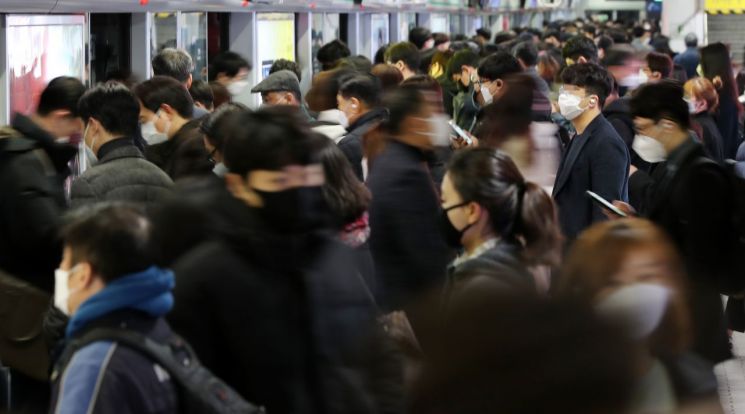 On the morning of the 13th of last month, citizens wearing masks are boarding and alighting the subway at Gangnam Station on Seoul Subway Line 2 for their commute. Photo by Yonhap News
Job seeker B (23) said, "Feeling lethargic is a problem, but I think I worry too much about the possibility of infection. That itself is stress."
B added, "Since this has been going on for months, sometimes it feels hard to breathe. My hands even tremble at the sound of safety alerts. I know others also feel significant stress like this, so I hope the government provides simple psychological stability guidance, like 'personal hygiene rules.'"
Experts emphasize the importance of psychological quarantine for stress and recommend communication with people around and light physical activity.
Professor Park Hye-ri of the Department of Neurology at Ilsan Paik Hospital recently said on YTN Radio's 'Choi Hyung-jin's O News,' "With social distancing, lifestyle patterns have changed, and due to worries about COVID-19, the number of patients complaining of insomnia and visiting hospitals is increasing," recommending maintaining regular lifestyle habits.
Professor Yoon Dae-hyun of the Department of Mental Health at Seoul National University said on last month's KBS Radio 'Kim Kyung-rae's Strong Current,' "Anxiety rises due to COVID-19. Anxiety itself is not pathological, but when anxiety increases, it can cause various brain fatigue and excessively strengthen stress responses," citing symptoms such as insomnia, panic disorder, and burnout.
Professor Yoon said, "The easiest way is to take a light walk. Light physical activity is as effective as anti-stress and antidepressant medications," recommending "wearing a mask and walking during quiet times and in quiet places." He also advised maintaining physical distance while communicating with friends and family.
© The Asia Business Daily(www.asiae.co.kr). All rights reserved.


















