[Hidden Business Story] Mao Zedong, Deng Xiaoping, Xi Jinping and Other Chinese Presidents' Beloved Liquor 'Moutai'
Brand Value Rated Higher Than 'Samsung Electronics' with Just One Drink
Shedding the Stigma of 'Bribery Liquor' to Become the 'National Liquor'
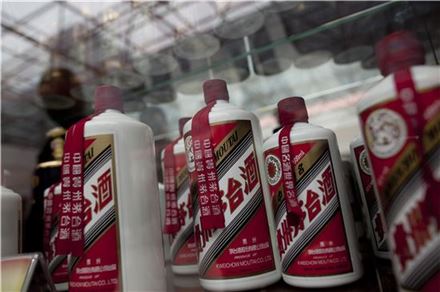 Maotai, a premium baijiu also known as China's national liquor (Photo by Bloomberg News)
[Asia Economy Reporter Yoon Shin-won] In 1972, during the historic meeting between former Chinese Chairman Mao Zedong (毛澤東) and former U.S. President Richard Nixon, Mao Zedong served Maotai liquor, which is made primarily from sorghum. It is said that former Chairman Deng Xiaoping also drank twenty-seven glasses of Maotai after arresting the leaders of the Cultural Revolution. At the 2018 dinner between President Xi Jinping and North Korean State Affairs Commission Chairman Kim Jong-un, Maotai liquor also made an appearance without fail. The company producing this Maotai liquor, 'Guizhou Maotai (貴州茅台·Guizhou Maotai),' which has been part of significant moments in Chinese history, is also highly regarded in the liquor industry.
Guizhou Maotai earns over 52.6 billion yuan (approximately 9 trillion KRW) annually from Maotai liquor alone. Last year, Guizhou Maotai became the first company in the Chinese stock market to surpass Alibaba and Tencent, reaching a stock price of 1,000 yuan (about 174,000 KRW). Currently, its market capitalization has exceeded 1.4 trillion yuan (approximately 243.5 trillion KRW). In terms of brand value, it ranks 35th worldwide and 5th within China, surpassing Samsung Electronics, which holds the highest brand value domestically.
The Secret of Guizhou Maotai
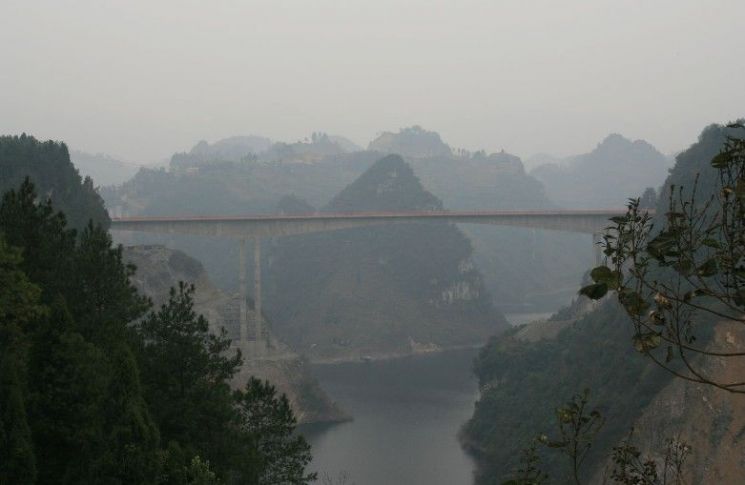
Maotai liquor is considered one of the world's three major distilled spirits alongside France's Cognac and Scotland's Scotch whisky. This is understandable, as the history of Maotai liquor dates back to 135 BC. Records in Sima Qian's (司馬遷) "Records of the Grand Historian" (史記), specifically the "Southwest Yi Lie Zhuan," mention that Maotai liquor was presented to Emperor Wu of Han in 135 BC. This liquor is produced exclusively in the village of Maotai in Renhuai City, Guizhou Province (貴州). The headquarters of Guizhou Maotai is also located here.
In fact, only liquor made in the Maotai village is recognized as authentic "Maotai liquor." Even if the same raw materials and methods are used elsewhere, there is a qualitative difference from the liquor produced in Maotai village. The village is a first-class pristine area without factories, dams, or power plants, and it is said that special microorganisms floating in the air impart Maotai liquor's unique taste and aroma during production. Therefore, even after production, the liquor must be aged in this village for at least three years to become "genuine Maotai liquor."
The production process itself is quite complex. The raw materials are steamed nine times, fermented with qu (fermentation starter) eight times, and distilled seven times. The liquor is then aged in sealed jars for over three years to evaporate all harmful substances. Afterward, different Maotai liquors with varying storage periods, aromas, and alcohol content are blended and filtered. The entire process takes five years. Due to these procedures and the limited production area, the annual production volume remains around 20,000 tons, which cannot meet consumption demand.
Guizhou Maotai, with its distinctive taste, meticulous production method, and rarity, is also relatively expensive. Typical Maotai liquor costs between 1,300 and 2,000 yuan per bottle (approximately 220,000 to 350,000 KRW). The second-largest company in the Baijiu category, Wuliangye (五粮液·Wuliangye), sells at around 1,000 yuan (about 170,000 KRW). Moreover, aged Maotai liquors can cost tens of millions of KRW, with a bottle aged over 30 years having been auctioned for 1.476 billion KRW. The Maotai liquor served by President Xi to Chairman Kim was reportedly priced in the 200 million KRW range. Because of this, even Maotai liquor sold in department stores or duty-free shops is sometimes counterfeit.
'Bribery' Synonymous with 'Maotai Liquor'
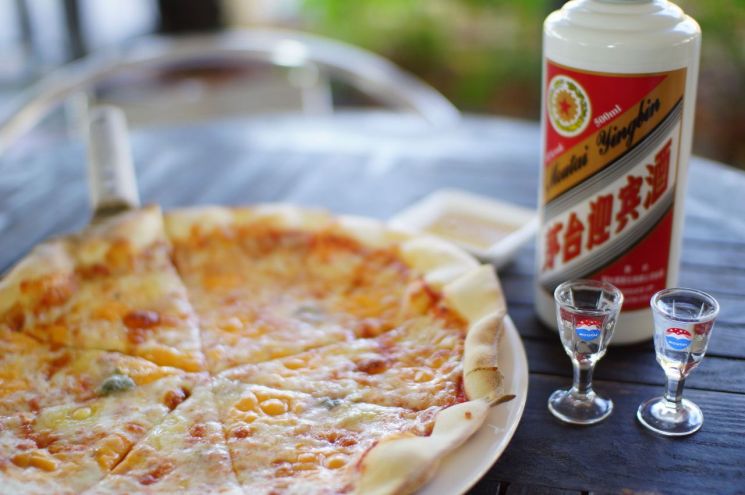
As the storage period lengthens, the price of Maotai liquor rises, earning it the nickname "bribery liquor." Even the cheaper bottles exceed 1,000 yuan, and vintage Maotai liquors can surpass 1 million yuan, making them frequently used for gifts or bribes. There was even a survey indicating that about half of Baijiu buyers were government agencies. A popular saying reflecting Maotai's association with bribery was, "Those who buy Maotai do not drink it, and those who drink Maotai do not need to buy it."
In fact, when Xi Jinping's administration launched the "war on corruption" at the end of 2012 and tightened regulations on "three public expenses" (official vehicle, travel, and entertainment expenses), Guizhou Maotai was hit hard. Maotai liquor, which had been a staple at gatherings of high-ranking officials and business leaders, disappeared, causing a sharp drop in sales and a fall in stock price from around 200 yuan to about 120 yuan in early 2014.
Guizhou Maotai then undertook bold changes. Until then focused solely on premium products, Guizhou Maotai launched mid- to low-priced brands. It also introduced fruit liquors targeting female consumers, expanding its customer base beyond high-ranking men. Products with lower alcohol content aimed at people in their 20s and 30s were also released, opening new avenues.
By 2015, the stock price recovered to the 200 yuan range, rose to 500 yuan in 2017, and finally reached 1,000 yuan in the Chinese stock market for the first time last year. Unlike the 1% sales growth in 2014, recent years have seen double-digit sales growth. Although most of Guizhou Maotai's sales still come from premium liquors, the sales ratio of mid- to low-priced brands is gradually increasing, elevating it to the status of a "national liquor."
© The Asia Business Daily(www.asiae.co.kr). All rights reserved.

![Clutching a Stolen Dior Bag, Saying "I Hate Being Poor but Real"... The Grotesque Con of a "Human Knockoff" [Slate]](https://cwcontent.asiae.co.kr/asiaresize/183/2026021902243444107_1771435474.jpg)
















