KCTU Announces 'COVID-19 Affected Worker Consultation Cases'
Consultation Numbers by Industry: Accommodation and Food Service, Manufacturing Lead
Dismissal and Voluntary Resignation Consultations Highest at 20.4% in Late March
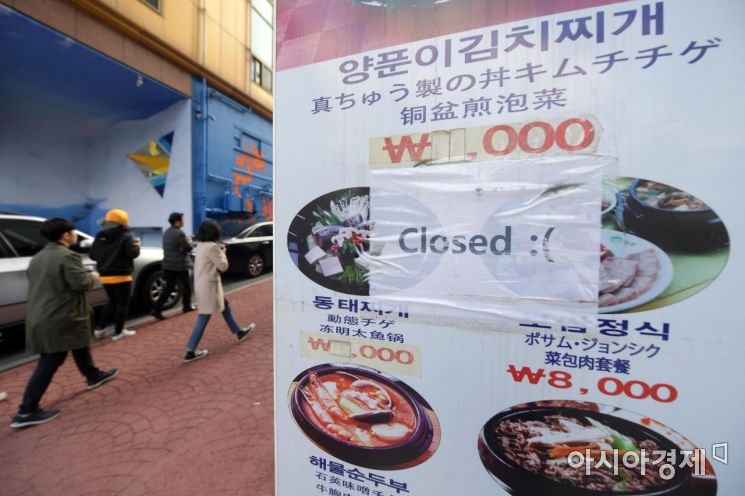
[Asia Economy Reporter Kim Bo-kyung] "Due to COVID-19, there are no customers at the restaurant, and they are telling me to quit because it's hard to operate. I was notified on the same day. I understand, but it feels very unfair."
"I have been working at an auto parts manufacturing company for three years, but due to a sharp drop in sales, I was put on unpaid leave for a month. However, during the unpaid leave period, the employer pressured me to resign, and I submitted my resignation letter on the 31st of last month. Can I receive unemployment benefits?"
As the impact of the novel coronavirus infection (COVID-19) prolongs, the distress in the employment sector is deepening. In the early stages of the COVID-19 outbreak, employers requested workers to use annual leave or unpaid leave, but now the situation is worsening with employers pressuring resignations or unilaterally notifying dismissals.
On the 1st, the Korean Confederation of Trade Unions (KCTU) announced 'COVID-19 Worker Damage Consultation Cases' at the KCTU conference room located in Jung-gu, Seoul. This is an analysis of 153 COVID-19 damage consultations (22.7%) out of 673 consultations received during February and March.
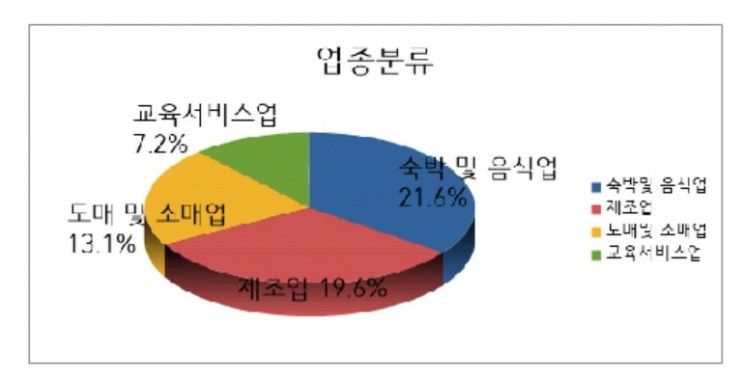
By industry, the number of consultations were: accommodation and food service 33 cases (21.6%), manufacturing 30 cases (19.6%), transportation and warehousing 23 cases (15%), wholesale and retail trade 20 cases (13.1%), education services 11 cases (7.2%), health and social welfare services 10 cases (6.5%), among others.
Choi Jeong-woo, Director of the Unorganized Strategy and Organization Office at KCTU, explained, "Physical distancing shows that the damage in the food service industry is severe," adding, "Damage is expanding not only in crisis industries such as tourism, aviation, accommodation, and food service but also across all industrial workers."
He stated, "It was confirmed that damage is concentrated especially on low-wage, unstable workers in small workplaces without labor unions," and "As social and economic activities shrink due to the COVID-19 crisis, vulnerable groups and workers in small workplaces are taking the direct hit."
By type of consultation, unpaid leave (19.5%), inquiries about suspension pay (16.6%), and dismissal or pressured resignation (14.2%) were the most common.
In particular, while consultations about forced use of annual leave and unpaid leave were frequent in the early spread of COVID-19, recently consultations about dismissal and pressured resignation have become the majority.
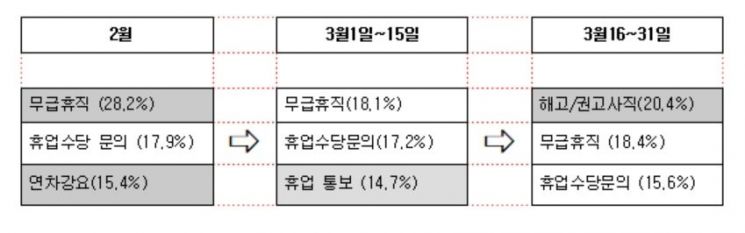
Looking at consultation types by period, in February unpaid leave (28.2%), suspension pay inquiries (17.9%), and forced annual leave (15.4%) were most common; in mid-March unpaid leave (18.1%), suspension pay inquiries (17.2%), and suspension notifications (14.7%) were prevalent. However, by the end of March, dismissal and pressured resignation consultations (20.4%) were the highest, followed by unpaid leave (18.4%) and suspension pay inquiries (15.6%).
As COVID-19 prolongs, the pattern of worker damage that began with forced use of annual leave has worsened through unpaid leave and suspension to pressured resignation and dismissal.
Director Choi said, "In February, consultations about forced use of annual leave and unpaid leave increased, but by March, the trend shifted to suspension notifications and dismissals," and argued, "Corporate support without a ban on dismissal during disaster periods is like 'pouring water into a bottomless jar.'"
KCTU demanded the government implement measures to prevent damage at the workplace, including ▲ban on dismissal during disaster situations and guarantee of total employment ▲corporate support premised on dismissal prohibition ▲measures against dismissal of indirectly employed workers and elimination of blind spots in employment retention subsidies ▲significant relaxation of application requirements for employment retention subsidies and unemployment benefits.
Meanwhile, starting this month, KCTU will operate a COVID-19 affected workers' reporting and consultation center. They also plan to conduct a nationwide campaign promoting union membership titled "Labor Vaccine Against Dismissal, Labor Union."
© The Asia Business Daily(www.asiae.co.kr). All rights reserved.



















