Surian, Analysis of COVID-19 Spread Impact
If School Opens on the 6th, Outbreak Ends on the 3rd of Next Month
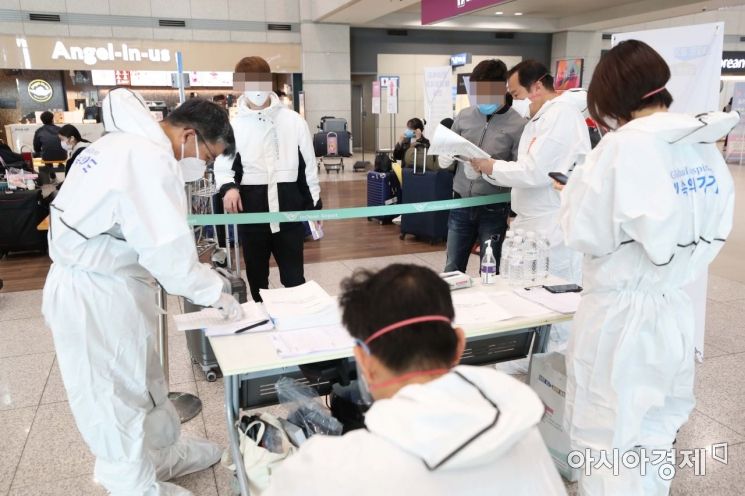 On the 1st, when the mandatory 2-week self-quarantine for all incoming travelers from abroad began, arrivals at Terminal 1 of Incheon International Airport were registering their names to board the special airport buses equipped with full quarantine measures for overseas arrivals. Photo by Moon Honam munonam@
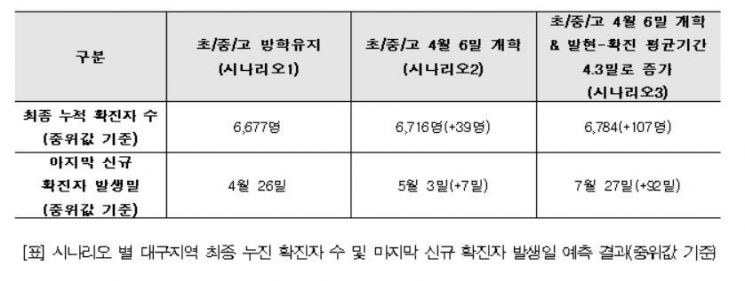
[Asia Economy Reporter Junho Hwang] A study has revealed that if schools at all levels in the Daegu region reopen on the 6th of this month, the end of the novel coronavirus infection (COVID-19) is expected by the 3rd of next month. However, if confirmed cases surge as they did when Shincheonji cases first appeared after reopening on the 6th, it is predicted that the last confirmed case will occur around July 27. On the other hand, if the current vacation period is maintained, the study results indicate that the last confirmed case will appear by the 26th of this month.
If schools reopen on the 6th, the last confirmed case will be on the 3rd of next month
On the 2nd, the Infectious Disease Research Team at the National Institute for Mathematical Sciences announced these findings after developing a micro-simulation model that reproduced the existing COVID-19 confirmed cases in the Daegu region.
The research team recreated the COVID-19 confirmed cases in Daegu up to the 26th of last month using a virtual population group of the same size as Daegu's population.
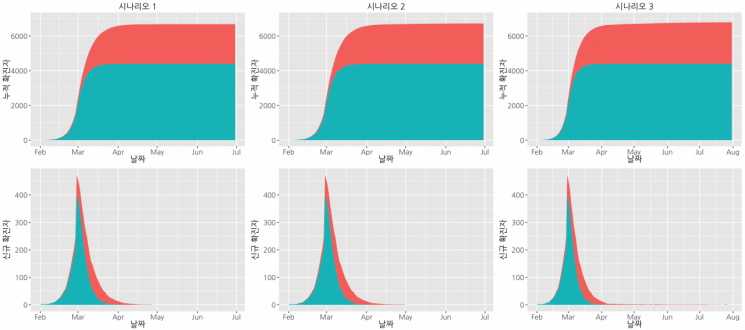
Based on this, the team analyzed the impact on COVID-19 spread under scenarios such as continuing school vacations for elementary, middle, and high schools, reopening schools on the 6th, and reopening on the 6th with the average period from symptom onset to confirmation increasing again to 4.3 days.
According to the median values for each scenario, the final cumulative number of confirmed cases in Daegu is expected to range from 6,677 to 6,784, with up to 107 additional cases possible. The date of the last new confirmed case (end of the outbreak) is predicted to vary by up to 92 days, from the 26th of this month to July 27.
Among the scenarios, maintaining the vacation period results in the earliest end of COVID-19, with the last confirmed case appearing on the 26th of this month. Reopening schools on the 6th is analyzed to lead to the end of the outbreak by the 3rd of next month. If schools reopen on the 6th and the average period from symptom onset to confirmation remains at 4.3 days, the end of COVID-19 is expected only by July 27.
Daegu Shincheonji members have 9.3 times higher COVID-19 infection rate
The research team stated that through this study, the COVID-19 outbreak in Daegu became a hotspot with the Shincheonji member group as a high-risk cluster, and the infection rate among Shincheonji members was found to be 575 times higher than that of the general population. Assuming Daegu's population is 2.5 million and the Shincheonji members number 9,000, the cumulative infection rate among Shincheonji members reaches 49.63%. Meanwhile, the cumulative infection rate among non-Shincheonji citizens is 0.08%.
However, under the assumption that each individual can be infected through contact with infected persons in households, workplaces/schools, and communities (religious and social gatherings), the infection probability for Shincheonji members in Daegu is analyzed to be 9.3 times higher than that of the general population. This analysis considers the condition that individuals can be infected through contact in households, workplaces/schools, and communities, and that after the isolation of Shincheonji members, the average period from symptom onset to confirmation shortened from 4.3 days to 2.7 days.
Son Woosik, head of the Infectious Disease Research Team at the National Institute for Mathematical Sciences, explained, "Although this study was conducted under the assumption that no new infections are introduced into Daegu from other regions, it is significant in that it developed a model to understand the COVID-19 outbreak in Daegu and predict infections within schools."
The research team plans to continue studies on infectious disease spread analysis and prediction models that incorporate inter-regional population movement and the entry of patients in the incubation period of overseas infections to enable more accurate forecasts and analyses of control policy effects in the future.
© The Asia Business Daily(www.asiae.co.kr). All rights reserved.



















