Posting Banners at Prime Spots with High Foot Traffic Marks the 'Opening'
Main Race Toward the Gold Badge Runs for Two Weeks Until Midnight on the 15th
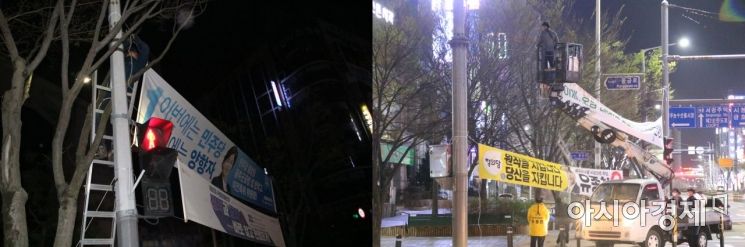 At midnight on the 2nd, the curtain rose on the full-scale election campaign for the April 15 general election. The photo shows the hanging of candidate banners at Punggeum Intersection in Seo-gu, Gwangju Metropolitan City.
[Asia Economy Honam Reporting Headquarters, Reporter Yoon Jamin] Around 11:30 p.m. on the 1st, at Punggeum Intersection in Geumho-dong, Seo-gu, Gwangju Metropolitan City, known for its heavy foot traffic. Men carrying ladders and ropes gathered as if by appointment, breaking through the thick darkness.
They were a group trying to hang banners in so-called "prime spots" that are highly visible to voters, just about 10 minutes before midnight on the 2nd, when the official campaign period for the 21st National Assembly election begins.
Posting banners before midnight on the 2nd is a violation of election law. Perhaps for this reason, no banners were hung yet, but ladders were set up and banners placed underneath, as if marking their territory to hang them immediately once the time arrived.
This tense standoff is explained by a banner company official as a necessity for candidates, who only have one body during the campaign period, to post banners in good locations to promote themselves even a little more.
The men lingering around the prepared spots for hanging banners exuded a tension reminiscent of track athletes waiting for the starting gun.
Election Commission staff were also visible, monitoring for election law violations such as posting banners earlier than the designated time.
Around 11:45 p.m., when a company climbed a ladder to check the size and position for hanging a banner, an Election Commission staff member stopped them, saying, "You can hang it starting at 12 o'clock."
Not long after, a man who frequently checked his phone clock shouted, "Let's hang it," and the men moved in unison. One held the ladder, another climbed up to tie the banner strings.
Another man stood back and shouted directions like "To the right," "To the left," to ensure the banner was level.
It took about 10 minutes to hang one banner. Within 20 minutes, three banners were hung at Punggeum Intersection.
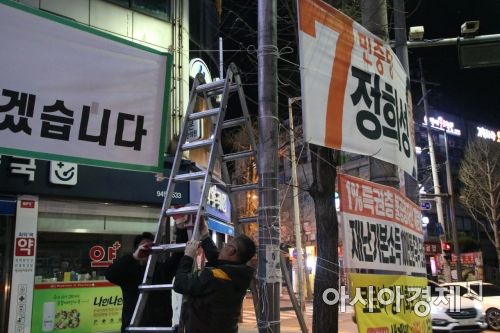 At midnight on the 2nd, banners of each candidate were hung at Yeonggwangtongsageori in Gwangsan-gu, Gwangju Metropolitan City.
Around the same time, Yeonggwangtong Intersection in Gwangsan-gu, another area known for heavy foot traffic, was also bustling.
Though it was late and there were few people and little vehicle traffic, a similar tense atmosphere prevailed.
This place is famously a prime spot, so during election season, banners are posted here and there. Three banners were quickly hung here as well.
The men who finished packed up ladders and equipment and hurried off to hang banners at other locations.
Mr. Kim, a banner company official met here, said, "Unlike local elections, there are fewer candidates, and each party had already preemptively occupied spots with party-related banners, so there was no fight over locations. Still, to hang all the banners at each place, we have to hurry until about 3 a.m."
Thus, the curtain rose on the campaign for the 21st National Assembly election and by-elections on April 15. A fierce main race with no retreat will unfold over two weeks until midnight on election day.
Candidates who have thrown themselves into this "war without gunfire" aiming for the gold badge will put all their effort into winning voters' hearts.
During this period, candidates and their spouses (or one registered direct relative in place of the spouse), election managers, and election workers may wear sashes, badges, or carry other items to conduct election campaigns.
They may also hang campaign banners on the streets, and candidates, election managers, election office heads, election workers, or designated persons authorized to campaign may use vehicles equipped with loudspeakers to give speeches or hold dialogues in public places.
With the revision of election law, full-time employees of public institutions are also allowed to participate in election campaigning.
© The Asia Business Daily(www.asiae.co.kr). All rights reserved.


















