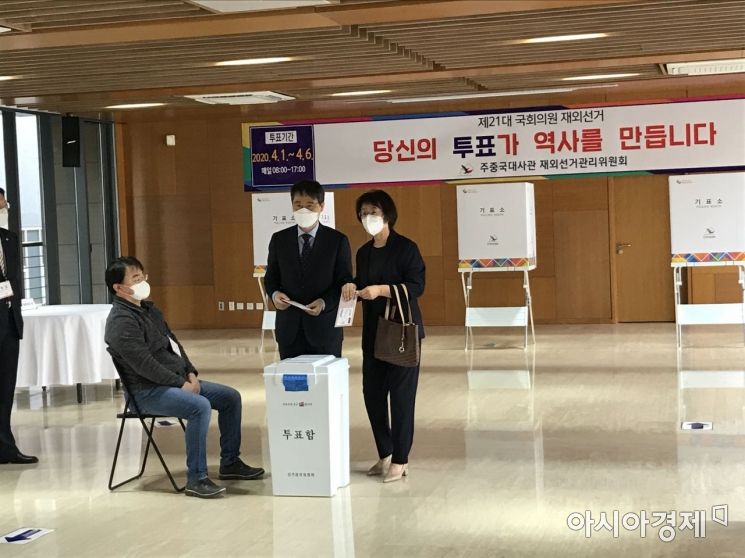
[Asia Economy Beijing=Special Correspondent Sunmi Park] Overseas voting for the 21st National Assembly election began on the 1st for voters residing abroad. Jang Ha-sung, the Ambassador of the Republic of Korea to China, expressed relief that polling stations were set up in nine regions across China, excluding Wuhan, calling it "a great relief."
At 8:50 a.m. local time that day, Ambassador Jang and his spouse visited the polling station established inside the Embassy of the Republic of Korea in China. After voting, Ambassador Jang said, "It is regrettable that overseas Koreans in the U.S. and other regions cannot vote due to COVID-19, but it is a great relief that overseas voting is possible here in China."
However, he expressed concern that the turnout might be low due to China's strengthened COVID-19 prevention measures. Ambassador Jang stated, "Many of our nationals in China registered in advance, but due to the enhanced COVID-19 controls, many have not yet been able to enter China, and movement is restricted. Some are currently in quarantine. Therefore, I am worried whether the voting will reach the expected level."
Regarding the polling station's quarantine measures, he explained, "From the entrance of the polling station, temperature checks are conducted, and if anyone has a fever, arrangements are made for them to vote in a separate area. We are doing our best. Also, we inform overseas Koreans coming from other regions about quarantine guidelines in advance."
Additionally, he revealed that he recently met with officials from the Chinese Ministry of Foreign Affairs to discuss Korea-China cooperation related to COVID-19. He said, "We discussed strengthening cooperation between the two countries as the COVID-19 situation stabilizes, and providing mutual convenience for the entry of businesspeople and international students. Since businesspeople can visit each other using health certificates recognized by both countries, we expect positive outcomes."
The overseas voting, held daily from 8 a.m. to 5 p.m. from the 1st to the 6th, is expected to have the worst turnout in history. Due to the COVID-19 pandemic, overseas election offices in many countries have been suspended, preventing half of overseas voters from voting. So far, overseas election offices have been suspended in 65 diplomatic missions across 40 countries, including the Consulate General in Wuhan, China; the Consulate General in New York, USA; the Consulate General in Los Angeles, USA; and the Consulate General in Frankfurt, Germany.
According to the Korean Embassy in China, the total number of overseas Korean voters registered in China is 20,549, with 4,291 in the Beijing jurisdiction. Polling stations have been set up in nine regions across China, excluding Wuhan.
A Korean resident who visited the polling station that day said, "I work at an auto parts company, and due to COVID-19, work has significantly decreased, making things difficult. During these tough times, I came out to vote to exercise my rights as a citizen. It is regrettable that many Koreans want to vote but cannot leave their homes to do so."
At 8 a.m. that day, staff wearing white protective suits, masks, and goggles were stationed in a somewhat strict security posture in front of the main gate of the Embassy of the Republic of Korea in China. This was a noticeably different scene compared to the usual deployment of only security guards. This special measure was in response to the Chinese authorities' "strengthened quarantine" order due to the special circumstances of the COVID-19 spread and the commencement of overseas voting for the 21st National Assembly election.
From 8 a.m., Korean residents wearing masks began to appear one by one to vote. However, despite it being before working hours, the turnout was somewhat sparse due to the COVID-19 situation. At the main gate entrance, election staff wearing masks conducted temperature checks on entrants. Masks must be worn, and only those with a body temperature below 37.3°C are allowed entry. Anyone with a temperature of 37.3°C or higher is not permitted inside and must vote at a temporary polling station set up next to the entrance. After voting, those with a fever are guided to a hospital for nucleic acid testing.
© The Asia Business Daily(www.asiae.co.kr). All rights reserved.

















