Only Production Lines with High Domestic Demand for Palisade and GV80 Operate Overtime
Production Planning Challenging Due to Unpredictable Global Impact of COVID-19
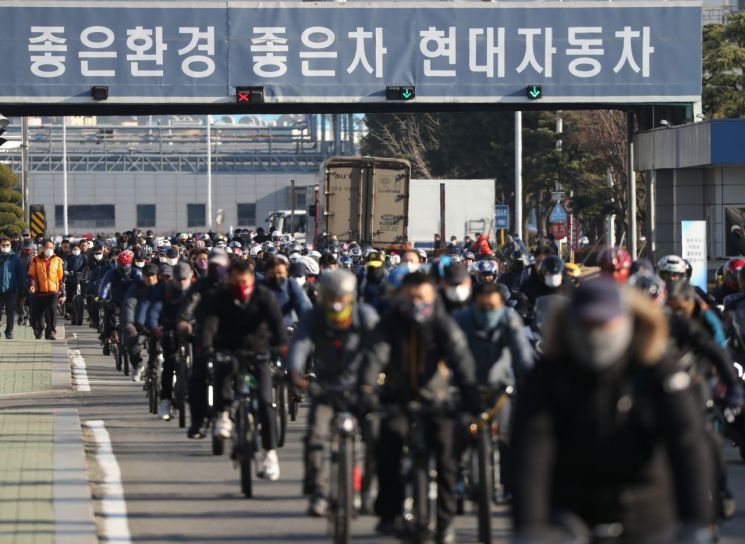
[Asia Economy Reporter Kim Ji-hee] Hyundai Motor Company's weekend overtime work, which resumed last month after about a month-long pause, has become precarious once again. This is due to the blockage of export routes to major automobile markets such as the United States and Europe amid the impact of the novel coronavirus disease (COVID-19). Hyundai plans to proceed with weekend overtime work focusing on models with high domestic waiting demand, but even that is uncertain.
According to industry sources on the 1st, Hyundai Motor's Ulsan plant will conduct special production overtime only at Plant 2, Plant 4 Line 1, and Plant 5 Line 1 this weekend. Plants 1 and 3 in Ulsan and the Asan plant will not operate overtime. For the next three weeks, only Plant 4 Line 1 has a special overtime plan in place.
This decision comes as a result of the global spread of COVID-19, which has halted export volumes accounting for about 70% of Hyundai's total production. In the North American market, dealers already have considerable inventory, and sales in major European countries have virtually come to a standstill. Since major countries worldwide have shut down economic activities and suspended cross-border movement, overseas port conditions are also a variable.
Accordingly, Hyundai is interpreted to have adopted a 'selection and concentration' strategy to accelerate production only for models with a backlog of domestic orders. Plants 2 and 4, which will operate this weekend, produce models such as the Palisade and Genesis GV80, which have waiting periods exceeding six months. Plant 5 Line 1 also produces the entire Genesis sedan lineup, including the recently fully redesigned G80.
Weekend overtime work at Hyundai's domestic plants resumed in early last month. Previously, in February, when the spread of COVID-19 in China disrupted the supply of wiring harness parts produced locally, Hyundai temporarily shut down each plant for about ten days and simultaneously canceled all weekend overtime work. From March, when parts supply began to stabilize, Hyundai focused on recovering losses by conducting full weekend overtime work.
The problem is the high uncertainty of the current overtime work plan. It is difficult to predict when the global export routes closed due to COVID-19 will reopen, and the possibility of supply issues similar to the previous wiring harness incident cannot be ruled out. Therefore, Hyundai decided to establish weekly production plans instead of a monthly overall production plan for April.
On the production floor, there are already talks of operating 'empty pitch' lines where conveyor belts run empty, as was the case in February and March, and even the possibility of additional shutdowns is being discussed. Discussions on special extended working hours, which Hyundai labor and management were reviewing to make up for production volume, have been put on hold for now.
An industry official said, "In a situation where it is difficult to predict how long the global shutdown and demand contraction due to COVID-19 will continue, Hyundai, whose domestic plants have a high proportion of export volumes, is expected to consider various options. While they will try to avoid additional shutdowns as much as possible, the possibility cannot be completely ruled out."
© The Asia Business Daily(www.asiae.co.kr). All rights reserved.
![User Who Sold Erroneously Deposited Bitcoins to Repay Debt and Fund Entertainment... What Did the Supreme Court Decide in 2021? [Legal Issue Check]](https://cwcontent.asiae.co.kr/asiaresize/183/2026020910431234020_1770601391.png)
















