Deliberation and Resolution on Strengthening Technology Protection Measures for Small and Medium Enterprises
[Asia Economy Reporter Kim Daeseop] The Ministry of SMEs and Startups will provide security solutions for smart factories. It also plans to activate the transfer and transaction of small and medium-sized enterprise (SME) trust technologies.
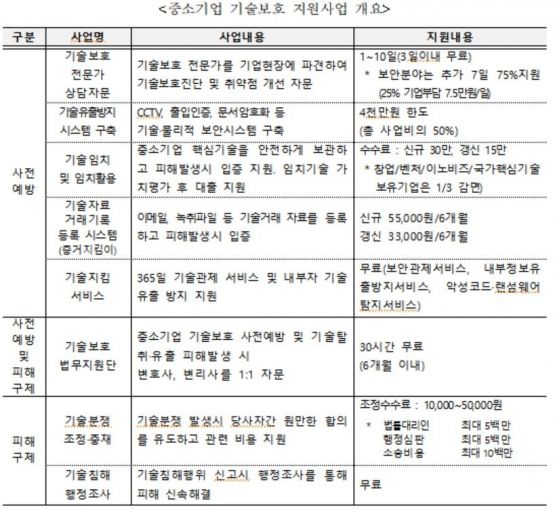
According to the Ministry of SMEs and Startups on the 1st, in accordance with the joint "SME Technology Protection Enhancement Plan" established by related ministries including the Fair Trade Commission and the Korean Intellectual Property Office, it will mandate technology escrow for smart factories and require smart factories above a certain level to obligatorily build security systems. In addition, on-site diagnosis and consultation by experts and security monitoring services by specialized institutions will be provided.
This SME Technology Protection Enhancement Plan was reviewed and approved through the SME Policy Deliberation Committee held in writing on the 27th of last month. Looking into the plan, the Korea Technology Finance Corporation will match demand companies such as large corporations with SME trust technologies and build and operate a large and SME technology transaction system to ensure fair technology transactions through coordinating.
The Ministry of SMEs and Startups will provide incentives such as awarding additional points for research and development (R&D) and for the evaluation of the Win-Win Growth Index to companies using these systems. Furthermore, it will protect national R&D outcomes and ideas from startup and venture companies. The government will also expand the escrow system for government-supported SME R&D and newly establish an escrow system for startup and venture companies’ ideas to strengthen technology protection.
The Ministry will support prompt responses from companies suffering from technology infringement. In particular, it plans to ease the administrative investigation reporting requirements for technology infringement acts. Currently, under the SME Technology Protection Act, the technology subject to administrative investigation requires "reasonable efforts" for confidentiality management, which may limit relief for SMEs lacking technology protection capacity. Therefore, it will push for amendments to the SME Technology Protection Act to delete "reasonable efforts," similar to the revised Unfair Competition Prevention Act.
The Ministry will also expand the administrative investigation reporting method from the existing written format to electronic methods to provide convenience in reporting. Additionally, it will establish legal grounds for the "Win-Win Mediation Committee," launched last year to induce quick resolution through mediation and arbitration of technology infringement cases, and strengthen inter-ministerial cooperation.
Relief for ongoing technology infringement disputes will also be strengthened. Since most evidence of technology infringement is held by the infringer, it is judged necessary to introduce a strong evidence acquisition system like those in advanced countries such as the United States for effective relief of victim companies.
The United States operates the Discovery system, a pre-trial procedure used to obtain all information related to litigation. Failure to submit materials results in strong sanctions such as contempt of court and deemed admission of the opposing party’s claims.
Accordingly, the Korean Intellectual Property Office plans to introduce a Korean-style Discovery system for intellectual property litigation. It will establish an evidence acquisition system that allows victim companies to effectively secure evidence related to infringement and damages, thereby easing the burden of proof and inducing early resolution of disputes.
Moreover, intellectual property infringement crimes will be changed from complaint-based offenses to semi-complaint offenses. Currently, patent and design infringement crimes are complaint-based, requiring a complaint within six months from the date the offender is known for investigation to be possible. However, through legal amendments, it will be improved to semi-complaint offenses allowing ex officio investigations without complaint or time limits.
The Ministry plans to strengthen litigation support for companies suffering from technology infringement. Even when SMEs have a chance to win technology infringement disputes with large corporations, many give up litigation due to cost burdens. The Ministry will establish an infringement relief team with extensive experience in intellectual property litigation within the Legal Support Group and provide victim companies with litigation representatives at the level of large law firms when administrative investigation results recommend corrective actions or impose fines.
The Ministry reviewed the progress of the "Measures to Eradicate Technology Theft by SMEs," announced in February 2018 through party-government consultations. Among the 29 implementation tasks of the technology theft eradication measures, 26 tasks were normally promoted except for three, including delays in legislation of the Win-Win Cooperation Act. It positively evaluated that the government established administrative, legal, and material support systems and various safeguards for prevention and post-relief of technology theft.
The government newly established administrative investigations for SME technology infringement and idea theft acts and significantly expanded investigative and administrative investigation authority for technology infringement, extending from trademark infringement to trade secrets, patents, and designs.
In addition, in May 2018, the government established the "Legal Support Group" to provide legal advice from lawyers and patent attorneys to SMEs lacking legal knowledge. As of the end of last year, 107 companies were supported. Furthermore, to alleviate the burden of patent infringement litigation costs, the "Patent Mutual Aid" was established. As of the end of last year, 1,409 companies had joined, with contract amounts reaching 47.9 billion KRW.
Especially regarding technology theft prevention, efforts such as introducing technology escrow utilization provisions in 27 standard subcontract agreements resulted in over 10,000 new technology escrow cases in 2019 (a cumulative total of 64,000 cases). The escrow system is useful for protecting undisclosed trade secrets by legally presuming the timing and facts of technology development.
In February last year, the "Technology Data Transaction Record Registration System" was established to preserve circumstantial evidence of technology data exchanges in preparation for technology data leaks. As of the end of last year, 272 cases were supported.
In November last year, the Ministry mandated confidentiality agreement regulations across 12 affiliated public institutions to spread the culture of confidentiality agreements. Additionally, it introduced the "SME Technology Trust System" to allow technology transfer and transactions with fair compensation without concerns of technology theft. As of the end of last year, 219 cases were entrusted, achieving 40 technology transfer results.
A Ministry official said, "However, punitive damages for technology infringement have been introduced and implemented in the Patent Act and the Unfair Competition Prevention Act, but the Win-Win Cooperation Act and the Subcontracting Act are still pending in the National Assembly. The government plans to continuously pursue legislative efforts in the future."
© The Asia Business Daily(www.asiae.co.kr). All rights reserved.
![User Who Sold Erroneously Deposited Bitcoins to Repay Debt and Fund Entertainment... What Did the Supreme Court Decide in 2021? [Legal Issue Check]](https://cwcontent.asiae.co.kr/asiaresize/183/2026020910431234020_1770601391.png)
















