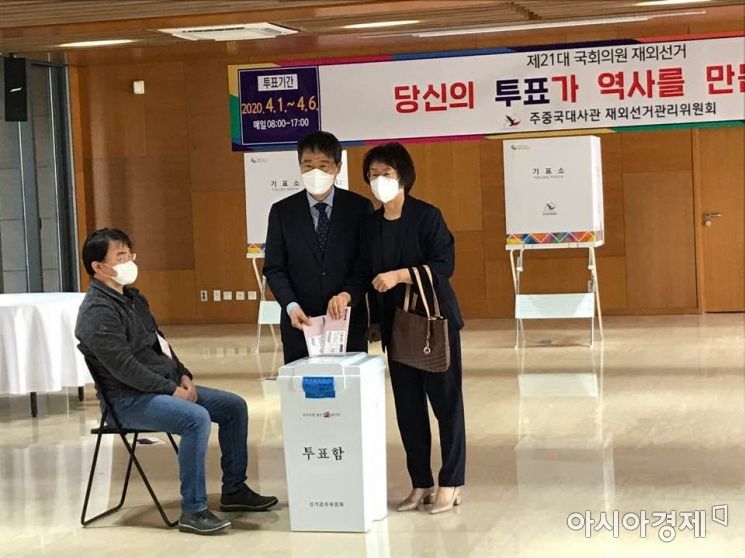
 Ambassador Jang Ha-sung to China and his spouse are casting their votes at the overseas election polling station set up at the Embassy of the Republic of Korea in Beijing at 8:50 a.m. (local time) on the 1st. Overseas voting will take place from the 1st to the 6th, from 8 a.m. to 5 p.m. Photo by Park Sun-mi, Asia Economy Beijing correspondent.
[Asia Economy Beijing=Special Correspondent Sunmi Park] At 8 a.m. local time on the 1st, staff wearing white protective suits, masks, and goggles were maintaining a somewhat strict security posture in front of the main gate of the Embassy of the Republic of Korea in Beijing.
This scene was quite different from the usual presence of only security guards. Due to the special circumstances caused by the spread of the novel coronavirus infection (COVID-19), overseas voting for the election of the 21st National Assembly members began on this day for overseas residents, following a special order from Chinese authorities to strengthen quarantine measures. Overseas voting is conducted daily from 8 a.m. to 5 p.m. during the period set by the Overseas Election Commission from the 1st to the 6th.
At the Embassy of the Republic of Korea in Beijing on this day, Korean residents wearing masks began to appear one by one from 8 a.m. to vote. Despite being before rush hour, the situation was somewhat quiet due to COVID-19. A masked election official at the main gate entrance conducted temperature checks on entrants. Wearing a mask was mandatory, and only those with a body temperature below 37.3 degrees Celsius were allowed entry. Those with a fever of 37.3 degrees or higher were not permitted inside and had to vote at a temporary polling station set up next to the entrance. After voting, those with a fever were guided to a hospital for nucleic acid testing.
Around 8:50 a.m. on the same day, Ambassador Jang Ha-sung and his spouse also visited the polling station.
After voting, Ambassador Jang said, "It is unfortunate that overseas Koreans in the U.S. and other regions cannot vote due to COVID-19, but it is a great relief that overseas voting is possible here in China." However, he expressed regret that the strengthened COVID-19 quarantine measures in China might result in a low voter turnout. Ambassador Jang stated, "Many of our nationals in China have pre-registered, but due to the strengthened COVID-19 quarantine measures, many have not yet been able to enter China, and movement is also restricted. Some are currently in quarantine. Therefore, I am worried whether voting will proceed as expected."
A Korean resident who visited the polling station that day said, "I work at an auto parts company, and due to COVID-19, work has significantly decreased, making things difficult. During these tough times, I came out with the mindset that I should at least exercise my rights by voting. It is unfortunate that many Korean residents want to vote but cannot leave their homes to do so."
© The Asia Business Daily(www.asiae.co.kr). All rights reserved.

















