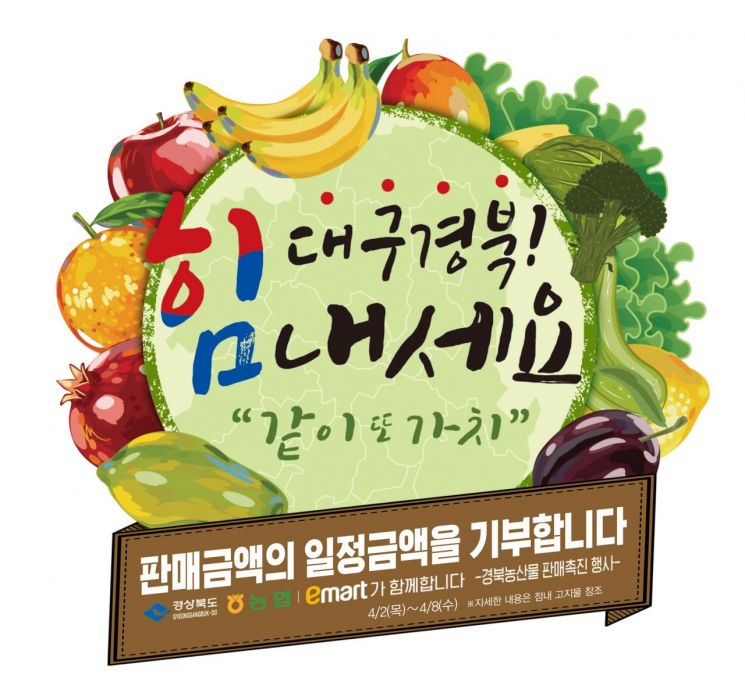
[Asia Economy Reporter Seungjin Lee] Emart announced on the 1st that it will hold the ‘Gyeongbuk Agricultural Products Fair’ to help Gyeongbuk farmers struggling due to the consumption slump.
Emart, together with Gyeongbuk Nonghyup and the Gyeongsangbuk-do Agricultural Food Distribution Education Promotion Institute, will promote the sale of Gyeongbuk agricultural products through the Gyeongbuk Agricultural Products Fair for seven days from the 2nd to the 8th, with about 4 billion KRW worth of products.
Representative products include ‘Apples (3kg/bag)’ sourced from Yeongju, Mungyeong, and Andong, the major apple-producing areas in Korea, sold at 9,980 KRW; ‘Chamoe (1.5kg/bag)’ from Seongju at 9,980 KRW; and ‘Rice (10kg)’ harvested in Gimcheon and Uiseong at 25,900 KRW. In addition, various famous Gyeongbuk agricultural products such as Yeongdeok spinach, Cheongdo water parsley, and peeled garlic from Uiseong will be offered at prices 20-40% cheaper than usual.
The reason Emart is holding the Gyeongbuk Agricultural Products Fair is that Gyeongbuk farmers are facing difficulties in selling agricultural products due to a sharp decline in direct transaction volumes and reduced demand for school meals caused by the COVID-19 pandemic. In fact, with all direct transaction markets for agricultural products canceled, an apple farmer in the Gyeongbuk region experienced a drop of over 90% in direct transaction sales, which accounted for about 20% of total sales.
Furthermore, Emart, together with Gyeongbuk Nonghyup, plans to donate about 1% of the sales from this event to snack expenses for children’s centers in rural Gyeongbuk through the Green Umbrella Children’s Foundation.
Separately from the Gyeongbuk Agricultural Products Fair, Emart will also support socially vulnerable groups such as elderly people living alone. Emart, in cooperation with the Seoul, Gyeonggi, and Daegu Social Welfare Councils, will provide ‘nutritious meal kits’ to elderly people living alone in the region who are in crisis due to the suspension of free meal services caused by COVID-19.
For elderly people living alone in a total of 24 local governments in Seoul, Gyeonggi, and Daegu, Emart plans to donate 300 to 500 ‘Hope Wagon Energy Recovery Kits’ per local government, each consisting of ‘Peacock nutritious meal’ products worth about 30,000 KRW. This donation is part of Emart’s Hope Delivery Wagon campaign, a representative corporate social responsibility project that has been delivering daily necessities directly to marginalized groups in the region since 2012.
The energy recovery kits prepared this time consist of six types of nutritious meal products such as ‘Peacock Seoul Cuisine Neungi Duck Baeksuk’ and ‘Peacock Seoul Cuisine Samgyetang,’ totaling about 8,000 units, with a donation value of approximately 250 million KRW.
In addition, various fresh food events will be held to help farmers and fishermen struggling due to the consumption slump. From the 2nd to the 8th, together with the Ministry of Agriculture, Food and Rural Affairs, Emart will hold an event to revive eco-friendly agricultural products affected by the consumption slump by selling about 50 tons of eco-friendly agricultural products at a 30% discount when using Shinsegae points.
Also, to secure sales channels for Jeju flatfish farms struggling due to domestic demand slump and export difficulties, Emart will purchase about 80 tons of flatfish in bulk and sell ‘Flatfish Sashimi (450g)’ at prices 40-50% cheaper than usual by lowering the margin.
Myunggeun Lee, head of fresh food at Emart, said, “Due to the impact of COVID-19, the consumption of agricultural and marine products has been sluggish, and farmers and fishermen nationwide, including the Gyeongbuk region, are facing difficulties. Emart plans to continue expanding sales channels for agricultural and marine products and to plan and present various promotions to stimulate domestic demand.”
© The Asia Business Daily(www.asiae.co.kr). All rights reserved.

















