Incheon City Withdraws Plan to Support Living Expenses for Those Below 100% Median Income
Government to Supplement COVID-19 Aid Extending Benefits to Top 30%
Payments to Be Made Around May via Incheon e-eum Card and Local Gift Certificates
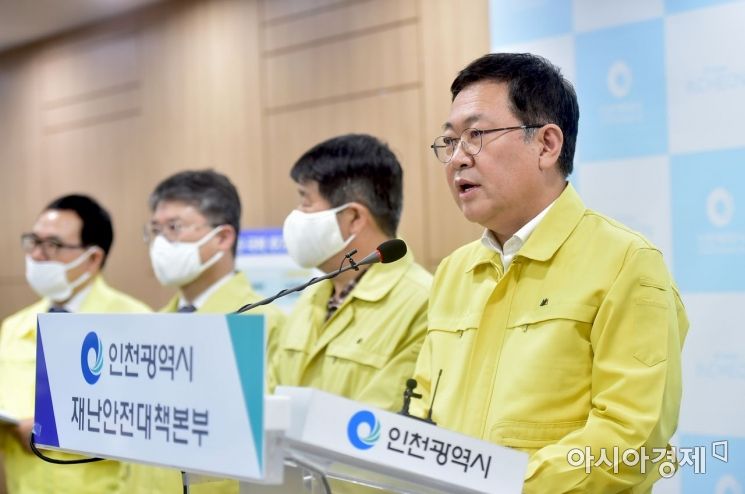 Incheon Mayor Park Nam-chun held a press conference on the 26th to explain the supplementary budget for 'COVID-19 response,' which includes emergency disaster living expenses support. March 26, 2020.
 [Photo by Incheon City]
[Asia Economy Reporter Park Hyesook] All 1.24 million households in Incheon will receive emergency disaster relief funds. Although it is not a 'disaster basic income' that provides a fixed amount to all residents like in Gyeonggi-do, benefits will also be extended to the top 30% income households who are not eligible for the government's COVID-19 emergency disaster relief funds.
Incheon City announced on the 1st that, in connection with the government plan to provide disaster relief funds ranging from 400,000 to 1,000,000 KRW depending on the number of household members for households below 70% of income (approximately 150% of median income), it will also provide a uniform support of 250,000 KRW per household to 370,000 households in the top 30% income bracket that were excluded from the government plan.
Accordingly, all 1.24 million households in Incheon will receive disaster relief funds ranging from 250,000 to 1,000,000 KRW per household without exception.
However, government support funds and city support funds cannot be received simultaneously. The government support funds are 400,000 KRW for single-person households, 600,000 KRW for two-person households, 800,000 KRW for three-person households, and 1,000,000 KRW for households of four or more.
Incheon City's disaster relief funds will be provided through the local currency Incheon e-eum card and local gift certificates (including Onnuri gift certificates). The city plans to promptly provide the disaster relief funds in line with the government's supplementary budget scheduled for May. The required funding is expected to reach about 110 billion KRW through local bonds and other means.
As of this year, Incheon City's debt ratio compared to its budget is about 16%, and the city explains that even if support funds are provided to all households, there will be no significant strain on fiscal soundness.
Meanwhile, Incheon City had previously announced on the 26th of last month that it would provide emergency disaster living expenses ranging from 200,000 to 500,000 KRW to 300,000 households below 100% of median income, but following the government's announcement, it withdrew the original plan and readjusted the support fund payment plan to benefit all citizens.
Additionally, the city decided to continue implementing support (200,000 to 500,000 KRW per person) for special employment types such as after-school instructors, child caregivers, substitute drivers, and unpaid leave workers as part of the emergency disaster living expense support plan.
An official from Incheon City stated, "Since the government's plan has been strengthened beyond our city's original support plan based on the principle of selection and concentration, we have expanded the support range to include households in the top 30% income bracket to stimulate consumption. By providing disaster relief funds through local currency and gift certificates, we expect it will help improve sales for local small business owners who are struggling due to COVID-19."
© The Asia Business Daily(www.asiae.co.kr). All rights reserved.

















