Rapid but Less Accurate Simple Testing Method
Quarantine Authorities Acknowledge Necessity in Emergencies... Approval Status in Focus
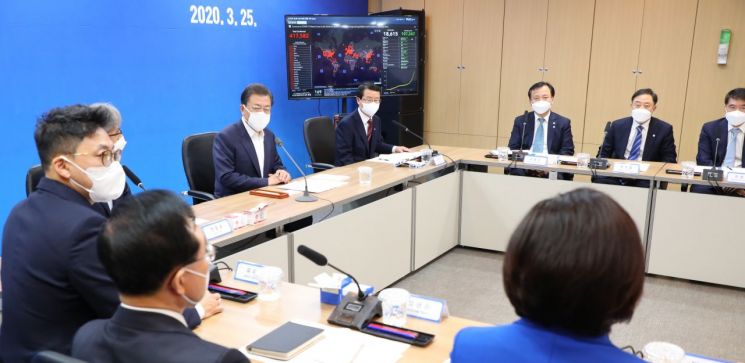 President Moon Jae-in is holding a meeting with representatives of companies approved for emergency use of COVID-19 diagnostic reagents at Seegene in Songpa-gu on the 25th.
 [Asia Economy Reporters Choi Dae-yeol, Kim Heung-soon, Jo Hyun-ui] Although there are calls to introduce methods to more quickly determine COVID-19 infection status, quarantine authorities are refraining from making hasty decisions. In the case of a high school student who died from worsening pneumonia symptoms, multiple COVID-19 diagnostic tests had to be conducted before and after hospitalization. Since the current diagnostic method takes nearly six hours, there is a need to determine infection status faster in urgent situations, and authorities are currently reviewing this. Field workers express opinions that such methods are necessary to compensate for the shortcomings of existing testing methods.
According to quarantine authorities on the 31st, South Korea currently uses real-time polymerase chain reaction (RT-PCR) for COVID-19 diagnostic testing. Samples are collected from the inside of the nose and throat, then tested using diagnostic kits developed by domestic companies and corresponding equipment. Until late January, when the first domestic case was confirmed, it took about two days to determine infection status, but applying this method has drastically reduced the time to six hours. The ability to conduct over 400,000 diagnostic tests to date is thanks to domestic companies supplying diagnostic kits using this method, enabling mass testing.
Recently, there have been calls within related academic societies and in vitro diagnostic companies to introduce a 'simple testing' method domestically that can more rapidly detect antigens and antibodies in the blood. Although the number of new confirmed cases in South Korea has somewhat subsided, patient numbers are surging worldwide, and rare cases such as re-positivity after discharge have emerged.
In particular, after it was revealed that a 17-year-old high school student who died while hospitalized at Yeungnam University Hospital on the 18th underwent 13 diagnostic tests due to pneumonia of unknown cause, quarantine authorities expressed willingness to adopt diagnostic techniques that can confirm infection more quickly in emergencies. Lee Sang-won, Director of the Infectious Disease Diagnosis Management Division at the Korea Centers for Disease Control and Prevention (KCDC), stated, "Various opinions are emerging from related academic societies, but we will gather opinions as quickly as possible and make a decision."
The issue is accuracy. Genetic methods have high sensitivity to confirm infection in positive cases, making test results reliable, whereas simple tests do not. Antibody-based methods have limitations in detecting infection during the early stages. Hong Ki-ho, Director of the Department of Laboratory Medicine at Seoul Medical Center, said, "Simple tests that detect antigens and antibodies are similar in principle to pregnancy tests and may be suitable for some underdeveloped countries with poor diagnostic infrastructure, but are not appropriate domestically."
According to the Ministry of Food and Drug Safety, five companies including CoGen Biotech and Seegene have received emergency approval for COVID-19 diagnostic reagents. All produce diagnostic kits using the RT-PCR method. As of the previous day, domestic companies have produced a total of 21,070 diagnostic kits, sufficient to test over 730,000 people. The current stock held by companies alone can test 100,000 people. Meanwhile, the daily number of tests conducted by quarantine authorities ranges from about 6,000 to 20,000. There is no shortage of diagnostic reagents domestically.
Recently, kits capable of testing within one hour using genetic amplification methods have been approved in the US and Europe, drawing interest from domestic medical staff and quarantine authorities. Director Hong said, "Since the existing testing method has clear advantages, such as being able to test more than 90 samples at once, we plan to maintain it while using rapid tests complementarily for cases like patients requiring immediate surgery."
© The Asia Business Daily(www.asiae.co.kr). All rights reserved.

















