First Round Competitive Bidding of $12 Billion Targeting KDB, KIS, Kookmin Bank, etc.
Banks Already Managing Foreign Currency Liquidity with 128.3% LCR in February
Concerns Over How Much to Borrow for 3-Month Loans with 110% Collateral
[Asia Economy Reporter Kangwook Cho] As the $60 billion Korea-US currency swap funds are scheduled to be released into the market starting from the 2nd of next month, the banking sector is facing deep concerns. While this is an essential measure to stabilize the domestic foreign currency fund market, the increased burden on banks raises risks in terms of asset soundness management.
According to the financial sector on the 31st, the Bank of Korea conducted a competitive bidding this morning for the first tranche of $12 billion out of the $60 billion Korea-US currency swap funds, targeting policy banks such as the Korea Development Bank and Export-Import Bank, as well as domestic commercial banks including KB Kookmin, Shinhan, Hana, and Woori. The scheduled bidding amount consists of $2 billion for 7-day notes and $10 billion for 84-day notes, totaling $12 billion. The minimum bid interest rates were set at an annual 0.322% for the 7-day notes and 0.3210% for the 84-day notes.
This foreign currency liquidity supply is a competitive bidding process where banks seeking dollar loans submit their bid rates, similar to the method used in 2008. This time, a multiple-price method was applied, where each successful bidder receives the rate they offered. The Bank of Korea requires collateral amounting to 110% of the total foreign currency loan amount. Accepted collateral includes government bonds, government-guaranteed bonds, monetary stabilization bonds, bank bonds, mortgage-backed securities issued by the Korea Housing Finance Corporation, and Korean won cash.
With recent increased volatility in the foreign exchange market, this measure is welcomed by the banking sector as it can alleviate concerns about a sudden tightening of foreign currency liquidity. It is understood that banks have actively participated in the bidding. However, some point out that although a solution to foreign currency liquidity concerns has been secured, the burden on banks continues to increase, causing new worries. This is due to potential disruptions in asset soundness management.
An official from Bank A said, "We welcome this measure as it proactively prevents a possible foreign currency liquidity crisis," but added, "However, we need to consider efficiency from a cost perspective, which is a concern."
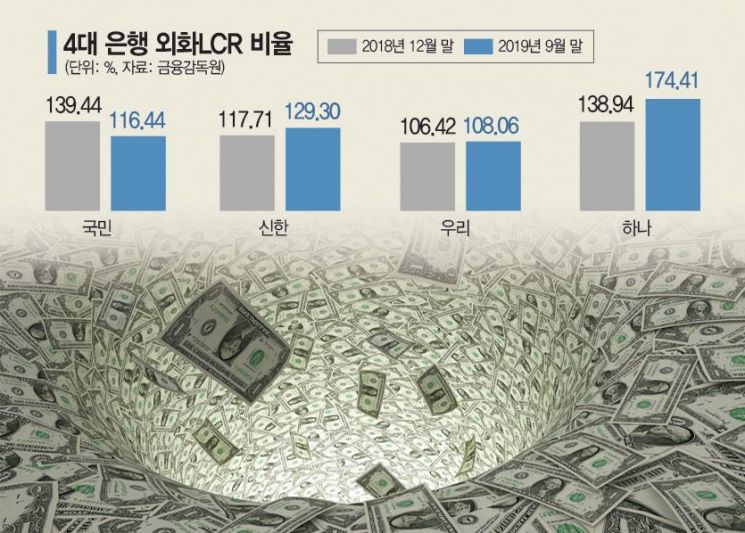
So far, commercial banks have been managing foreign currency liquidity to prepare for liquidity shortages caused by financial crises. As of the end of February, the average foreign currency liquidity coverage ratio (LCR) of domestic banks was 128.3%, significantly exceeding the Financial Supervisory Service's regulatory ratio of 80%. Additionally, banks have secured foreign currency liquidity through an additional mechanism called the 'Committed Line.' The size of the committed lines by bank is led by Shinhan Bank with $1.2 billion, followed by Woori Bank with $800 million, Kookmin Bank with $500 million to $800 million, and Nonghyup Bank with $140 million. As of the end of last month, the foreign currency deposit balance of the four major banks stood at $43.9 billion, showing a steady increase.
An official from Bank B expressed, "The Bank of Korea says it has secured foreign currency liquidity and encourages us to use it, but banks have been continuously managing foreign currency liquidity, so we are unsure how much of the three-month loan requiring 110% collateral we should actually take," adding, "This could rather cause problems in asset soundness management."
Currently, the banking sector is under increasing pressure due to funding requests not only from small and medium-sized enterprises but also from large corporations. They also need to invest in tens of trillions of won worth of Cha-an and Jeung-an funds. The pressure to prevent a market-wide collapse and concerns over deteriorating soundness are converging, creating a dilemma. Consequently, the won LCR of the four major commercial banks?Shinhan, KB Kookmin, Woori, and Hana?has fallen from 104-110% at the end of February to around 102-105% recently (based on balances).
An official from Bank C said, "Bank profits are inevitably going to worsen this year, so the current focus is not on profits but on risk management such as asset soundness," and added, "There is also the aspect of issuing bank bonds to invest in government funds, but there is a possibility that we might borrow funds and end up not using them, so we cannot avoid concerns about costs and efficiency."
© The Asia Business Daily(www.asiae.co.kr). All rights reserved.
![Clutching a Stolen Dior Bag, Saying "I Hate Being Poor but Real"... The Grotesque Con of a "Human Knockoff" [Slate]](https://cwcontent.asiae.co.kr/asiaresize/183/2026021902243444107_1771435474.jpg)
















