Injection of 9.1 Trillion KRW to 14 Million Low-Income Households
30% Discount from March for Bottom 40% in Health Insurance
3-Month Payment Deferral for National Pension, Employment Insurance, and Industrial Accident Insurance
3-Month Extension of Electricity Bill Payment Deadline for Small Businesses and Vulnerable Groups
[Asia Economy Reporter Kwangho Lee] The government will provide emergency disaster relief funds totaling approximately 9.1 trillion won to 14 million households in the bottom 70% income bracket to support those affected by the novel coronavirus infection (COVID-19).
Additionally, for health insurance subscribers in the bottom 20-40% of premium payments, a 30% reduction in health insurance premiums will be applied for three months, a 30% reduction in industrial accident insurance premiums for six months, a three-month deferral of national pension and employment/industrial accident insurance premium payments, and a three-month deferral of electricity bill payments will be provided.
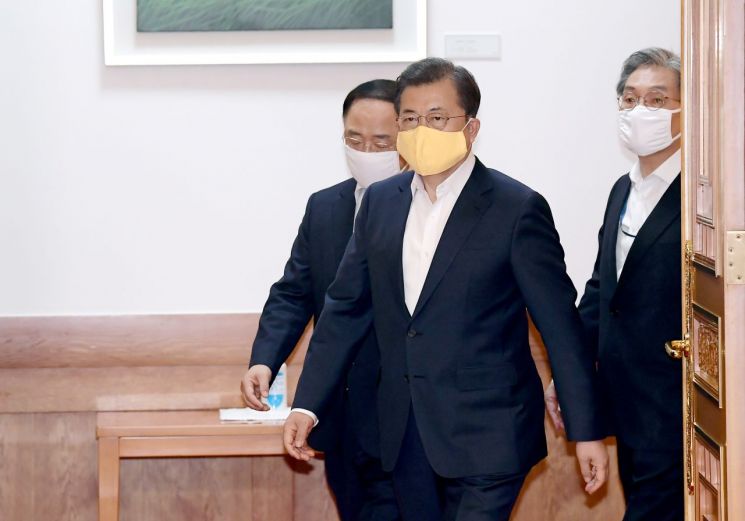
The government announced on the 30th, at the 3rd Emergency Economic Meeting chaired by President Moon Jae-in, that it had prepared the 'Emergency Disaster Relief Fund Introduction Plan' and the 'Social Insurance Premium Burden Relief Plan' with these details.
First, the emergency disaster relief fund targets 14 million households in the bottom 70% income bracket, with 1 million won provided per household of four or more members, paid through local gift certificates or electronic money currently used by local governments.
The emergency disaster relief fund is expected to total 9.1 trillion won. When combined with low-income consumption coupons fully funded by the national treasury through supplementary budgets and emergency welfare resources (1.2 trillion won), a total of 10.3 trillion won will be used to respond to the COVID-19 situation.
The actual funding will be covered by adjusting the budget expenditure structure. The plan is to reduce as much as possible by focusing on projects expected to underperform due to changing conditions or those that can be cut through active reduction efforts.
The government plans to prepare the second supplementary budget as soon as possible for the emergency disaster relief fund as a single project and establish a cooperative system with local governments to coordinate project plans in advance. While the government’s criteria will be met in principle, the execution method and additional support will be tailored as much as possible to local government circumstances. To this end, the Ministry of the Interior and Safety and the Ministry of Health and Welfare have been selected as the project-leading ministries.
Also, starting from March premiums, premium reductions and deferral benefits will be implemented to ease the living expenses burden on low-income groups and support management and employment maintenance for small businesses. The health insurance, which has 25.58 million subscribers nationwide, will expand the reduction target to the bottom 40% based on premium payments. The existing bottom 20% (bottom 50% in special disaster areas) are already receiving premium reductions through the first supplementary budget. Expanding the target to the bottom 40% of premiums, including workplace subscribers with monthly income below 2.23 million won, is expected to provide a total reduction benefit of 417.1 billion won (13.9 billion won per month) over three months to 4.88 million people.
The health insurance premium reduction will be applied from the March premiums, and if already paid, it will be combined and reduced in the April premiums. Since health insurance premiums are withheld by employers from earned income, the deferral effect applies only to employers; therefore, the support direction was set to reduce premiums rather than defer payment.
The national pension, with 18.84 million subscribers, will allow a three-month payment deferral from March to May, and late fees will not be collected during this period. Workplace subscribers who have lost or reduced income due to COVID-19 can apply for deferral. Regional subscribers can apply if they prove business suspension or losses over three months due to COVID-19. Given the nature of the national pension, where benefits are returned based on premiums paid, only payment deferral will be pursued instead of premium reduction or support.
Employment insurance premiums will not need to be paid for three months starting from March for workplaces with fewer than 30 employees that wish to apply. The government estimates that if all 6.12 million eligible people and 2.28 million workplaces apply, a total of 766.6 billion won in premium payment deferral benefits will be provided over three months.
For industrial accident insurance, which employers bear fully, workplaces with fewer than 30 employees, self-employed individuals, and special employment types can apply for either a three-month payment deferral or a 30% reduction for six months.
The government estimates that the total support effect will be 7.5 trillion won through deferral of the four major insurance premiums and 900 billion won through reduction measures.
Along with this, the government will implement electricity bill burden relief measures targeting vulnerable groups and small business owners. For 3.2 million small business households and 1.572 million low-income households, the payment deadline for bills from April to June will be extended by three months. After the extension period ends, installment payments will be possible until the end of this year according to the payer’s desired number of months. This is expected to provide a maximum payment extension effect of seven months.
Small business owners are defined as businesses with fewer than five regular employees (fewer than 10 for mining and manufacturing), and low-income groups include basic livelihood security recipients, near-poverty groups, persons with disabilities, and independent or distinguished veterans.
© The Asia Business Daily(www.asiae.co.kr). All rights reserved.

















