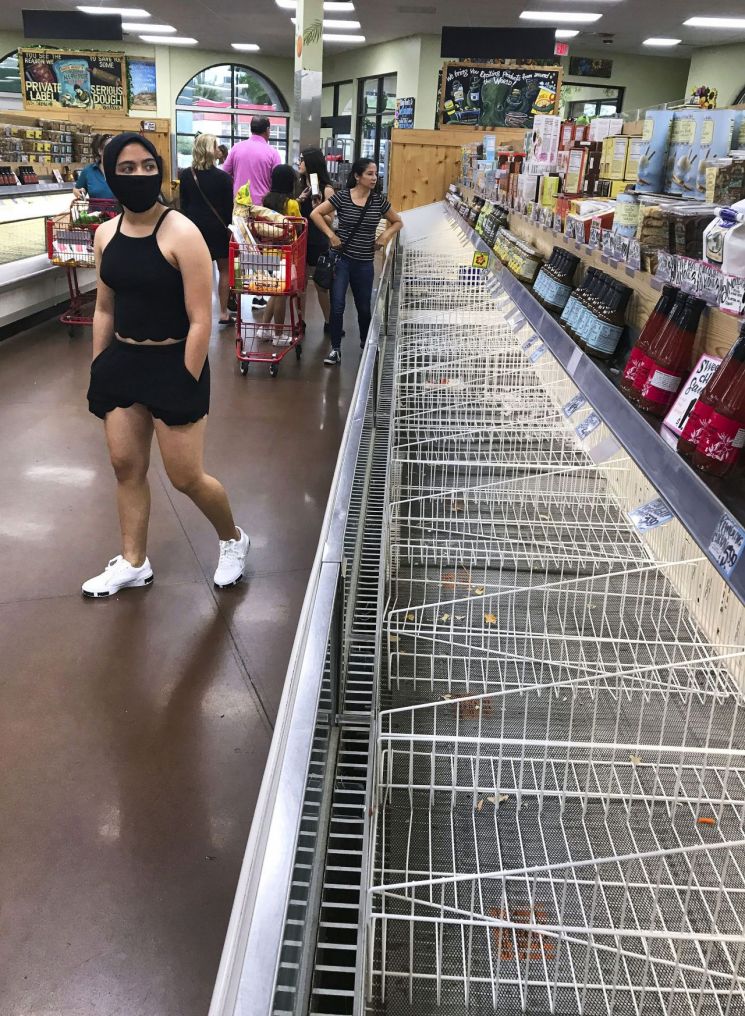
[Asia Economy Reporter Jeong Hyunjin] The novel coronavirus infection (COVID-19) is threatening the globalized dining table. Following declarations of export suspensions by countries exporting grains to secure their own food supplies amid the spread of COVID-19, supply chain disruptions have occurred in the manufacturing and transportation processes of food ingredients. If the COVID-19 crisis prolongs, a chain reaction of food supply issues may arise, putting global food security on high alert.
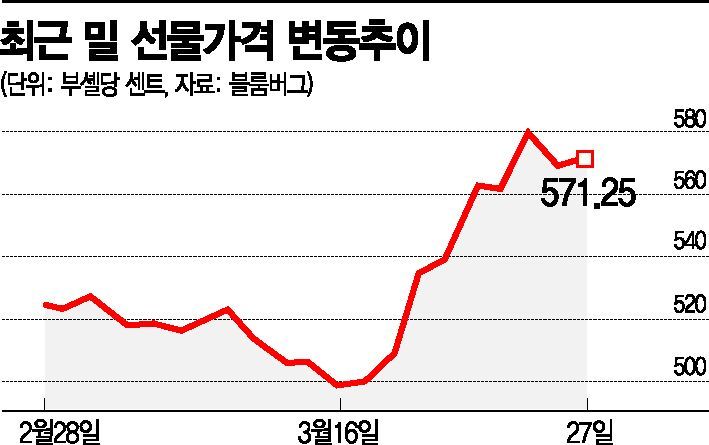
According to Bloomberg on the 29th (local time), the price of May delivery wheat on the Chicago Board of Trade closed at 571.25 cents per bushel on the 27th. Wheat prices had fallen below 500 cents on the 16th but rose nearly 15% within two weeks.
The reason for the sharp rise in wheat prices is that demand has surged rapidly in the US and Europe recently, but supplying countries have blocked exports. According to foreign media, pasta sales in the UK surged 168% compared to the previous week as of the 14th. Sales of noodles, bread, rice, and other products also increased. Due to movement restrictions caused by COVID-19, end consumers' demand increased because of the advantage of long-term storage and use.
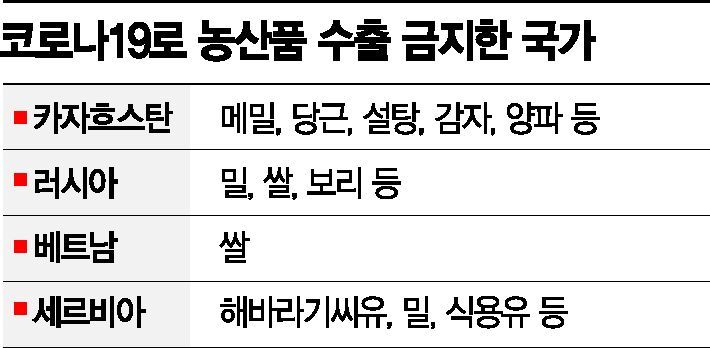
The problem is that suppliers are locking down their exports. Russia, the world's largest wheat exporter, issued an export ban on wheat, rice, barley, and other grains on the 20th. Kazakhstan also suspended exports of buckwheat, carrots, sugar, potatoes, onions, and more from the 22nd, while Vietnam is blocking rice exports and Serbia is preventing sunflower oil exports.
In response to this situation, some countries are strategically seeking to stockpile food. Major wheat importers Turkey and Algeria are looking for new wheat suppliers to ensure stable supply, and Morocco has decided to exempt import tariffs on wheat until mid-June. China, the world's largest rice producer and consumer, has also announced plans to stockpile large quantities of rice and other grains before production.
The food crisis caused by COVID-19 is not only a matter of supply and demand. The spread of the virus has also disrupted supply chains, shaking the dining table. Grains like wheat are processed into food ingredients in factories, shipped to various countries, and distributed through retailers to households and restaurants. COVID-19 has had a significant impact on this overall supply process. Peter Alexander, a global food security expert at the University of Edinburgh, pointed out, "If the shock is limited to a specific region or product, recovery can be faster by using alternative suppliers or substitutes, but systemic shocks will be the weak link."
For example, pasta, which is widely consumed in Europe, is made from wheat produced in Canada, imported by Italy, processed into pasta in factories, and delivered to final consumers through European supermarkets using trucks and ships. Border closures and movement restrictions imposed by countries to prevent COVID-19 halt the transportation of ingredients and products and also stop factory operations. Additionally, variables such as employees testing positive affect the supply chain.
For now, countries can endure the food supply impact caused by COVID-19, but the United Nations Food and Agriculture Organization (UNFAO) forecasts supply problems for fresh fruits and vegetables, which require freshness, within two months. Maximo Torero, Chief Economist at UN FAO, recently told The Guardian, "The worst-case scenario is governments restricting the flow of food," adding, "Any measures that block free trade will backfire. Now is not the time for restrictions or trade barriers but to protect the global flow of food." He also mentioned that they will soon look into issues related to the supply of fresh vegetables and fruits.
There is an analysis that food supply issues may be a result of nationalism (prioritizing one's own country) revealed during the COVID-19 response process. As countries close borders to prevent the spread of COVID-19, even countries producing food ingredients are blocking exports, prioritizing their own countries. The leaders of the Group of Twenty (G20) emphasized in a joint statement on the 26th, "Let us maintain trade relations to ensure smooth supply of essential agricultural products."
© The Asia Business Daily(www.asiae.co.kr). All rights reserved.



















