[Asia Economy (Suwon) = Reporter Lee Young-gyu] As early as April, an enormous amount of funds amounting to around 1.5 trillion KRW is expected to be released in Gyeonggi Province.
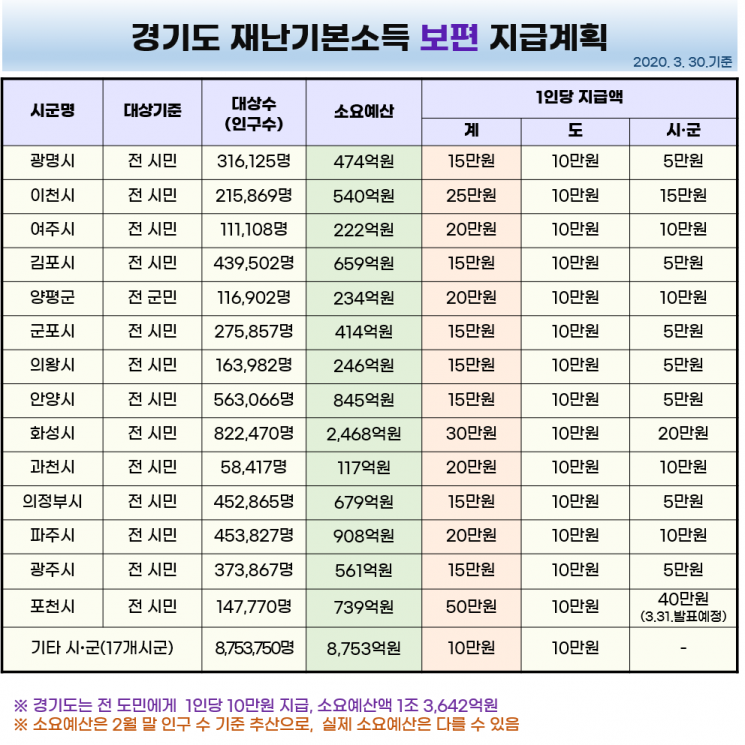
Gyeonggi Province plans to provide 100,000 KRW in local currency per resident to its 13.26 million residents, and among the 31 cities and counties in the province, 17 regions are considering providing up to 2 million KRW in resident support from their own budgets.
Additionally, the province has decided to provide financial support of 10,000 KRW per person to local governments that offer additional resident support from their own budgets.
◆ Gyeonggi Province to provide 100,000 KRW per person to 13.26 million residents starting in April
On the 24th, Gyeonggi Province Governor Lee Jae-myung held a press conference and announced, "Starting in April, we have decided to provide disaster basic income of 100,000 KRW per resident."
Governor Lee emphasized, "Some suggested excluding high-income earners and minors or differentiating for minors, but this goes against the ideology of basic income," adding, "Excluding high-income earners is double discrimination against high taxpayers, and the additional cost for selection is excessive. Minors are also residents who pay taxes, and their consumption demand is no different from adults, so we decided not to exclude or discriminate."
The disaster basic income payment target must be a Gyeonggi resident from 24:00 on March 23, 2020, until the application date. According to the Ministry of the Interior and Safety, the population of Gyeonggi Province as of the end of February 2020 is 13,265,377.
The province plans to simplify the payment procedure as much as possible. Starting in April, residents can receive the full amount immediately upon application by verifying their identity at the local administrative welfare centers in their town, township, or neighborhood, and a household member can apply on behalf of all household members (a power of attorney is required for adults). However, considering busy election-related work, some are also considering delaying the payment timing until after the general election (April 15) or adding additional personnel.
The province plans to pay the disaster basic income in local currency that expires after three months. This measure aims to ensure full consumption within a short period, thereby achieving a dual effect of household support and increased sales for businesses and self-employed individuals.
The necessary funds of 1.3642 trillion KRW will be secured by internally borrowing 340.5 billion KRW from the disaster management fund, 273.7 billion KRW from the disaster relief fund, and 700 billion KRW from the regional development fund created by automobile purchase bonds. The additional shortfall will be covered by cutting 50 billion KRW from the ultra-low credit loan project budget of 100 billion KRW.
The Gyeonggi Research Institute estimated that providing 100,000 KRW disaster basic income per person would generate a production inducement effect of 1.1235 trillion KRW, a value-added inducement effect of 622.3 billion KRW, and an employment inducement effect of 562.9 billion KRW.
◆ 20 cities/counties provide up to 2 million KRW additional support vs. 11 cities/counties 'under consideration'
According to Gyeonggi Province, among the 31 cities and counties, 20 have prepared their own funds to provide additional support. Gunpo, Gwangmyeong, Anyang, Uiwang, and Gimpo will provide 50,000 KRW disaster basic income to all citizens. Gwacheon, Yeoju, and Yangpyeong will provide 100,000 KRW; Icheon, Gwangju, and Uijeongbu will provide 150,000 KRW; Paju and Hwaseong will provide 200,000 KRW; and Pocheon will provide the highest amount in the province, 400,000 KRW.
Residents in these 14 regions will receive additional support ranging from 50,000 KRW to 400,000 KRW per person regardless of income. Hwaseong, in particular, plans selective support for small business owners experiencing sales declines, in addition to providing 200,000 KRW to all residents.
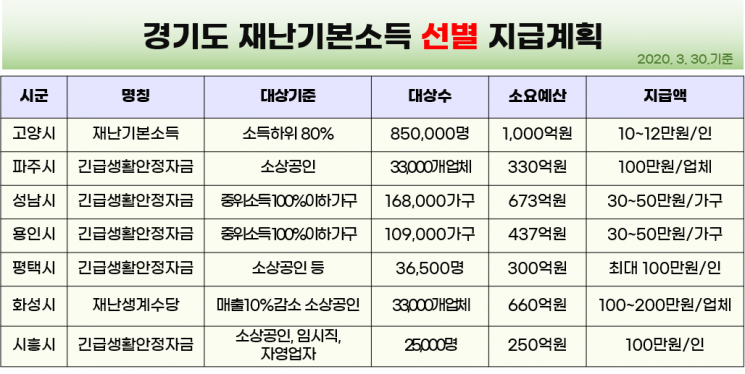
Additionally, seven local governments including Goyang, Paju, Seongnam, Yongin, Hwaseong, Siheung, and Pyeongtaek are pursuing selective support.
Goyang will provide disaster basic income of 100,000 to 120,000 KRW per person to 850,000 residents in the bottom 80% income bracket. Paju will provide emergency living stabilization funds of 1 million KRW per business to about 33,000 small businesses.
Seongnam and Yongin plan to provide emergency living stabilization funds of 300,000 to 500,000 KRW per household to 168,000 and 109,000 households respectively, with incomes below 100% of the median income.
Pyeongtaek will support up to 1 million KRW per person to about 36,500 small business owners and others in the area as emergency living stabilization funds. Hwaseong decided to provide disaster livelihood allowances of 1 to 2 million KRW per business to about 33,000 small businesses with sales declines of 10% or more.
Siheung is considering providing 1 million KRW per person as emergency living stabilization funds to about 25,000 small business owners, self-employed, and temporary workers.
Among the remaining 14 cities and counties including Suwon, many are actively considering resident support plans using their own funds, so the number of additional supporting local governments is expected to increase.
◆ Gyeonggi Province to provide 10,000 KRW financial support per person to additional supporting local governments
In addition to the 100,000 KRW disaster basic income, Gyeonggi Province will provide financial support equivalent to 10,000 KRW per person to cities and counties that provide additional disaster basic income on their own.
Earlier on the 27th, Governor Lee Jae-myung sought residents' opinions via social media (SNS), stating, "We are considering prioritizing the 400 billion KRW special adjustment grant budget held by Gyeonggi Province to cities and counties that provide disaster basic income."
The special adjustment grant is a fund provided by the governor to cities, counties, and autonomous districts to resolve financial disparities and provide balanced services.
Considering the population of 13.26 million in Gyeonggi Province as of the end of February, if all 31 cities and counties provide their own disaster basic income, the maximum support amount is expected to be 132.6 billion KRW.
A provincial official stated, "Combining the 100,000 KRW Gyeonggi-style disaster basic income and additional support funds from local governments, an enormous amount of around 1.5 trillion KRW will be released into local small businesses, which is expected to greatly help revitalize the local economy given the large amount of money released in a short time."
© The Asia Business Daily(www.asiae.co.kr). All rights reserved.


















