[Asia Economy Reporter Moon Chae-seok] Last month, the increase in online distribution sales was the largest in 3 years and 9 months since June 2016. This is attributed to the impact of 'social distancing' measures due to the widespread outbreak of the novel coronavirus (COVID-19).
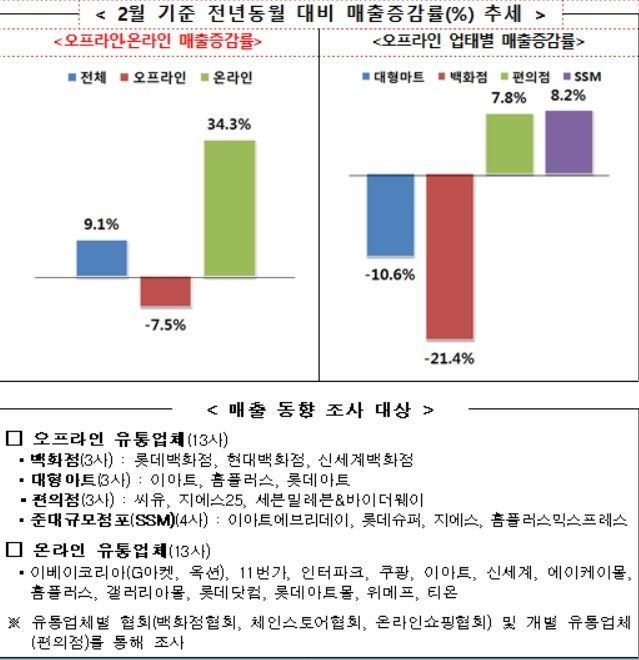
On the 30th, the Ministry of Trade, Industry and Energy announced the results of a sales trend survey of 26 major online and offline distribution companies last year, revealing that sales of 13 online distribution companies increased by 34.3% compared to the previous year. Offline sales decreased by 7.5%.
Since the revision of the major distribution company sales trend statistics in June 2016, the increase in online sales was the largest recorded.
The reason for the increase in online sales was attributed to the rise in demand for online delivery instead of face-to-face contact due to the spread of COVID-19. The so-called expansion of the 'social distancing' phenomenon influenced sales.
In particular, food sales surged by 92.5% compared to the same period last year. Sales of daily necessities and household goods also increased by 44.5% due to increased sales of hygiene products including masks. Notable growth was also seen in children and infants (40.6%), cosmetics (37.5%), and books and stationery (37.5%).
Offline sales saw a decrease in total purchase transactions (-2.1%) due to reduced purchases at large marts and department stores. The average purchase price increased mainly at convenience stores, which generally have lower prices, but overall decreased by 5.5%.
At department stores, only overseas famous brands (4.2%) saw sales growth. Sales in all other sectors such as women's casual wear (-41.3%), children's sportswear (-37.2%), and household goods (-4.8%) declined. Overall, department store sales recorded -21.4%.
The large marts were similarly affected by the social atmosphere of refraining from going out, with sales decreasing by 10.6% compared to the same period last year.
Clothing sales dropped by 46.5%. Due to the delay in school openings, demand for new semester items such as bags, stationery, and laptops also shrank. Miscellaneous goods (-41.5%) and electronics and culture (-20.9%) were also impacted.
Convenience stores saw a 7.8% increase in sales compared to the same period last year as local consumption increased due to COVID-19. Food consumption rose by 5.6%. Sales of daily necessities (33.3%) and other items such as tobacco (8.7%) also increased due to higher sales of masks and safety over-the-counter medicines.
SSMs (Super Supermarkets) also benefited from increased preference for local consumption and rising demand for home-cooked meals. Sales of agricultural, fishery, and livestock products (5.9%), fresh and prepared foods (7.8%), and processed foods (11.1%) all increased evenly. Overall sales rose by 8.2% compared to the same period last year.
The increase in SSM sales is the first in 9 months since May last year. It recorded the highest sales growth rate since February 2015 at 9.4%.
© The Asia Business Daily(www.asiae.co.kr). All rights reserved.

















