Chronic Deficit Korean Air Corporation, Becoming a Global Airline in 50 Years "Turning Crisis into Opportunity"
Credit Shines Amid Middle East War Crisis
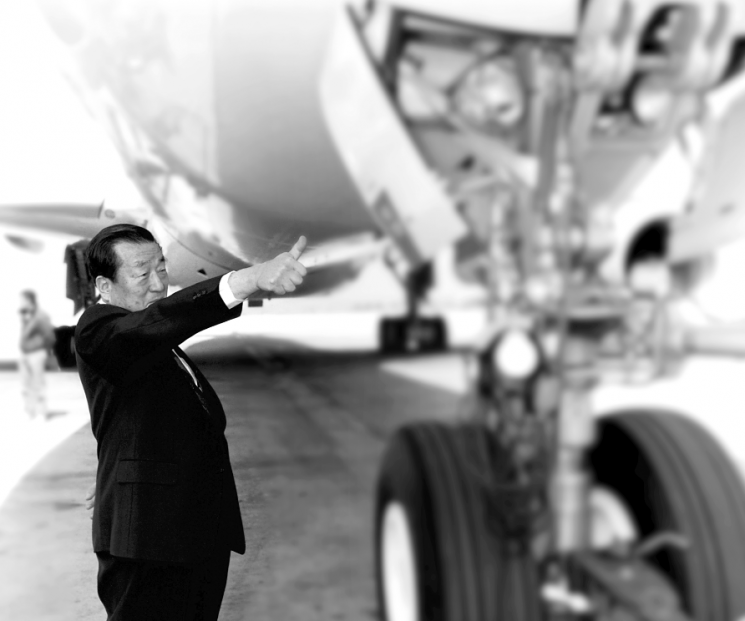
As the aviation industry faces a crisis due to the novel coronavirus disease (COVID-19), attention is once again focused on the leadership of the late Cho Jung-hoon, chairman of Hanjin Group. Based on the philosophy of 'Transporting for National Prosperity (輸送報國),' Chairman Cho turned multiple crises into opportunities, and similarly, Korean Air plans to overcome the COVID-19 crisis as the nation's leading flag carrier and dedicate itself to the country.
Chairman Cho Jung-hoon established 'Hanjin Sangsa,' the foundation of Hanjin Group, in Incheon on November 1, 1945, shortly after liberation during a time of ongoing chaos. 'Hanjin' means 'Advancement of the Korean People.' At that time, the only asset Chairman Cho had was a single truck.
Despite the turmoil, Hanjin Sangsa continued to grow rapidly. Within five years of starting the business, Hanjin Sangsa had grown into a logistics company with about 40 employees and around 30 trucks. The rapid expansion was attributed to the 'credit' emphasized by Chairman Cho. He valued credit so highly that he never missed a repayment deadline on borrowed funds.
However, the outbreak of the Korean War on June 25, 1950, pushed Hanjin Sangsa to the brink of collapse. Vehicles and equipment were requisitioned as military supplies, and Chairman Cho was only able to return to Incheon in 1953, three years later. All that remained for him was land reduced to rubble and bank debts.
◆Management Emphasizing 'Credit' = Even under these circumstances, Chairman Cho dreamed of recovery with the single truck he had driven during evacuation. The credit he had built before the war became his weapon. Investors provided unsecured loans based on Chairman Cho’s credit, and loyal customers flocked to the company, enabling it to quickly regain its pre-war scale by 1955, two years after the armistice.
Credit also shone in dealings with the U.S. military. In 1956, a driver of a truck leased from another company sold over 1,300 winter uniforms meant for the U.S. military on the black market. Despite suffering a huge loss of $30,000 at the time, Chairman Cho bought back all the stolen goods. This turned into a blessing in disguise. Later, Hanjin nearly monopolized transportation rights from the U.S. military, significantly expanding its business.
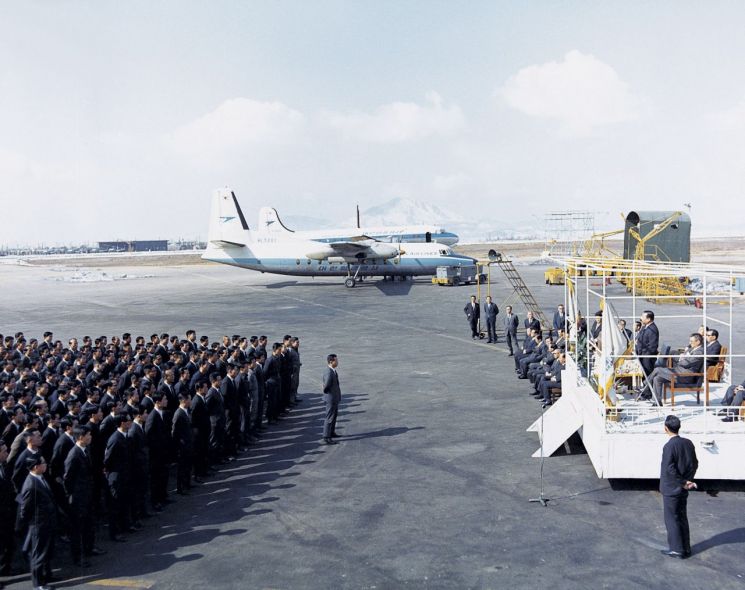
◆Turning Crisis into Opportunity... Chairman Cho Expands into the Skies = A new challenge came to the thriving Hanjin Group in 1969. Then-President Park Chung-hee requested the acquisition of Korean Air Lines, which was suffering chronic deficits. Entering the aviation business, which required huge fixed costs, was a gamble even for Chairman Cho. He said at the time, "There are businesses that must continue even at a loss. The acquisition of Korean Air Lines should be considered a mission in terms of national interest and public good," and proceeded with the acquisition.
However, the outbreak of the Middle East War shortly after the normalization process began plunged Chairman Cho and Korean Air into crisis again. With international oil prices soaring, the company faced a situation where fuel supply would be cut off if payment was not made within a month. The situation became so urgent that jumbo jets purchased in 1973 had to be put up as collateral.
But Chairman Cho used trust as his weapon to turn the crisis into an opportunity. Needing $50 million, he secured a payment guarantee from Soci?t? G?n?rale Bank in France based on his credit, overcoming the crisis. Korean Air, having overcome early difficulties, grew into a global airline with 166 aircraft, 124 routes in 44 countries, and sales of 13 trillion won as of last year.
◆Expanding the Transport Path to the Seas = Chairman Cho, who had pursued the logistics industry with the philosophy of transporting for national prosperity, later focused on pioneering sea routes. In 1977, he dismantled the financially troubled Daejin Shipping and established Hanjin Shipping, a container shipping company. At that time, Hanjin Shipping experienced rapid annual growth based on increasing shipping demand driven by a strong export push.
As the shipping business stabilized, Chairman Cho also turned his attention to shipbuilding. Having spent much of his youth at the Haewon Training Center and Japanese shipyards, he had a deep attachment to the shipbuilding business. Moreover, as Hanjin Shipping steadily grew, demand for cargo ships increased, and the volume of repairs for owned vessels was significant, giving him confidence that the business would be profitable.
As a result, Chairman Cho participated in the bidding for the sale of a shipbuilding company undergoing court receivership, acquired it, and launched Hanjin Heavy Industries in 1989. This completed Hanjin as a comprehensive logistics company covering land, sea, and air.
During this time, Chairman Cho also focused on nurturing talent. In 1968, he acquired Inha Academy, and in 1979, Korean Air University, concentrating on facility expansion and improving education quality. From 1988, he established Korea’s first in-house industrial university, 'Hanjin Industrial University (now Jeongseok University),' for employees who could not attend college due to family circumstances.
Additionally, until his passing in 2002, Chairman Cho donated about 100 billion won of his personal wealth to public foundations and affiliates. Of this, 50 billion won was allocated to transportation and logistics research development and educational funds, distributed to Inha Academy, Jeongseok Academy, and the 21st Century Korea Research Foundation.
© The Asia Business Daily(www.asiae.co.kr). All rights reserved.


















