[Asia Economy Reporter Park Cheol-eung] "I am hosting a weekly current affairs talk show on a YouTube broadcast operated by an internet newspaper. Does this classify me as a journalist who is prohibited from running for office while in service?"
This is a recent inquiry made by the Incheon Election Commission to the Central Election Commission. The Central Election Commission responded that considering the contract details and employment relationship, the individual does not fall under the category of journalists restricted from candidacy.
As the 21st general election approaches, controversy is intensifying over whether YouTube should be regarded as a media outlet. With the outbreak of the novel coronavirus disease (COVID-19), the influence of online platforms, especially YouTube, is growing in the election arena.
'Journalists as defined by the Central Election Commission regulations' refer to publishers, managers, and regularly employed staff of registered newspapers, magazines, and broadcasts under relevant laws. However, party newsletters, school newspapers, purely academic journals, and corporate promotional materials are excluded.
In the case questioned by the Incheon Election Commission, the individual appears as a freelancer with a one-year contract and receives appearance fees but is not enrolled in the four major social insurances such as the national pension. The Central Election Commission seems to have considered that this is not a form of regular employment. However, as indicated by the title 'current affairs talk show,' it falls within the scope of media defined by the Central Election Commission regulations, such as 'for the purpose of political reporting and commentary' and 'for the purpose of public opinion formation.'
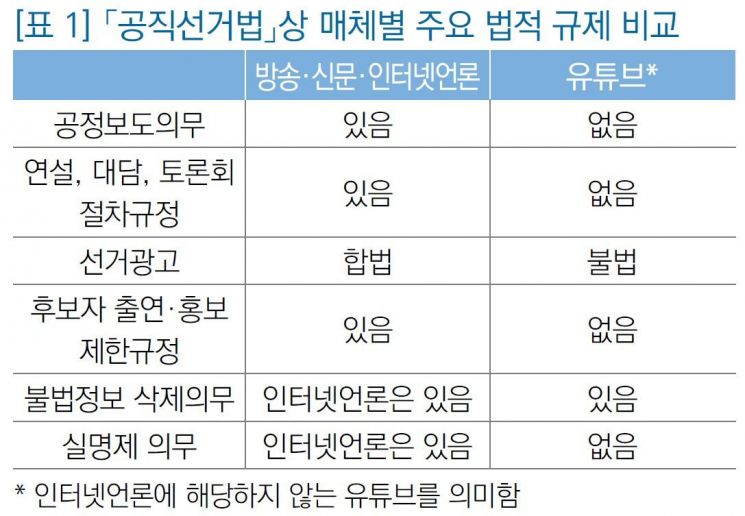
Since YouTube is a blind spot in media regulation, the National Assembly Legislative Research Office has also suggested the need to establish reasonable regulatory measures. On the 30th, Choi Jin-eung, a legislative researcher at the National Assembly Legislative Research Office, stated in a report, "The Public Official Election Act includes similar media outlets within the category of internet media companies, but general YouTube channels that are not media institution channels are not considered similar media outlets," adding, "There needs to be serious discussion on whether YouTube media that claim journalistic characteristics should be regarded as private media within the realm of freedom of expression or as public media within the realm of freedom of the press."
He continued, "There is also a need to discuss improvements to regulations restricting YouTube election campaigning under the Public Official Election Act," adding, "Considering that unlike traditional media such as broadcasting and newspapers, social media allows low-cost election campaigning, a reasonable review of the validity of regulations limiting online election advertising is necessary."
YouTube is becoming essential for politicians. According to research published last year by Won Seong-sim, Editorial Director of Headline Jeju (doctoral candidate in the Department of Media and Communication at Jeju National University), 243 out of 297 incumbent members of the National Assembly, accounting for 81.8%, have created YouTube accounts.
© The Asia Business Daily(www.asiae.co.kr). All rights reserved.

















