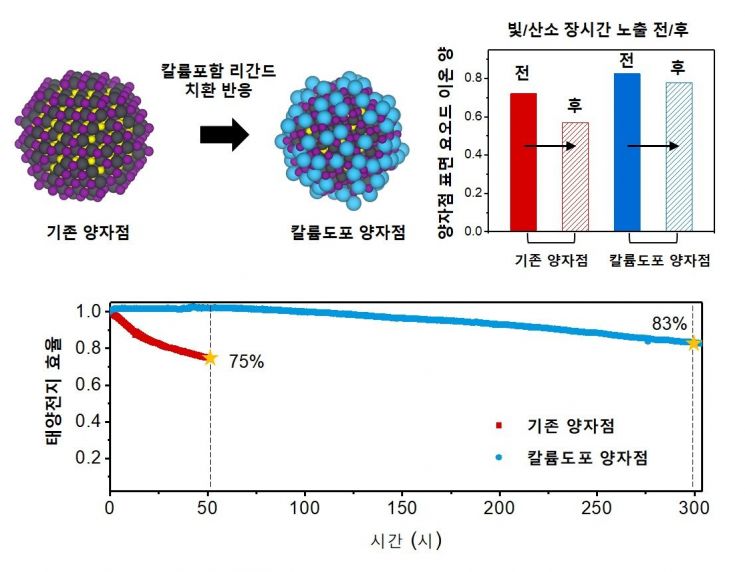
 The research team stabilized iodine ions on the quantum dot surface through potassium ions to prevent oxidation. This enabled the realization of a stable solar cell.
[Asia Economy Reporter Junho Hwang] A material processing method that can solve the lifespan degradation problem of quantum dot solar cells has been developed. It is expected to further accelerate the commercialization of quantum dot solar cells. On the 30th, the research team led by Professor Chongmin Choi of the Department of Energy Engineering at Daegu Gyeongbuk Institute of Science and Technology (DGIST) and Professor Edward H. Sargent of the University of Toronto announced their research results.
The research team solved the lifespan degradation problem of solar cells through this study. They revealed that the iodine ions on the surface of quantum dots are removed by oxidation, forming an oxide layer, which causes structural deformation of the quantum dots and reduces the device's efficiency.
The research team addressed this issue through a ligand exchange method containing potassium. Ligands refer to ions or molecules bonded like branches to the central atom of a coordination compound. The team introduced potassium ions onto the surface of the quantum dots to prevent the oxidation of iodine. As a result, the solar cells, which previously showed 75% efficiency after 50 hours of operation, demonstrated improved stability by maintaining 83% efficiency over 300 hours.
Professor Chongmin Choi stated, "This study demonstrated that quantum dot solar cells can operate more stably even in actual operating environments," adding, "We expect that these research results will further accelerate the commercialization of quantum dot solar cells."
The research results were published in the world-renowned international journal Advanced Materials.
© The Asia Business Daily(www.asiae.co.kr). All rights reserved.

















